By JBizNews Desk | Tuesday, May 5, 2026
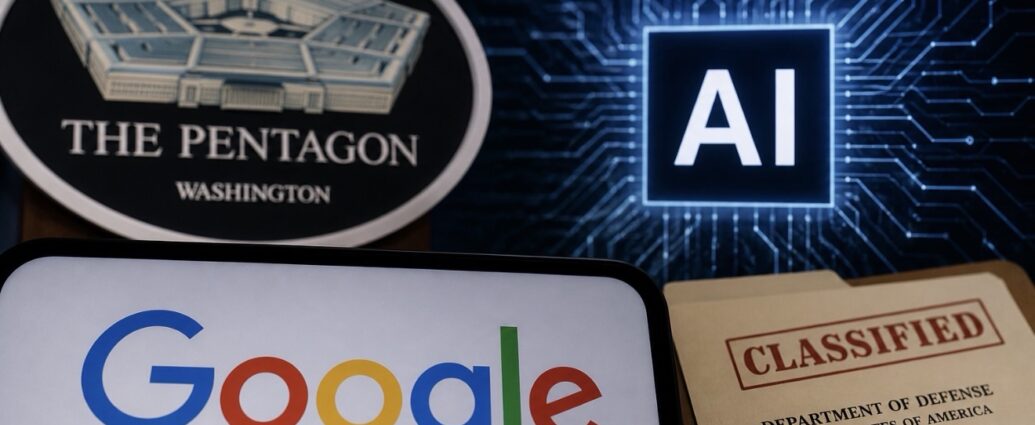
The U.S. Department of Defense has struck one of the most consequential technology agreements in modern military history, embedding leading artificial intelligence systems from top tech firms directly into classified military networks—while igniting internal resistance inside one of its key partners, Google.
The Pentagon confirmed agreements with Amazon Web Services, Google, Microsoft, Nvidia, OpenAI, SpaceX, Reflection, and Oracle, aimed at accelerating what officials describe as a full transformation toward an AI-driven military. The initiative is designed to give U.S. forces “decision superiority” across all domains of warfare, integrating advanced AI into intelligence, logistics, and operational systems.
For the tech companies involved, the deal represents both a massive commercial opportunity and a strategic alignment with national defense priorities. For Google, it has also triggered a growing internal conflict.
Google’s Deal Sparks Internal Revolt
Google has signed a classified agreement allowing the Pentagon to deploy its Gemini AI models for what officials describe as “any lawful governmental purpose.” The scope of that language has raised concerns among employees, particularly within Google DeepMind and Google Cloud.
More than 600 employees have signed an internal letter urging CEO Sundar Pichai to reconsider the company’s involvement in classified military AI work. The signatories warn that such deployments could enable uses ranging from autonomous targeting systems to large-scale surveillance capabilities.
One researcher familiar with internal discussions said “there was long-standing pride in building AI for beneficial use, and now there is growing concern that these tools could be applied in ways that lack sufficient oversight.” The same source noted that many employees were not fully aware the company was negotiating or finalizing the agreement.
The concerns center on two core risks: the potential for AI systems to assist in identifying or selecting targets in military operations, and the broader capability of AI to aggregate vast amounts of personal data into detailed profiles—functions that, while technically feasible, raise ethical and regulatory questions when deployed in classified environments.
Echoes of a Previous Clash
The internal pushback recalls Google’s 2018 conflict over Project Maven, a Pentagon initiative that used AI to analyze drone footage. At the time, more than 4,000 employees protested the program, leading Google to ultimately withdraw and not renew the contract.
The landscape in 2026, however, is markedly different.
While the earlier dispute involved a relatively limited contract, the current defense AI ecosystem represents tens of billions of dollars in potential spending. The Pentagon has also demonstrated a firmer stance toward companies unwilling to meet its requirements.
A critical shift came in 2025, when Google revised its public AI Principles and removed language that had previously restricted involvement in weapons-related applications. The change signaled a broader repositioning of the company’s approach to government and defense work.
A Clear Message From Washington
The Pentagon’s approach to AI partnerships has also evolved. One notable case involved Anthropic, whose AI system had been used within classified networks. The relationship deteriorated after the company declined to support certain military use cases, leading to its designation as a “supply chain risk” and the loss of government contracts.
The episode sent a clear signal across the industry: participation in defense AI initiatives is increasingly tied to broader access to federal contracts and long-term growth opportunities.
As a result, major technology firms—including Google, Microsoft, Amazon, and others—have moved to secure positions within the Pentagon’s expanding AI infrastructure.
The Financial Stakes
The scale of government investment underscores the urgency. The U.S. defense budget allocated $13.4 billion for AI and autonomy in fiscal 2026, with projections rising sharply in future years as military modernization efforts accelerate.
For companies competing in artificial intelligence, defense contracts offer not only revenue but also strategic positioning in a sector expected to shape the future of both national security and commercial technology.
Analysts note that walking away from such opportunities carries significant competitive risk, particularly as rivals deepen their own government relationships.
What It Means Beyond the Military
The implications extend beyond defense. The same companies building AI for classified military use are deeply embedded in everyday civilian life—powering search engines, cloud infrastructure, communications platforms, and business tools used by billions globally.
This overlap is at the center of the internal debate. Employees and observers alike are grappling with how technologies developed for commercial purposes may be adapted for military applications, often outside the visibility of public oversight.
At the same time, government officials argue that integrating cutting-edge AI is essential to maintaining national security advantages in an increasingly competitive global environment.
What Comes Next
The internal backlash at Google has not yet altered the company’s trajectory, but it highlights a broader tension facing the technology sector: balancing commercial innovation, ethical considerations, and government partnerships in an era where artificial intelligence is becoming central to both economic and military power.
What comes next: As defense spending on AI accelerates and more companies enter classified partnerships, the intersection between Silicon Valley and national security is set to deepen—bringing with it continued scrutiny from employees, policymakers, and the public.
JBizNews Desk