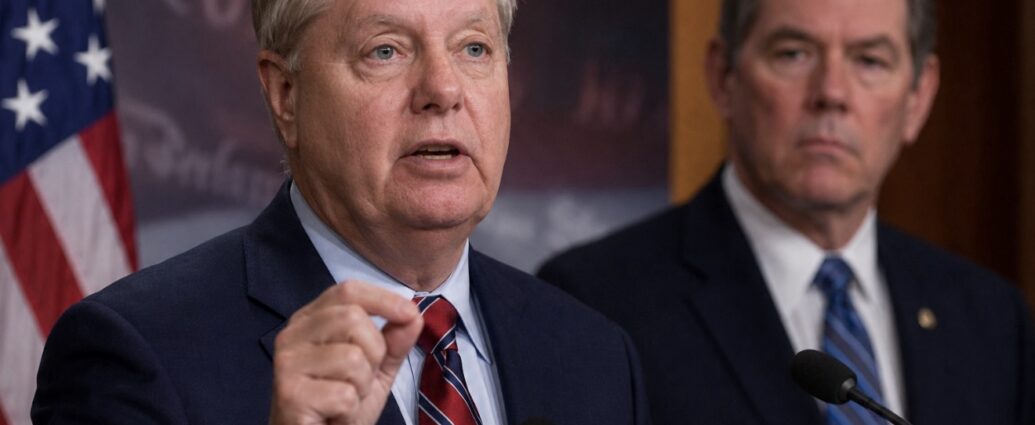
Washington — The sudden death of Senator Lindsey Graham, announced by his office early Sunday, July 12, removes the single most important congressional force behind a sanctions package that energy traders, defense contractors, and Kyiv had tracked for months. President Trump, speaking Sunday on NBC’s “Meet the Press,” said he spoke with the South Carolina Republican by phone Saturday evening — possibly Graham’s final call — and that the senator was still pushing legislation hours before he died at 71 of what his office called a brief and sudden illness.
The immediate economic casualty is Graham’s Sanctioning Russia Act, the bill he co-authored with Senator Richard Blumenthal that would slap a 500% tariff on any country buying Russian oil, gas, uranium, and other goods. Just two days earlier, on July 10, Graham stood in Kyiv after his tenth wartime visit and told reporters he had reached a deal with the White House on a version the administration would support, declaring it would become law. The measure carried 85 cosponsors — past the two-thirds threshold needed to override a veto — and had been designed to pressure buyers like China, India, and Brazil to abandon discounted Russian crude. Graham was the engine keeping it alive after Senate Majority Leader John Thune repeatedly slowed it to give Trump room to negotiate with Vladimir Putin.
With Graham gone, the bill loses its most relentless salesman at the exact moment it was closest to a floor vote. Blumenthal and Senator Jeanne Shaheen remain attached, but neither commands the same standing with Trump, and the timing question now reopens. For markets, the stakes are concrete. A 500% secondary tariff on Russian-energy buyers would ripple straight into global oil pricing, refiner margins, and the shipping and insurance costs already inflamed by the closure of the Strait of Hormuz. The same trip produced Trump’s political green light for Ukraine to co-produce Patriot missile interceptors and advance a bilateral drone agreement — deals that funnel real dollars to U.S. and allied defense manufacturers and that Graham had personally championed.
The Middle East loses a comparable weight. Graham was the Senate’s loudest advocate for military pressure on Iran, arguing for months that Tehran’s leadership was an unreliable negotiating partner and backing the U.S. and Israeli campaign now in its fifth month. His death lands as Iran has shut the Strait of Hormuz, fired on a commercial tanker, and drawn a third round of American strikes — a crisis pushing Brent crude back near $76 a barrel and war-risk insurance toward 3% of a vessel’s value. Graham had been among the most forceful voices tying that confrontation to a regime-change outcome, and his absence shifts the balance of hawks shaping how far Washington presses.
For Israel, the loss is personal and strategic. Prime Minister Benjamin Netanyahu, who long called Graham the country’s best friend in Washington, paid tribute Sunday and was said to be weighing a trip to the funeral. Graham cosponsored anti-boycott legislation and consistently defended U.S. security assistance — the kind of aid that underwrites contracts across the American defense-industrial base.
Trump, who described Graham as “like a member of the family to me,” framed the death partly through the lens of his stalled legislative wish list, calling it “a big blow” to the SAVE America Act, the voter-identification bill Graham was pressing in that last call. “We’re going to get it done, Lindsey,” Trump recalled telling him. Whether the president can move either the sanctions package or the election bill without Graham’s floor management is now an open question in a chamber where he supplied both the votes and the urgency.
There is also a South Carolina seat to fill. Graham was running for a fifth term this fall, and Trump said Sunday he already has a successor in mind but considers it too soon to name. The appointment will shape the balance on the Senate Budget Committee, which Graham chaired, and the fate of the spending and sanctions priorities he steered through it.
For now, the desks watching Russia sanctions, Ukraine reconstruction, defense procurement, and Iran policy face the same recalculation: a bill that looked destined to pass, and a hawkish posture that looked locked in, both suddenly depend on who inherits the fight. Graham spent three decades turning foreign-policy conviction into legislation and contracts. Replacing the conviction is one problem. Replacing the man who could count the votes is another.
JBizNews Desk | Washington © JBizNews.com All Rights Reserved. Reproduction or distribution without written permission is prohibited.