Bond investor Jeffrey Gundlach said on CNBC’s “Closing Bell” on Wednesday, June 17, that the nation’s new top central banker is not the rate-cutting dove that markets spent the winter betting on. The DoubleLine Capital chief executive said Federal Reserve Chairman Kevin Warsh sounded far tougher on inflation than investors had expected, and that anyone still waiting for cheap money is likely to be disappointed.
Gundlach’s verdict landed hours after the Federal Reserve finished its first meeting under Warsh and left its benchmark interest rate unchanged. He pointed to the central bank’s plain promise, written into its own policy statement, that it will deliver price stability — language Warsh returned to again and again at his first press conference as chairman.
“He is absolutely telling you that he plans on delivering on price stability,” Gundlach said. That, he argued, means the easy-money policy that traders counted on back in the first quarter of this year, when nearly everyone was expecting rate cuts, is off the table. The new chairman, he added, doesn’t sound like that at all anymore.
The shift matters because President Donald Trump handpicked Warsh for the job in hopes he would push borrowing costs lower. Instead, Warsh spent his debut stressing that the Fed is committed to getting inflation back down to 2%, a level the country hasn’t seen in five years. He called the failure to hold that line a problem the central bank intends to fix.
Warsh also broke from recent custom in two notable ways. He declined to submit his own interest-rate forecast to the Fed’s closely watched “dot plot,” the grid that shows where each policymaker expects rates to head. And he signaled a broad review of how the central bank communicates with the public, suggesting the institution’s habits around forward guidance are due for an overhaul.
For Gundlach, the tougher tone is a reason to like long-term government bonds. When a chairman pledges to keep prices stable, the risk that runaway inflation eats into the value of a 10- or 30-year Treasury falls. “There’s a greater reason to own long-term Treasuries today now that the new sheriff is in town,” he said. He went further, arguing that Warsh has effectively staked his own credibility on the outcome — and that if he fails to bring inflation under control, he will have announced his own failure on day one.
The billionaire investor’s bottom line: with a chairman this focused on prices, aggressive rate cuts are unlikely, and investors no longer have to fear the kind of over-easing that would punish long-term bonds.
Markets read the day much the way Gundlach did. The Dow Jones Industrial Average dropped 507.12 points, or 0.98%, to close at 51,492.55, after touching a fresh record high earlier in the session. The S&P 500 lost 1.21% to finish at 7,420.10, and the Nasdaq Composite fell 1.34% to 26,021.66. Big technology names led the slide, with Microsoft, Meta Platforms, Alphabet, and Amazon all closing lower.
That 1.2% drop in the S&P 500 was the worst first “Fed Day” for the index under a new chairman since 1994, according to Bespoke Investment Group. The only other newcomers in that span were Ben Bernanke, Janet Yellen, and Jerome Powell, and none saw a debut sting like this one.
Bond yields, which move opposite to prices, jumped as traders repriced the path ahead. The 2-year Treasury yield climbed more than 16 basis points to 4.216%. The cause was the Fed’s own forecast: the dot plot now puts the year-end rate at a median of 3.8%, up from 3.4% in the March projections. In plain terms, the committee that three months ago leaned toward a cut now leans toward at least one hike this year. The Fed held its target range at 3.5% to 3.75% on Wednesday.
The change in mood traces back to prices at the gas pump and the grocery store. Since the conflict in the Middle East began in late February, higher energy costs have pushed inflation up, with the Consumer Price Index running at a 4.2% annual rate in May, the hottest reading since April 2023. Claudia Sahm, chief economist at New Century Advisors, said the market reaction was driven mainly by how hawkish the dot plot turned out to be, noting that the inflation picture has shifted sharply.
Fed funds futures now point to a possible rate increase as soon as October. For households hoping for cheaper mortgages, car loans, and credit cards, the message from Warsh’s first meeting — and from one of Wall Street’s most-watched bond voices — is to stop counting on relief anytime soon.
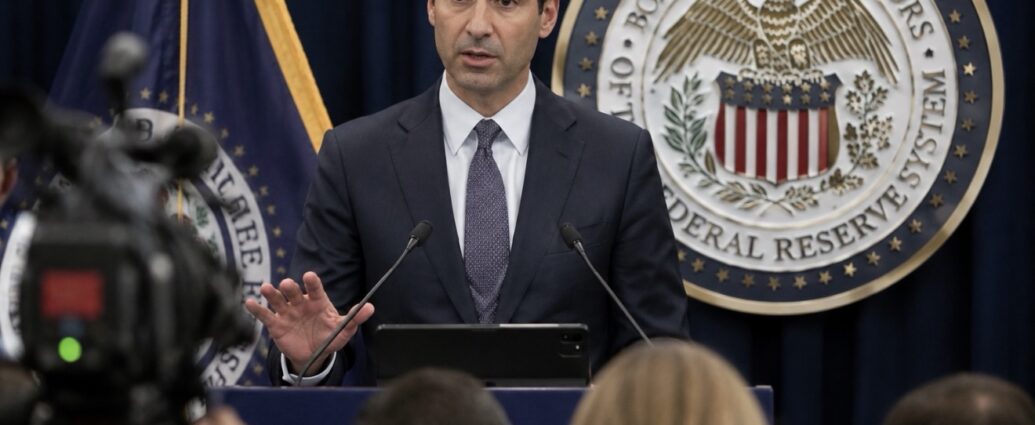
AP Pic: AI-generated AP-style news photo of Federal Reserve Chairman Kevin Warsh speaking at a podium after a Fed meeting, Federal Reserve seal visible in the background, reporters and cameras in the foreground, serious monetary-policy atmosphere, realistic news photography.
JBizNews Desk
Washington
© JBizNews.com All Rights Reserved. Reproduction or distribution without written permission is prohibited.