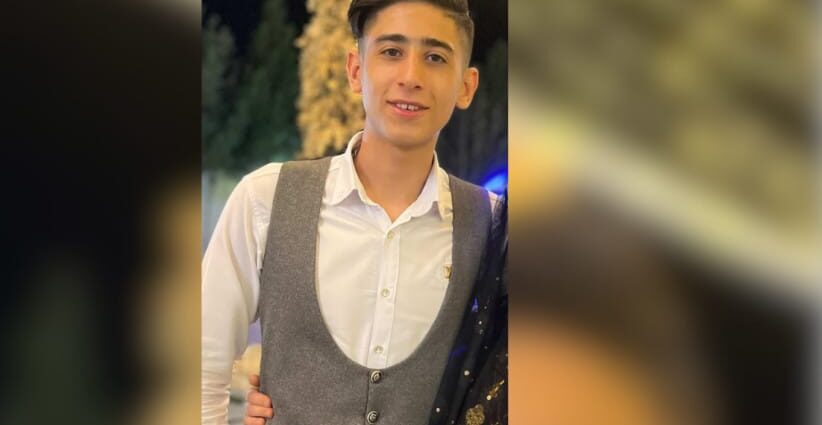
Six months after Iran’s January 8–9 massacre, in which opposition-linked estimates and evidence from inside Iran place the number of dead at between 35,000 and 40,000, The Jerusalem Post is highlighting some of those killed, based on testimony provided by their families.
Among them was Abolfazl Jahedi, an 18-year-old from Tehran who, according to his mother, wanted to study firefighting and serve his country by saving lives.
Abolfazl was born in Tehran on August 18, 2007. He was killed in Tehran on January 9, 2026, and buried four days later at Behesht-e Zahra Cemetery.
His mother remembers him as loyal, innocent, respectful, and hardworking.
“Abolfazl was such a loyal and faithful boy,” she told the Post. “He was so innocent and trusting that he never imagined he would be confronted with live ammunition.”
On the evening of January 8, his mother said, Abolfazl went outside and returned disappointed that more people had not joined the protests.
“There was nobody there; nobody had the courage to say anything,” he told his father, according to his mother. “Dad, at worst they’ll only use shotgun pellets.”
The following evening, he was killed.
According to his mother, Abolfazl was struck twice by shotgun pellets, once in the head and once in the leg. She said he had gone out believing he could stand, empty-handed, for the rights of the poor and for justice for those whose blood had already been spilled.
Abolfazl worked hard to pursue dream of being a firefighter
“My Abolfazl was a modest, understanding boy – well-mannered and polite,” she said. “He treated everyone with great respect.”
Abolfazl worked constantly to help himself and pursue his dreams. He came home with grease on his hands after work, saved money for new clothes, distributed leaflets through the night, and worked in wedding halls and reception venues until 3 a.m., earning around 500,000 toman a night.
Often, his mother said, he would come home late and go to school exhausted the next morning. Sometimes, the family could not even afford his bus fare, so he walked long distances.
Eventually, with his family’s support, Abolfazl bought an old second-hand motorcycle.
It was, his mother said, his greatest dream.
But he was only able to ride it for one or two months before he was killed. Today, the motorcycle still stands in the corner of the parking lot, gathering dust.
On the night he left and never returned, Abolfazl had planned to enroll the next day at university to study firefighting.
“My son wanted to serve this country,” his mother said. “His kind soul wanted to save people’s lives.”
None of those dreams came true, she said. He never became a firefighter. He never enjoyed the motorcycle he had worked so hard to buy. He never finished building the strong body he wanted from going to the gym. He never bought himself new clothes again.
“My son left this world with nothing,” she said.
Abolfazl refused to turn back, bravely stood in front row of protests
According to testimony later given to the family by the friend who was with him that night, Abolfazl had already been struck twice but refused to turn back.
“Our blood is no more valuable than anyone else’s,” he said, according to his mother’s account. “If you’re afraid, don’t come with us.”
When others said they had done enough and should go home, he replied: “If my sister is staying out in the crowd until late at night, my pride won’t allow me to go home.”
Near the entrance to a street by the district administration building, his mother said, a crowd had gathered. Abolfazl stepped into the front row and threw a stone at one of the officers. When people began to flee, she said, he could not run quickly enough because he was wearing heavy safety boots.
He took cover behind a garbage container, but because he was tall, his head remained visible above it.
“The coward holding the weapon showed no mercy and deliberately aimed at his forehead,” his mother said.
She said he was struck just above his right eyebrow, shattering the back of his skull.
His friend tried to get him to the hospital, but Abolfazl was already dead. His father rushed there believing his son had only been wounded in the leg. At first, fearing for his safety, he did not give nurses Abolfazl’s name.
He searched everywhere, then finally asked whether Abolfazl Jahedi had been brought in.
‘In a single instant, our wonderful boy had been taken’
“As he turned around, he saw the tall body of his son inside a black body bag,” his mother said. “In a single instant, our wonderful boy had been taken from us.”
The family said the hospital refused to release his body and told them to go to the forensic medical center in Kahrizak. There, his mother said, they found him “alone, lifeless, and abandoned among thousands of other bodies.”
Abolfazl was buried on January 13. According to his mother, because of the large number of dead, his body was only handed over late at night, forcing the family to bury him in darkness.
Afterward, she said, authorities contacted the family several times and wanted to officially register him as a state “martyr.” The family refused.
Officials also came to the family’s neighborhood and to Abolfazl’s school asking questions, she said. The family still does not know why.
“This left us living in fear for a long time,” his mother said. “To this day, we lock our front door securely every night before going to sleep.”
The loss has devastated the family. Abolfazl’s father, his mother said, can no longer sleep without heavy sedatives and sleeping pills.
“Every day we still wait for Abolfazl to come home from work at five o’clock in the afternoon,” she said. “Every time we hear the sound of a motorcycle, we startle, and our hearts ache.”
She said she had once worried about how she would cope when Abolfazl eventually left home for two years of compulsory military service. Now, he has been gone for months.
“His voice, his belongings, even his scent are gone,” she said.
For Abolfazl’s mother, justice means the complete removal of those responsible for killing Iran’s young people.
“We thought it would never happen to our family – but it did,” she said. “It will happen to your families as well. These people will leave every one of us in mourning, one family after another. Do not remain silent.”
Until now, she said, almost nothing had been published about her son.
“No one knows who he was,” she said.
Six months later, his family still struggles to leave the house. Even the most basic errands, his mother said, would force them to pass the place where Abolfazl was killed.
“Every street and alley smells of blood,” she said. “Our emotional state is utterly catastrophic.”