The world’s largest hedge funds are generating some of their strongest returns since the financial crisis by riding the artificial-intelligence infrastructure boom, as hyperscale technology companies prepare to spend nearly $700 billion on AI hardware, data centers, networking systems, and computing capacity in 2026 alone. According to Bloomberg reporting and industry performance data, technology-focused hedge funds posted outsized gains last year by heavily concentrating positions in Nvidia, Broadcom, Oracle, CoreWeave, Arm Holdings, and other companies tied directly to the global AI buildout.
The underlying investment thesis has become one of the clearest and most profitable trades on Wall Street: when Alphabet, Amazon, Meta Platforms, and Microsoft commit hundreds of billions of dollars toward AI infrastructure, the companies supplying the chips, optics, cooling systems, cloud capacity, and networking hardware stand to experience a historic earnings surge.
The returns across the hedge fund industry reflect just how aggressively managers positioned for that trend. Apis Capital’s flagship fund gained 55.1% in 2025, while Michel Massoud’s Melqart Opportunities Fund rose 45.1% and Alex Sacerdote’s Whale Rock Long Opportunities Fund climbed 45%, according to Bloomberg and Business Insider performance compilations.
Several major “Tiger Cub” funds also posted powerful gains. Lee Ainslie’s Maverick Capital Long Enhanced fund returned 40%, while Glen Kacher’s Light Street Mercury Master fund rose 37.3%.
Among the multi-strategy giants, Bridgewater Associates, founded by Ray Dalio, posted a record 34% gain for its Pure Alpha II strategy. D.E. Shaw’s Oculus Fund rose 28.2%, while the firm’s Composite strategy gained 18.5%. Steve Cohen’s Point72 finished up 18%, ExodusPoint returned 18%, and Dmitry Balyasny’s firm gained 16.7%.
Even among the traditionally lower-volatility mega-platform firms, the AI cycle fueled unusually strong profits. Ken Griffin’s Citadel returned 10.2% in its flagship Wellington fund, narrowly trailing Izzy Englander’s Millennium, which returned 10.5% — the first year Millennium outperformed Citadel since 2020.
The financial rewards for top managers were staggering. According to Bloomberg’s annual hedge fund rich list, Cohen earned approximately $3.4 billion last year, followed by David Tepper of Appaloosa Management at $3.2 billion, Englander at $3.1 billion, and Chris Hohn of TCI Fund Management at roughly $3 billion.
Industrywide assets surged alongside performance. Hedge Fund Research reported that global hedge fund capital increased by $642.8 billion during 2025 to a record $5.15 trillion, marking the largest single-year inflow into the industry since 2009.
At the center of the trade sits the AI hardware supply chain itself. Philippe Laffont’s Coatue Management, which oversees roughly $70 billion, built its largest public equity position in Nvidia, owning approximately 11.5 million shares by mid-2025. Coatue also accumulated major positions in CoreWeave, Broadcom, Oracle, and Arm Holdings while creating its own “Fantastic 40 Index” tracking companies it believes will dominate AI over the next five years.
Boston-based Whale Rock similarly maintained Nvidia as its largest holding throughout much of 2025, while Bill Ackman’s Pershing Square concentrated nearly 40% of its portfolio into Amazon, Alphabet, and Meta Platforms after buying aggressively during periods of investor skepticism.
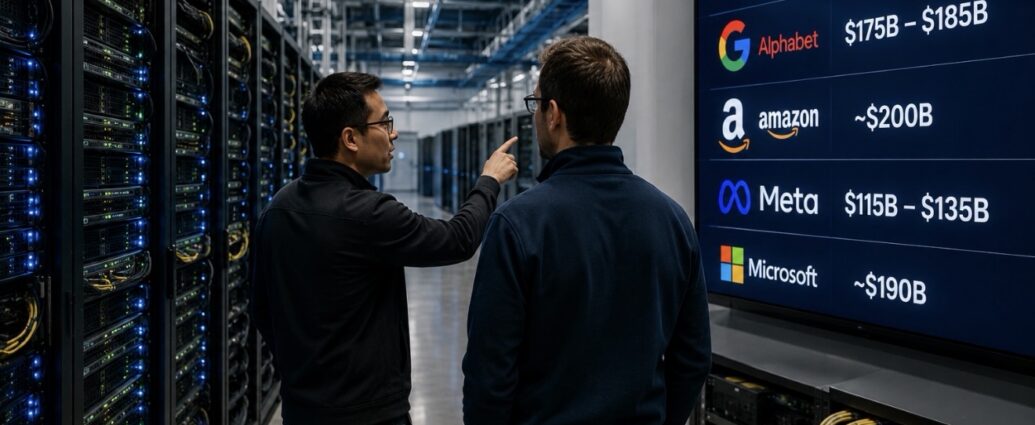
The spending projections driving those bets remain enormous. Alphabet has guided toward between $175 billion and $185 billion in 2026 capital expenditures tied largely to AI infrastructure. Amazon is expected to spend approximately $200 billion, Meta between $115 billion and $135 billion, and Microsoft roughly $190 billion.
That wave of investment continues flowing through the semiconductor and infrastructure ecosystem. Nvidia CEO Jensen Huang said earlier this year that the company’s next-generation Rubin AI processors are already in production and shipping to customers. Networking, optical, and cooling companies including Broadcom, Coherent, and Vertiv have all benefited from surging order volumes tied to data center expansion.
Private markets are increasingly becoming part of the same trade. AI cloud provider CoreWeave secured a $10 billion Blackstone-led financing package in February to expand infrastructure capacity, with participation from Coatue and other major investors. Jane Street reportedly committed approximately $6 billion toward CoreWeave infrastructure financing while separately investing another $1 billion directly into the company’s equity.
Several hedge funds are now restructuring themselves to capitalize on the growing overlap between private and public AI markets. Coatue recently launched a crossover strategy designed to simultaneously invest in publicly traded AI infrastructure firms and late-stage private companies, reflecting how many of the most valuable AI businesses are remaining private longer than previous generations of technology firms.
Still, risks are beginning to emerge beneath the rally. Hedge fund positioning has become increasingly concentrated in a relatively small group of mega-cap AI names, raising concerns about crowding and volatility if earnings growth slows or hyperscaler spending moderates.
Some investors have already begun positioning against parts of the trade. Quantitative hedge funds reportedly initiated short positions in Oracle over valuation concerns, while a former OpenAI researcher launched a hedge fund earlier this year betting against Nvidia, Taiwan Semiconductor Manufacturing, and Broadcom while taking long positions in Intel based on expectations that hyperscalers may increasingly develop their own custom AI chips internally.
Analysts also warn that investor sentiment around AI infrastructure remains highly momentum-driven. Morningstar analyst Dan Romanoff noted earlier this year that “anything-but-AI” market sentiment briefly triggered sharp first-quarter corrections across several AI-linked names before the sector rebounded.
For now, however, the dominant direction of capital remains clear. With Alphabet, Amazon, Meta, Microsoft, Oracle, Apple, and others signaling they will continue spending aggressively through 2026 to secure AI computing capacity, hedge fund managers see little reason to abandon the trade that has driven some of the industry’s biggest gains in over a decade.
The next major test arrives May 20, when Nvidia reports earnings that many on Wall Street increasingly view as the single most important checkpoint for the entire AI hardware cycle.
JBizNews Desk
© JBizNews.com. All rights reserved. This article is original reporting by JBizNews Desk. Unauthorized reproduction or redistribution is strictly prohibited.