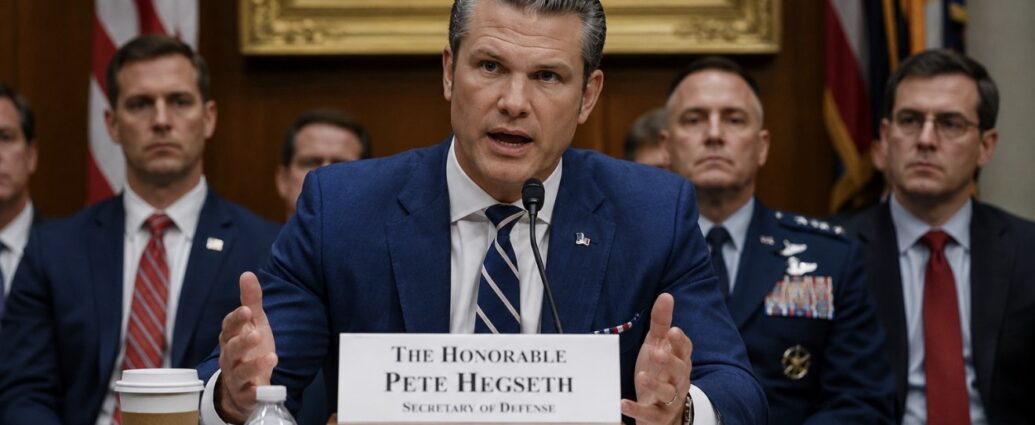
Defense Secretary Pete Hegseth spent Tuesday in back-to-back House and Senate Appropriations subcommittee hearings defending the Trump administration’s historic $1.5 trillion fiscal 2027 Pentagon budget proposal — a 44% increase over the current defense budget — while disclosing that the cumulative cost of the Iran war has climbed to nearly $29 billion, up $4 billion from the figure provided to Congress two weeks ago, with no public timeline for reopening the Strait of Hormuz or ending hostilities.
The hearings opened at 8 a.m. before the House Appropriations Defense Subcommittee chaired by Rep. Ken Calvert (R-Calif.) and continued in the afternoon before the Senate Appropriations Defense Subcommittee chaired by Sen. Mitch McConnell (R-Ky.). Hegseth appeared alongside Gen. Dan Caine, chairman of the Joint Chiefs of Staff, and acting Pentagon comptroller Jules Hurst. The hearings followed similar appearances two weeks ago before the House and Senate Armed Services Committees, which produced sharper partisan exchanges on questions of war-powers authorization, civilian casualties, and the dismissal of former Army Chief of Staff Gen. Randy George.
The $1.5 trillion fiscal 2027 request is the largest U.S. defense budget proposal in history, representing a 42% to 44% increase over fiscal 2026 levels, depending on how one counts supplemental allocations. Hegseth described it as “admittedly a historic budget” but framed it as “fiscally responsible” and reflective of “the urgency of the moment,” citing China’s military expansion, the ongoing war in Russia-occupied Ukraine, the active conflict with Iran, and threats from Iranian-aligned proxies across the Middle East. Gen. Caine called the current period “delicate and dangerous” and emphasized that sustained investment is required to maintain readiness given the operational tempo since February 28.
The Iran war cost disclosure was the central new data point. Hurst, the acting Pentagon comptroller, told the House subcommittee that war costs have risen to approximately $29 billion, up from the $25 billion figure provided two weeks ago. Lawmakers from both parties have repeatedly indicated they expect the eventual war-funding request to climb closer to $100 billion. Sen. Mark Kelly (D-Ariz.), a member of the Senate Appropriations Committee, called the $1.5 trillion budget number “outrageous” on CBS’s “Face the Nation” Sunday, noting that the defense budget was “just over $700 billion” when he entered the Senate five and a half years ago. “Now they’re asking for twice as much money — it’s nearly the amount that the rest of the world pays for its defense,” Kelly said.
The budget request prioritizes munitions production, missile defense systems, warships, drones, and what the administration calls the Golden Dome and Golden Fleet modernization projects championed by President Trump. Hegseth said the goal is to multiply munition production rates and rebuild the U.S. defense industrial base on a “wartime footing,” with what he described as a large troop pay increase and elimination of “all poor or failing barracks.” Concerns about depleted weapons stockpiles — particularly missile-defense interceptors and precision-guided munitions used in the Iran campaign — drew bipartisan questioning, though Hegseth said the concerns have been “unhelpfully overstated.”
The 60-day War Powers Act clock remained a central legal and constitutional issue. The 1973 statute requires congressional authorization for sustained military operations within 60 days of commencement, a deadline that fell on Friday absent congressional action. Hegseth has argued that the April 8 Pakistan-brokered ceasefire “pauses or stops” the 60-day clock — a reading rejected by Sen. Tim Kaine (D-Va.) and several other Democratic and some Republican lawmakers. Sen. Susan Collins (R-Me.), facing a challenging 2026 reelection, voted with Democrats late last month on an effort to halt the conflict. Sen. Lisa Murkowski (R-Alaska) has voted against war-powers resolutions but called for congressional authorization to define the war’s “limits and objectives.”
The fiscal mechanics of the request drew bipartisan scrutiny. House Appropriations Committee Chairman Tom Cole (R-Okla.) pressed Hegseth on the administration’s use of the reconciliation process for defense funding, warning that the approach “creates cliffs for this committee in the future” because reconciliation funding eventually expires and would force “a massive increase in discretionary funding to sustain it.” Rep. Betty McCollum (D-Minn.), the House subcommittee ranking Democrat, said the committee had asked “several times for a complete update on munitions levels, and it has not been provided.”
The economic backdrop intensified the political pressure. The Iran war is now in its eleventh week of effective Strait of Hormuz disruption, with the waterway operating at roughly 5% of pre-war capacity. WTI crude traded above $102 a barrel Tuesday morning, U.S. gasoline averaged $4.50 per gallon nationally according to AAA, and Tuesday’s April CPI release showed energy prices accounting for more than 40% of the headline monthly inflation increase. The compounding economic pressure on consumers and businesses now sits at the center of midterm-election political risk for Republicans defending House and Senate seats in 2026.
McConnell used his opening statement to warn that strained relationships with Democratic allies “only serves our adversaries’ interests and limits our capacity and deterrent power globally,” and to press for resumption of stalled Ukraine aid. The hearings concluded with a bipartisan push from both subcommittees for the Pentagon to provide additional munitions data, a clearer Hormuz reopening plan, and a more detailed breakdown of supplemental versus fiscal 2027 funding needs by the end of next week.
For markets, defense contractors Lockheed Martin, RTX Corporation, Northrop Grumman, General Dynamics, L3Harris Technologies, Boeing, Huntington Ingalls Industries, and pure-play missile-defense names including Kratos Defense & Security Solutions all stand to benefit if Congress approves a meaningful share of the $1.5 trillion request. The defense subsector has been one of the strongest performers in the S&P 500 during the Iran conflict, with the iShares U.S. Aerospace & Defense ETF outperforming the broader index by a wide margin since February 28.
JBizNews Desk
© JBizNews.com. All rights reserved. This article is original reporting by JBizNews Desk. Unauthorized reproduction or redistribution is strictly prohibited.