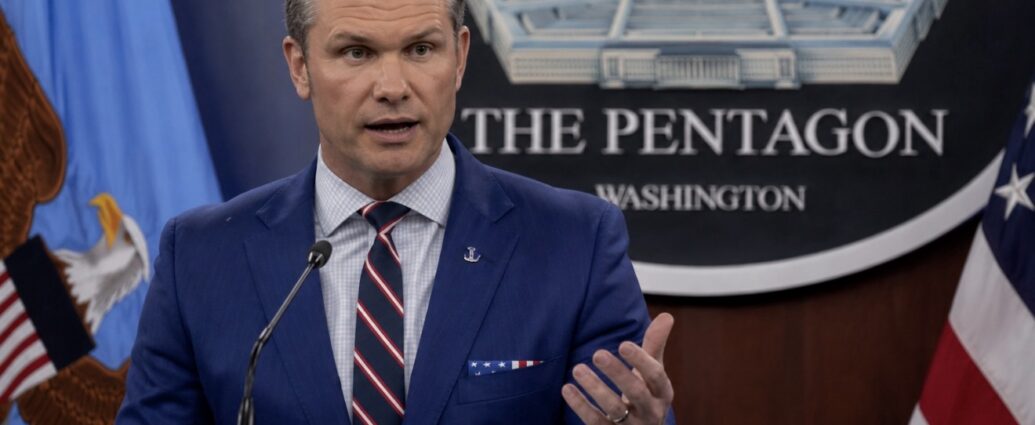
Defense Secretary Pete Hegseth announced on Thursday a six-month Pentagon review of American forces in Europe and warned that future U.S. payments to NATO will shrink if allies fail to spend more on their own militaries, telling defense ministers at alliance headquarters in Brussels that “the era of free-riding is over.”
Hegseth called it the “NATO 3.0 review” and said it would examine where American troops, jets, ships and weapons are based across the continent. “I’m announcing today, a six-month Department of War review that will examine America’s force posture and basing in Europe — up to six months, could be less,” he said, framing it as a way to push the alliance “fast and irreversibly toward Europe leading.”
The money threat was the sharpest part of his message. Hegseth said Washington’s annual dues — the roughly $790 million the U.S. pays in 2026 toward NATO’s common running costs — would now be tied to whether allies hit their spending goals. “Annual NATO dues will be contingent on other countries meeting their defense spending targets,” he said. “Where other allies do not spend with urgency, our dues contributions will go down.” He warned the force review is one “that some countries will fail, and others will pass with flying colours.”
The review does not pull out any troops by itself. But roughly 80,000 U.S. service members are currently based in Europe, and the study lands on top of cuts already underway. The Pentagon said last month it would withdraw about 5,000 troops from Germany over the next year, and on June 3 told allies it would no longer commit an aircraft carrier, support ships, refueling planes and dozens of fighter jets to a European crisis. NATO Secretary-General Mark Rutte said European members are already moving to “fill” the gear the U.S. is pulling back.
Much of Hegseth’s anger traced to the recent Iran war, code-named Operation Epic Fury. He called it “shameful” that some allies refused to let U.S. forces use their bases and airspace to strike Iranian targets. He named no countries, but Spain has drawn heavy U.S. criticism for denying access, raising questions about the future of Rota, a key Navy base there. By contrast, Poland — which Hegseth has praised — could actually gain troops, after President Donald Trump said he would send 5,000 American forces back to the country.
Why this matters for business
Behind the political fight is one of the largest spending shifts Europe has seen in decades, and it is reshaping a whole industry.
European governments are rearming at a pace not seen since the Cold War. EU member states spent roughly €360 billion on defense in 2025, up from about €240 billion in 2022. Germany has activated a €100 billion special fund and approved a separate €500 billion multi-year package for defense, infrastructure and industry. Poland now spends more than 4.5% of its economic output on its military. NATO members agreed last year to push defense-related spending toward 5% of GDP by 2035, a target leaders will revisit at a summit in Turkey.
That money flows to a short list of arms makers. Germany’s Rheinmetall, the continent’s largest weapons and ammunition maker, reported 2025 sales of €9.9 billion, up 29%, with an order backlog of €64 billion. Britain’s BAE Systems, France’s Thales and Dassault Aviation, Italy’s Leonardo, Sweden’s Saab and engine maker Rolls-Royce all hold order books stretching past 2032. Hegseth’s demand that Europe “take the lead” steers more of that work toward these firms.
But the trade is no longer a sure thing. The Stoxx Europe Aerospace & Defence index is down about 1.2% this year after a blockbuster 2025, as buyers turn choosier. Rheinmetall shares have pulled back sharply on worries the company cannot build orders fast enough — its supply of skilled workers, explosives and high-grade steel is stretched. Analysts now describe 2026 as a year of “consolidation,” when actual deliveries, not promises, decide the winners.
There is also a catch hidden in Hegseth’s words. The administration wants allies to buy European-made gear instead of American — but also wants Europe to stop shielding its own companies against U.S. rivals like Lockheed Martin in outside markets. That tension could redirect billions in future contracts.
The pressure is already rippling through allied governments. In Britain, Defence Secretary Dan Jarvis arrived in Brussels without a finished investment plan; his predecessor, John Healey, resigned a week ago in a dispute over funding, after officials said the armed forces needed £28 billion over four years rather than the £13.5 billion on offer.
For U.S. taxpayers and contractors, Hegseth held up a different figure: the $1.5 trillion defense budget Trump is seeking for the fiscal year beginning October 1, which he called an “arsenal of freedom.” In dollar terms the U.S. still dwarfs its partners — NATO data show it spent an estimated $845 billion on defense last year, against $559 billion for the rest of the alliance combined.
The review begins as soon as Hegseth returns to Washington, with input from Congress and U.S. European Command. Its real test comes this summer, when Europe’s big defense makers report half-year results and the market learns whether record order books are turning into real deliveries — and profits.
JBizNews Desk
© JBizNews.com All Rights Reserved. Reproduction or distribution without written permission is prohibited.