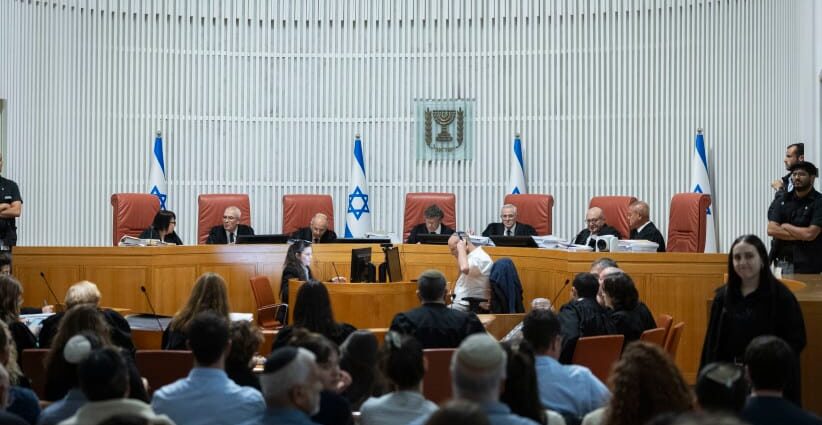
The High Court of Justice on Sunday pressed Justice Minister Yariv Levin’s lawyer over his refusal to fully convene the Judicial Selection Committee, repeatedly questioning why Levin’s plan to make only partial appointments should be enough while district courts remain short-staffed and criminal cases pile up.
The hearing, held before Justices Ofer Grosskopf, Alex Stein, and Gila Canfy-Steinitz, focused less on the long-running political fight over Supreme Court appointments and more on the practical crisis in the lower courts – especially the Beersheba District Court, where the bench said there was no permanent president and seven judges were missing.
Following the hearing, Constitution, Law and Justice Committee chairman MK Simcha Rothman (Religious Zionist Party) escalated his criticism of the court, telling KAN Reshet Bet that High Court justices were “robbers and bullies” who had taken powers away from the justice minister.
Grosskopf opened the line of questioning bluntly.
“In Beersheba, there is no president, and seven judges are missing. What about that?” he asked.
He called them “robbers and bullies”
Levin’s lawyer, attorney Zion Amir, replied: “Why does that bother your honor?”
“Why?!” Grosskopf shot back.
“Why?” Stein added. “Because crime is rampant.”
Grosskopf continued, saying the southern district was “a crime-stricken district” and was missing roughly a quarter of its district court judges. Stein said that when seven judges are missing from the Beersheba District Court, “there are no serious-crime panels.” He asked whether Amir knew that “every day there is a murder there.”
Amir argued that the court should avoid intervening in the justice minister’s discretion, and insisted that “there is no court in Israel that is paralyzed.”
But the justices’ questions suggested they were not satisfied by Levin’s broader claim that the petition had become unnecessary simply because he announced plans to convene the committee for a limited round of appointments.
“I do not want to deal with the question of who prevented this until now,” Grosskopf said. “I want to look forward – how can we succeed in trying to advance the appointments? If the minister thinks it is not important to appoint judges to Beersheba, that is one thing. But if the minister thinks it is necessary, then go ahead.”
Grosskopf added that while the shortage at the Supreme Court was also real, “we will deal with that later,” and said the district courts had to come first.
The petition was filed by the Movement for Quality Government after Levin repeatedly declined to convene the Judicial Selection Committee to fill vacant judicial posts. In February, the High Court issued a conditional order requiring Levin to explain why he would not use his authority under the Courts Law to convene the committee for judicial appointments.
Rather than file a full response, Levin submitted an update asking the court to dismiss the petition. He said he planned to convene the committee for a limited first stage: appointments to traffic, family, and juvenile courts, along with some magistrates’ court posts in the North and Haifa districts. He set June 7 for a committee meeting and said further meetings would follow in June and July.
Levin argued that this meant the case was moot. Attorney-General Gali Baharav-Miara argued the opposite, saying Levin’s proposal failed to answer the conditional order, ignored acute shortages in the district courts, and did not cure the harm caused by the committee’s paralysis.
That position appeared to resonate with the bench on Sunday.
Grosskopf repeatedly asked whether Levin intended to act quickly, particularly because judicial candidates must be published in the government gazette 45 days before the committee can vote on them. Because general elections are expected on October 27, the committee cannot convene after July 27, making mid-June the practical deadline to publish candidates.
“I am trying to understand a timetable, that is all,” Grosskopf said. “When are judges being appointed?”
Amir asked for a break to speak with Levin. When he returned, he said the situation was “complex” and suggested the court invite Levin himself to explain.
“The minister needs to compile a list of candidates,” Amir said. “He also works on other matters and other ministries, and he is a member of the cabinet and participates in all discussions on the war. He does everything for the good of the state and the judicial system. He is not thwarting and not delaying.”
Grosskopf asked whether judicial appointments could be given priority.
Amir said that after an agreement “blew up,” magistrates’ court presidents approached Levin, who then met with them and with the Courts Administration. Levin, Amir said, had conducted serious staff work, including on traffic court reform and the appointment of juvenile and traffic judges.
But district court appointments, Amir argued, required compiling a much broader list of candidates – possibly 200 people – and checking “who wants [the position], who is suitable.”
Grosskopf was not persuaded that this answered the urgency. “I understand,” he said, “but it must be understood that this issue is in our souls. The question is how it can be advanced.”
The hearing also exposed the continuing rancor inside the Judicial Selection Committee. Amir claimed that all judicial vacancies could already have been filled, but that a representative on the committee had thwarted the move. Israel Bar Association chairman Amit Becher, who was sitting in the courtroom, called out: “Liar.”
Amir later said the situation was “not acute.”
“Not acute?!” Grosskopf responded.
“No,” Amir said. “There is no paralysis. And on the contrary, I am calling here to the refusers – agree.”
Becher interjected: “Then publish the candidates’ names in the gazette already.”
Amir replied: “Maybe convene them in your bureau.”
Grosskopf pushed back: “Why does your honor want me to make decisions? I want the minister to make the decisions.”
The attorney-general’s representative told the court that Levin’s proposal did not meet his duty to act with proper speed to fill vacancies, and that the obligation applied to all courts, not only the ones Levin chose to prioritize.
At the end of the hearing, Grosskopf made clear that the court was, for the moment, separating the lower-court crisis from the politically explosive fight over the Supreme Court.
“We are putting aside for a moment the appointments to the Supreme Court,” he said. “Appointments to the Supreme Court have in recent years become a kind of political debate. The minister is not giving an answer regarding appointments to the district courts.”
The bench said that a decision will be issued later.