I didn’t expect this.
We drove deep into the Jordan Valley, past anywhere we’d ever been, and just when I started to wonder if we’d made a wrong turn, an orderly Parks Authority sign appeared at the side of the road. We passed through a gate, and the world changed.
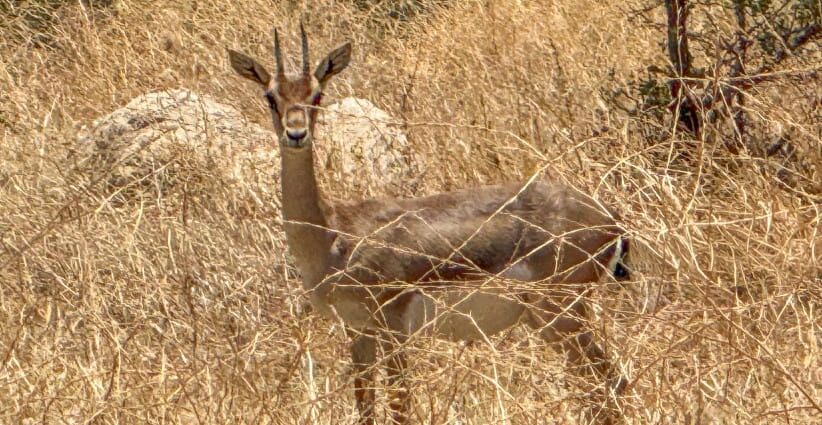
Meadows stretched out in every direction. Gazelle, actual herds of them, grazed and galloped across the grasslands. Birds swooped low over the road. The whole scene felt less like Israel and more like the African savannah, and for the 10 minutes it took to drive in, I almost forgot we’d come here for the water.
Then we reached the rocks.
A few cars were pulled over. We stepped out, walked to the edge, and peeked down, and there it was. A crystal-clear pool, rimmed by greenery and limestone, with a small waterfall trickling in at one end. Butterflies and dragonflies hovered over the water. The whole canyon was silent except for the trickle of the spring.
This is Einot Petzael, the Petzael Springs Nature Reserve, and most Israelis have never heard of it.
The main pool sits in a natural stone amphitheater, fed by springs that emerge straight from the rock. It isn’t deep, neck-high at the most, but the water is cold and clear and impossibly refreshing in the dry heat of the Jordan Valley. We waded in, made our way to the waterfall, and let the spray hit our faces. Wild mint grew thick along the banks, releasing its sharp, clean scent every time we brushed against it.
From there, you can keep exploring. Hidden pools lie tucked behind boulders and greenery – they take a bit of climbing to reach, but they reward the effort with complete solitude. And further upstream, you reach the actual source: Einot Petzael itself, a series of shallow wading pools shaded by trees, the sound of cool rushing water filling the air. These upper pools are ideal for families with small children, with easy access, gentle water, and plenty of shade.
It’s the kind of place you keep expecting to be crowded and isn’t.
A nature reserve quietly coming to life
Petzael Springs Nature Reserve was formally declared in 1993, but for years it remained largely undeveloped, beautiful but neglected, the kind of site only known to locals and serious hikers. That has changed in recent years.
The Parks Authority has been steadily developing the reserve. Signage has gone up. Fire pits, benches, and picnic areas have appeared. An information station near the entrance has been established. Visiting now feels like visiting any other well-cared-for Israeli park, except for the part where you’re often the only ones there.
This investment is part of a broader expansion of nature reserves in Judea and Samaria announced by then-defense minister Naftali Bennett in 2020. Einot Petzael is one of the clearest beneficiaries – a place that was always beautiful, finally getting the attention it deserved.
A place with layers
Like most beautiful places in this country, Einot Petzael sits atop a much older story.
The Jewish history here runs deep. The lower part of the stream valley has been identified by some scholars with biblical Ataroth, the town mentioned in the Book of Joshua as marking the northern border of the inheritance of the tribe of Ephraim. The Iron Age tel where the stream meets the valley floor likely preserves that ancient settlement.
A thousand years later came Herod. The name Petzael comes from Phasael, Herod the Great’s elder brother, who took his own life in 40 BCE rather than be handed over to his enemies during the Parthian invasion. Herod, devastated by his brother’s death, founded a town here in his memory and called it Phasaelis. The name has survived for more than two thousand years, carried by the springs, the stream, and the nearby modern Moshav Petzael.
Herod didn’t just build a town. He built an aqueduct that carried water from these springs about six kilometers down to Phasaelis, watering the famous palm groves that produced dates praised across the Roman world.
The remains of his enormous storage reservoir, which the Parks Authority describes as “super Olympic-sized,” can still be seen near the moshav. An old Ottoman-era flour mill that operated on the same aqueduct water is still standing along the stream, a reminder that every group that has lived in this valley, from ancient Israelites to Byzantine Christians, drew their life from the water that still flows from these springs today.
Walking back to the car at the end of our visit, past the meadows full of gazelle and the cliffs full of hyrax, I kept thinking about that continuity. More than two thousand years of people drinking from this same water. And here we were, on an ordinary spring afternoon, the only ones around.
If you go
Location: Petzael Springs Nature Reserve, off Route 90 in the Jordan Valley, near Moshav Petzael. Roughly one hour from Jerusalem.
Best season: Late winter through spring (February-May). The water flows strongest, the hillsides bloom, and temperatures are comfortable. Avoid July-August unless you’re heading straight into the water – the Jordan Valley becomes punishingly hot.
What to bring: Bathing suit, water shoes (the rocks can be slippery), plenty of drinking water, a picnic, and sun protection. There’s no food or water available at the site.
For families: The upper wading pools at the spring source are ideal for small children. The main pool requires more confident swimmers.
Safety note: As with all West Bank travel, check current conditions before heading out, and travel in a group when possible.
Tours: The Parks Authority occasionally runs guided tours on weekends in spring – check parks.org.il
The writer is the founder of Hiking the Holyland. This is the first in a series of columns exploring Israel’s lesser-known nature reserves and national parks. Read more of her writing at hikingintheholyland.com and on Substack at Sacred Trails.