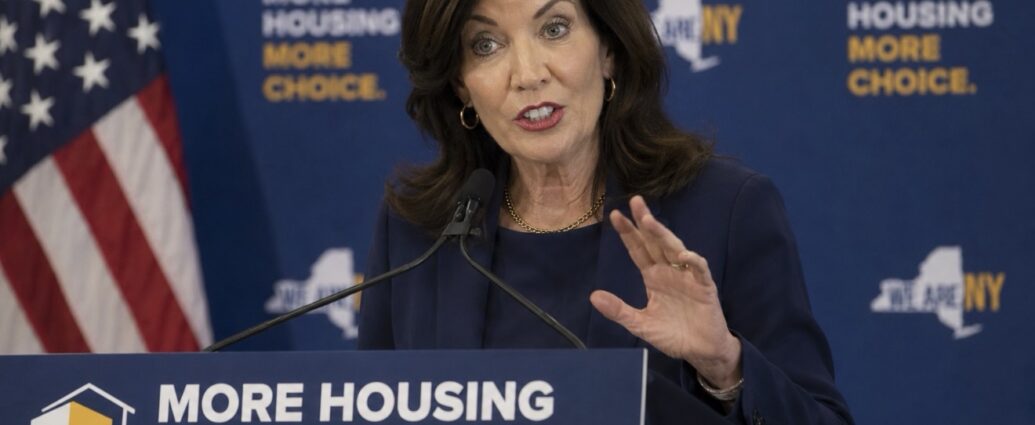
New York Gov. Kathy Hochul defended her decision Monday to move toward participation in the federal Education Freedom Tax Credit program, placing herself at odds with powerful teachers unions and prominent Democratic lawmakers as a national school choice battle increasingly spreads into deep-blue states.
Speaking at a news conference in Midtown Manhattan, Hochul pushed back forcefully against criticism that the program would siphon money away from public education systems already facing financial pressure and enrollment declines.
“This money,” Hochul said, “it’s not public dollars that could have been going to public schools are now going to private schools. It’s just not how it works.”
The debate centers around the Education Freedom Tax Credit, a Republican-backed initiative created under last year’s One Big Beautiful Bill Act, which allows American taxpayers to receive a dollar-for-dollar federal tax credit of up to $1,700 for donations made to approved nonprofit scholarship-granting organizations. Those organizations would then distribute scholarships to qualifying families earning up to 300% of local median income to help cover private school tuition, tutoring, special education services, and other educational expenses.
The structure of the program has transformed school choice from a state-level policy fight into a national political issue with major implications for governors across the country. States must formally opt in for their residents to fully benefit. If New York declines participation, taxpayers could still claim the federal credit, but the scholarship dollars generated from New York donors would largely flow to programs operating in other states — most of them Republican-led.
That possibility has added urgency to the debate in Albany.
The backlash from the political left was immediate.
Both the United Federation of Teachers (UFT) and New York State United Teachers (NYSUT) issued statements condemning the governor’s position, arguing the program would weaken public education while accelerating student migration into private and religious schools.
State Sen. John Liu, chairman of the New York City Education Committee, threatened legislative action to block the state from joining altogether.
“While this tax credit may appear enticing,” Liu said, “there will undoubtedly be long-term damage to the ability of states to provide public education.”
The criticism places Hochul in an increasingly delicate political position as she balances progressive labor allies against growing support for school choice among suburban voters, religious communities, and working-class families frustrated with public school performance following years of pandemic disruption and declining test scores.
Political strategists say the issue could become one of the defining education battles of the 2026 election cycle.
“This is no longer just a conservative issue,” said one New York political consultant involved in statewide education advocacy efforts. “What’s changing is that middle-income families — including many Democrats — increasingly want educational flexibility, and politicians are starting to recognize that reality.”
Supporters argue the program could generate hundreds of millions of dollars annually in scholarship funding if large donor participation materializes in New York, home to one of the nation’s largest private and parochial school systems. Tuition pressures have intensified sharply in recent years across Jewish day schools, Catholic schools, and independent schools, particularly in the New York metropolitan area where many families now face annual tuition costs exceeding $20,000 to $40,000 per child.
Tommy Schultz, CEO of the national school choice advocacy organization American Federation for Children, called Hochul’s position a turning point.
“Finally, school choice is coming to New York, thanks to the courage of Governor Hochul and the tremendous advocacy of countless families, educators, and supporters who have worked for generations,” Schultz said.
Sydney Altfield, CEO of Teach NYS, which advocates for government support for Jewish schools, described the governor’s position as highly significant beyond New York itself.
“This is extraordinary news for Jewish families and for every community across our state,” Altfield said. “Blue states across the country will now be watching closely.”
The politics surrounding the issue are unmistakable.
Hochul, who is seeking reelection this year against Nassau County Executive Bruce Blakeman, has faced growing pressure from Republicans and religious education advocates who argue New York families are effectively subsidizing educational choice programs in other states while receiving little benefit themselves.
Blakeman has already criticized the governor for moving too slowly on participation, attempting to position Republicans as the clearer advocates for school choice expansion.
At the same time, Hochul has spent years strengthening ties with the Orthodox Jewish community, an increasingly influential voting bloc in New York politics. Her administration previously supported measures easing state oversight pressure on certain yeshivas and backed broader nonpublic school support initiatives. In 2023, she also proposed expanding charter schools in New York City, triggering opposition from many of the same Democratic allies now attacking her over the federal tax credit program.
As of this week, roughly 27 to 29 states — overwhelmingly Republican-led — have opted into the federal initiative. Colorado Gov. Jared Polis remains the only Democratic governor to formally join so far, while North Carolina Gov. Josh Stein has signaled plans to participate once federal implementation rules are finalized.
If Hochul ultimately signs on, New York would instantly become the most politically significant Democratic-led state in the country to embrace the program, potentially reshaping the national school choice debate ahead of the 2026 midterm elections.
The final decision may ultimately depend on regulations now being drafted by the U.S. Treasury Department, which is expected to clarify whether scholarship organizations may impose student eligibility restrictions and whether any scholarship funds may support public school-related educational services — an issue Hochul has publicly said remains central to her review.
For now, the governor appears determined to keep the door open despite mounting pressure from within her own party — signaling that the politics of education, particularly in New York, may be entering a new era.
JBizNews Desk
© JBizNews.com. All rights reserved.