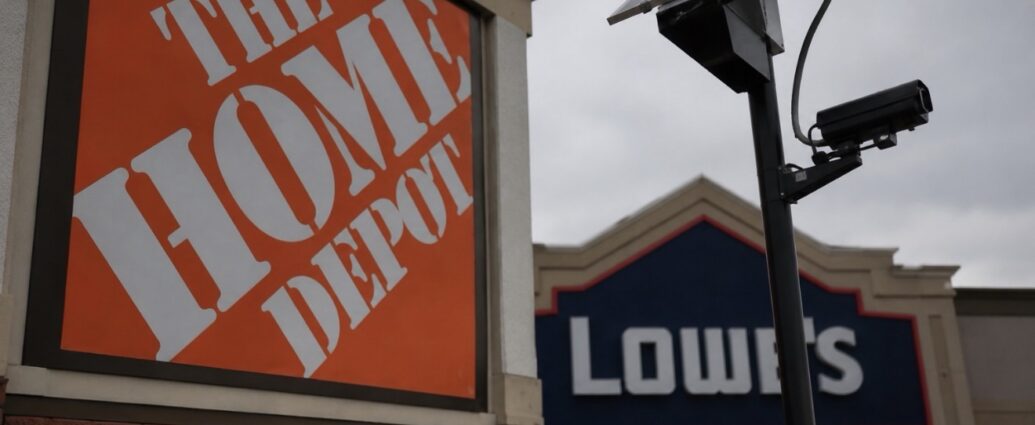
NEW YORK — May 15, 2026 — The Home Depot Inc. and Lowe’s Companies Inc. are facing a growing consumer backlash over the quiet rollout of AI-powered license-plate-reading cameras in their store parking lots, a loss-prevention program that the two home-improvement giants describe as a tool against organized retail theft but that shoppers say they were never told about — and that some are now citing as a reason to take their business elsewhere, according to a fresh report Thursday from TheStreet and an earlier investigation by 404 Media. The cameras, manufactured by Atlanta-based surveillance startup Flock Safety Inc., were installed at hundreds of locations beginning in 2024, with neither retailer running a public announcement before the program went live.
The hardware is mounted on tall poles alongside solar panels at parking-lot entrances and exits and is built on the same automated license-plate reader, or ALPR, platform that Flock sells to more than 5,000 police departments nationwide. According to the company’s own marketing, each camera captures six to twelve images of every passing car, along with the make, model, color, and what Flock calls “unique features” — roof racks, dent patterns, bumper stickers. Every scan flows into a national database that Flock licenses to law enforcement. 404 Media reported last August that a single Texas sheriff’s office had searchable access to data from 173 cameras at Lowe’s locations across the country and dozens at Home Depot stores within Texas alone. Shoppers entering for a sheet of plywood or a bag of mulch are being scanned in the same way drivers passing a highway checkpoint would be.
The retailers say the cameras are about shrink, not surveillance. According to the National Retail Federation, the average number of shoplifting incidents per store rose 93% between 2019 and 2023, and both companies have repeatedly described retail theft as one of their most pressing operational problems. Home Depot Chief Executive Ted Decker told CNBC’s “Squawk Box” in 2023 that “this isn’t the random shoplifter anymore,” framing the problem as organized rings rather than individual lifters. Lowe’s Chief Executive Marvin Ellison told a Goldman Sachs retail conference the same year that the company was leveraging technology behind the scenes to manage shrink. The companies point to landmark cases — including what authorities described as the largest organized retail-theft operation ever targeting Home Depot, with losses exceeding $10 million, and a yearlong Connecticut investigation that produced six arrests for $250,000 in Lowe’s thefts last October — as evidence the investment is producing returns.
But customers say they had no idea the cameras existed. Threads on Reddit’s home-improvement and privacy boards over the past several weeks have included shoppers expressing surprise at discovering the cameras, with multiple commenters saying they have either stopped going to one or both retailers or started parking on adjacent public streets to avoid the lot scans. Lowe’s discloses the program on its website with language that the company uses ALPRs at some stores “when allowed by law” and that the data is collected to “help ensure security, prevent theft and fraud, assist with parking enforcement, and to help maintain your safety.” Home Depot discloses that its cameras are used for “detecting and preventing theft and protecting the safety of our customers and associates” and that the company “does not grant access to our license plate readers to federal law enforcement.” Neither retailer posts the disclosure at the cameras themselves or at store entrances.
The federal-access carveout has not satisfied critics. Home Depot shares its Flock data on a standing-access basis with local police, who are themselves networked into the national platform. State audit logs reviewed by the Electronic Frontier Foundation from Virginia, Colorado, Georgia, and Washington state show federal agents accessed the broader Flock network through local police intermediaries during 2024 and 2025. Flock Chief Executive Garrett Langley has said publicly that U.S. Immigration and Customs Enforcement does not have direct access to the company’s platform, and Flock has acknowledged ending a pilot program with Customs and Border Protection and Homeland Security Investigations after public exposure.
The legal exposure is now beginning to bite. Home Depot was hit with a class-action lawsuit in California last month alleging the company installed the cameras without customer consent and without the safeguards required under state privacy law. The filing, reviewed by the Daily Journal, argues the retailer has shared Flock camera feeds with law enforcement since at least March 2025 in violation of customer expectations. The California Senate Judiciary Committee on April 21 separately passed legislation that would require Home Depot to publicly disclose immigration-enforcement activity at its stores, with state lawmakers citing the company’s lack of voluntary disclosure. Dominick Miserandino, chief executive of retail analytics firm RTMNexus, told TheStreet that the two retailers are “effectively turning their parking lots into a law enforcement database.”
For the chains’ shareholders, the program has so far produced limited financial impact. Home Depot closed Thursday at roughly $384 a share with a market value above $380 billion. Lowe’s is valued at roughly $135 billion. Neither retailer has commented on whether it will modify, pause, or expand the Flock rollout in light of the California lawsuit or the recent consumer pushback. With 38 civil-society organizations — including Fight for the Future, the Electronic Frontier Foundation, and the American Federation of Teachers — having sent an April 1 letter to Ellison demanding the company terminate its Flock contracts, and with the legal calendar now ticking forward, the pressure on the two home-improvement giants is unlikely to ease in coming months.
— JBizNews Desk
© JBizNews.com. All rights reserved. This article is original reporting by JBizNews Desk. Unauthorized reproduction or redistribution is strictly prohibited.