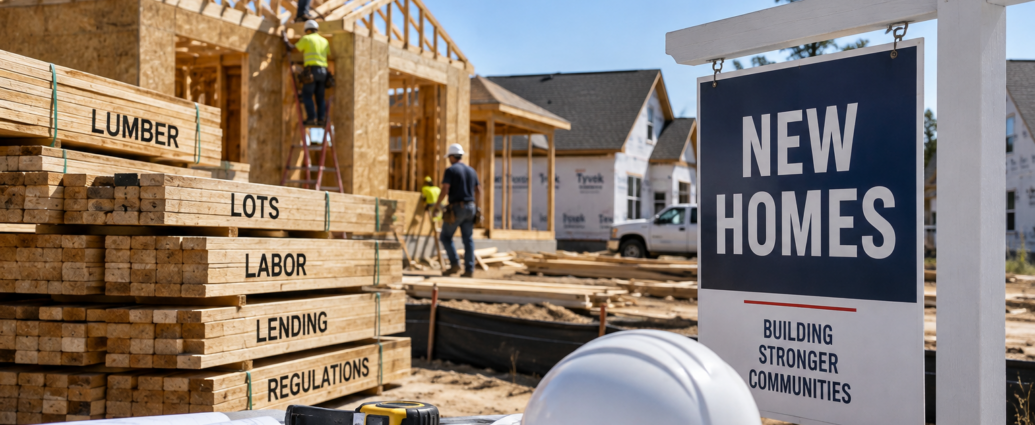
America’s homebuilders are battling high borrowing costs, expensive land, worker shortages and rising construction expenses. Most of those pressures are largely outside an individual builder’s control.
What builders can control is how efficiently they operate — and in today’s difficult housing market, that distinction is becoming increasingly important.
The National Association of Home Builders has long summarized the supply-side obstacles confronting the industry as the “Five Ls”: labor, lots, lumber and building materials, lending, and legal and regulatory barriers.
Together, those problems help determine how quickly homes can be built and how much buyers ultimately have to pay.
NAHB estimates the United States faces a structural housing shortage of roughly 1.2 million homes, while builders continue confronting delays and rising costs that make closing that gap more difficult.
The Five Problems Builders Can’t Easily Fix
Each of the Five Ls can become a bottleneck.
A builder needs available land. That land needs regulatory approval. Construction financing needs to be available at a workable cost. Materials need to arrive on time. And contractors need enough skilled workers to actually build the house.
A problem with any one of those pieces can delay an entire project.
Those pressures remain very real in 2026.
Builder confidence fell to 32 in September, its lowest level since September 2025, according to the NAHB/Wells Fargo Housing Market Index. NAHB Chief Economist Robert Dietz pointed to tight lending conditions and elevated land, labor and construction costs as continuing pressures on builders.
Earlier this year, NAHB also estimated that residential construction needs to add roughly 740,000 workers annually simply to keep pace with industry growth, retirements and workers leaving the sector.
Individual builders have limited ability to change those conditions.
They cannot independently lower national interest rates, rewrite local zoning rules or instantly create thousands of skilled construction workers.
But they can change how their companies respond.
The Sixth Factor: The Builder Itself
That puts greater importance on something much closer to home: the builder’s own organization.
John McManus, founder of The Builder’s Daily and a longtime housing-industry analyst, has repeatedly emphasized the importance of operational discipline, customer relationships and organizational execution as builders navigate difficult market conditions.
The idea is that a homebuilder’s competitive position is determined by more than the house it eventually hands to a buyer.
Builders also depend on subcontractors, suppliers, lenders, land sellers and local partners.
Those relationships can become especially valuable when resources are scarce.
A reliable builder may have an easier time retaining skilled trade partners. Strong relationships with suppliers can matter when materials are constrained. Credibility with lenders can become important when financing conditions tighten.
None of those relationships eliminates the Five Ls.
They can, however, determine how effectively a company navigates them.
Cutting Costs Without Destroying Value
That challenge becomes particularly important as builders try to produce homes buyers can still afford.
Builders have increasingly used incentives and price reductions to attract hesitant buyers. In July, 37% of builders reported cutting prices, with an average reduction of 6%, while 63% reported using sales incentives.
But lowering costs creates another question:
What can a builder remove without removing something the customer actually values?
Customer-experience consultant Joseph Michelli draws an important distinction between price and value. His broader framework argues that companies build loyalty by reducing unnecessary friction while protecting the moments and services customers consider important.
Applied to housing, that can mean scrutinizing floor plans, options, processes and construction expenses rather than simply making across-the-board cuts.
A buyer trying to reach an affordable monthly payment might willingly trade an optional feature for a lower purchase price.
The same buyer may be considerably less accepting of poor construction quality, confusing communication or unexpected delays.
That makes operational discipline part of the affordability equation.
Why This Matters for Homebuyers
The pressure is already changing what builders offer.
Builders have been using discounts and incentives as affordability problems keep potential buyers on the sidelines. At the same time, elevated mortgage rates, expensive land, material prices and skilled-worker shortages continue to weigh on the industry.
For buyers, that means the sticker price is only one part of evaluating a new home.
Construction quality, warranty service, communication, financing incentives, completion reliability and the builder’s reputation with contractors and suppliers can all affect the experience long after a contract is signed.
That becomes especially important when builders are under pressure to cut expenses.
No Easy Reset
There is little evidence that all of the industry’s problems are about to disappear simultaneously.
NAHB’s September survey found worsening labor shortages, higher material costs and elevated mortgage rates continuing to weigh on builders and buyers.
Single-family construction also declined across every major U.S. geographic region during the first quarter of 2026, with NAHB citing higher financing and material costs as significant headwinds.
That leaves builders facing a business problem as much as a construction problem.
They cannot control interest rates. They cannot manufacture buildable lots overnight. They cannot single-handedly eliminate labor shortages or regulatory delays.
They can control how efficiently their organizations operate, how carefully they allocate costs and how they treat the buyers, contractors, suppliers and lenders their businesses depend upon.
In a housing market where nearly every external pressure is pushing in the wrong direction, that may be one of the few levers builders can still pull themselves.
JBizNews Desk | New York
© JBizNews.com All Rights Reserved. Reproduction or distribution without written permission is prohibited.