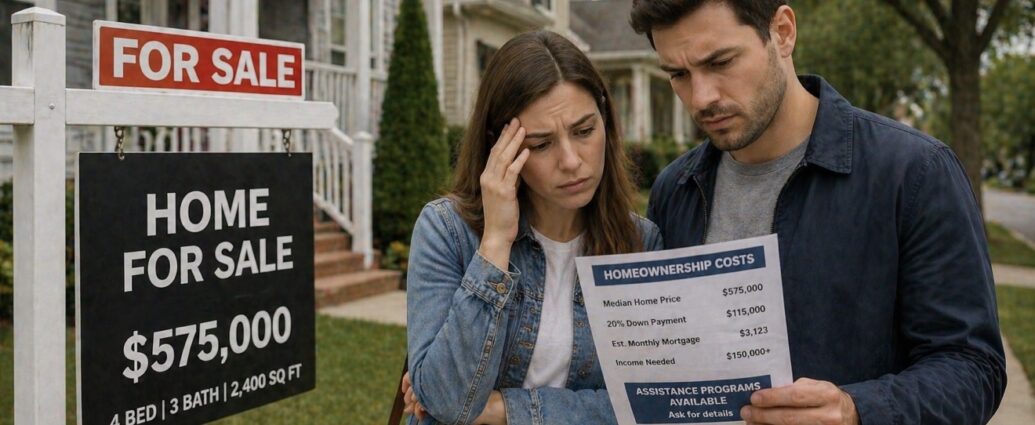
WASHINGTON — Buying a first home in America has rarely been more difficult, as elevated mortgage rates, limited inventory, and persistently high prices continue to sideline millions of would-be buyers — even as government and nonprofit assistance programs expand to record levels.
Across the housing market, prospective buyers are facing a convergence of financial barriers. Higher borrowing costs, tighter lending standards, and a shortage of affordable listings are creating a bottleneck that disproportionately impacts first-time buyers, who typically lack the savings and credit depth of repeat homeowners. In many markets, renters are delaying purchases indefinitely or abandoning homeownership plans altogether.
New data from LendingTree highlights the widening affordability gap. As of early 2026, homeowners with mortgages are paying 36.9% more per month than renters, translating to roughly $548 extra monthly or more than $6,500 annually. In 22 of the 100 largest U.S. metropolitan areas, the cost of owning exceeds renting by at least 50%, underscoring how sharply the economics have shifted against entry-level buyers.
Income requirements further illustrate the divide. Analysts estimate that prospective buyers now need to earn approximately $111,000 per year to afford a typical home, compared to about $76,000 for renters — a gap that places homeownership out of reach for a large share of American households.
Mike Fratantoni, Chief Economist at the Mortgage Bankers Association, said demand remains supported by a resilient labor market, even as affordability pressures intensify. “We are seeing continued interest from buyers,” Fratantoni noted, adding that in many areas, rising inventory relative to last year is beginning to shift conditions toward a more balanced market. Still, 30-year fixed mortgage rates hovering near 6.5% continue to weigh heavily on purchasing power.
At the same time, policymakers and housing advocates are expanding efforts to bridge the gap. Down Payment Resource, a leading housing data firm, reported in its Q1 2026 Homeownership Program Index that there are now 2,679 homebuyer assistance programs nationwide, marking a 2% increase from the prior quarter and extending a steady upward trend.
These programs span a wide range of targeted support, including grants and low-interest loans for veterans, educators, law enforcement personnel, and first responders, as well as new initiatives aimed at expanding access to manufactured housing and multi-unit properties. The goal is to reduce upfront costs, particularly the down payment barrier that remains one of the biggest hurdles for first-time buyers.
But despite the growing number of programs, structural affordability challenges persist. With the median U.S. household income around $86,000, homeownership still requires earning roughly $25,000 more per year than what most Americans make — a gap that assistance programs alone have struggled to close.
Housing analysts say meaningful improvement will likely depend on a combination of factors rather than a single solution. Increased construction of lower-priced homes, even modest declines in mortgage rates, and stable rent growth that allows renters to build savings are all seen as critical to restoring balance.
Some regions are beginning to show early signs of progress, particularly where inventory has improved and bidding wars have cooled. However, those gains remain uneven, and many first-time buyers continue to find themselves priced out of neighborhoods near employment centers and transportation hubs.
For now, the trajectory is clear: while support programs are expanding, the fundamental math of homeownership remains challenging — leaving a growing number of Americans on the sidelines of the housing market.
JBizNews- Desk