Honda Motor Co. reported the worst financial year in its modern history Thursday, posting the first annual loss since becoming a publicly traded company nearly seven decades ago, as the Japanese automaker dramatically retreated from its electric-vehicle ambitions and pivoted back toward hybrids and gasoline-powered vehicles.
The company reported a net loss of 423.9 billion yen, or roughly $2.7 billion, for the fiscal year ended March 2026, according to its annual earnings release. The result marks Honda’s first full-year loss since listing on the Tokyo Stock Exchange in 1957.
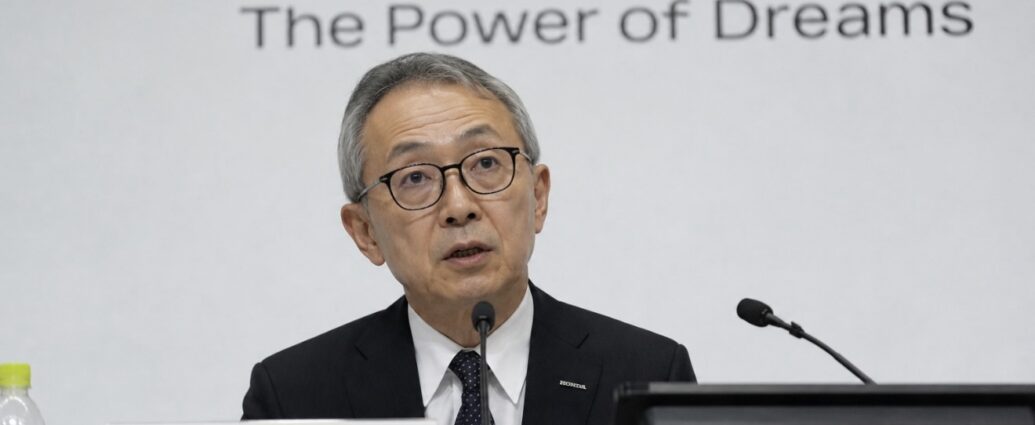
At a Tokyo press conference, Chief Executive Toshihiro Mibe said the losses stemmed largely from the collapse of Honda’s U.S. electric-vehicle strategy, which triggered nearly $10 billion in EV-related writedowns after the company canceled several planned electric models, dissolved its partnership with Sony Corp., and indefinitely suspended a massive Canadian EV and battery manufacturing project.
“This was a painful but necessary reset,” Mibe told reporters, acknowledging that slowing consumer demand for battery-electric vehicles in the United States and changes to the regulatory environment under President Donald Trump forced Honda to rethink its long-term strategy.
Honda disclosed that total EV-related losses tied to the fiscal year just completed and the current fiscal year are expected to approach 2 trillion yen, or roughly $13 billion, with 1.45 trillion yen already booked.
The company also formally abandoned several of the ambitious electrification goals Mibe introduced in 2021, including a pledge that all Honda vehicles would become electric or fuel-cell powered by 2040. Honda additionally scrapped a target calling for EVs to account for one-fifth of total vehicle sales by 2030.
Asked whether he would resign following the historic loss — a traditional step often taken by Japanese executives after major corporate failures — Mibe said his immediate responsibility was rebuilding the company.
Honda Retreats From U.S. EV Expansion
Among the canceled projects were three planned U.S. electric vehicles, including a midsize SUV, a sedan, and a luxury Acura-branded model.
Honda also effectively dissolved its highly publicized EV partnership with Sony Corp., which had previously been positioned as a premium electric platform designed to compete with Tesla and fast-growing Chinese EV manufacturers.
In another major reversal, Honda indefinitely froze its planned $11 billion EV and battery manufacturing project in Canada, which would have represented one of the largest automotive investments in Canadian history.
The strategic retreat places Honda alongside other legacy automakers including Ford Motor Co. and General Motors, both of which have taken multibillion-dollar losses tied to slowing EV demand and weaker-than-expected profitability.
Meanwhile, Toyota Motor Corp. — which spent years resisting Wall Street pressure to aggressively pursue full EV adoption — has emerged as one of the industry’s strongest performers thanks to its continued focus on hybrid vehicles.
Analysts increasingly view Toyota’s hybrid-heavy strategy as the winning near-term model for legacy automakers.
Motorcycles Become Honda’s Financial Lifeline
While Honda’s automotive business absorbed enormous losses, its motorcycle division delivered record profitability and helped stabilize the broader company.
Honda reported record motorcycle sales and operating income during the fiscal year, driven by strong consumer demand in India and Brazil.
The company said it plans to expand production capacity in India as it targets annual motorcycle sales of approximately 22.8 million units.
Strong cash flow from the motorcycle business allowed Honda to maintain shareholder-return commitments despite the historic loss.
Management pledged at least 800 billion yen in shareholder returns over the next three years and kept the annual dividend unchanged at 70 yen per share.
Investors responded positively to the announcement, sending Honda shares up roughly 3.8% in Tokyo trading Thursday, although the stock remains down approximately 14% year to date amid broader concerns involving global tariffs, the Iran conflict, and EV profitability pressures.
China Weakness Deepens
Honda’s long-term position in China remains one of management’s biggest concerns.
The company said sales in China have fallen by more than half over the last five years amid intense price competition from domestic EV manufacturers including BYD, Geely, and Nio.
Honda sold roughly 1.5 million vehicles annually in China at its peak in 2020 but now delivers closer to 600,000 units, according to company filings.
To offset the deterioration, Honda is increasingly relying on North America, where hybrid demand has strengthened sharply and dealerships are reporting waiting lists for fuel-efficient models.
The company projected global vehicle sales of roughly 3.39 million units for the fiscal year ending March 2027, essentially flat from the prior year, with North American hybrid growth expected to balance continued weakness in China.
Industry-Wide EV Reality Check
For the current fiscal year, Honda forecast a return to profitability with projected net income exceeding $1.6 billion, despite the possibility of additional EV-related writedowns.
Mibe said Honda would continue investing in long-term battery and EV research but would rebuild the company around hybrids, traditional gasoline-powered vehicles, and motorcycles.
Honda’s dramatic reversal increasingly reflects a broader industry-wide reassessment of electric-vehicle demand after years of aggressive forecasts by global automakers.
Federal EV subsidies in the United States have been rolled back under the Trump administration, charging infrastructure remains inconsistent outside major metropolitan areas, and consumers continue favoring hybrids over fully battery-powered vehicles.
At the same time, Tesla maintains dominance in premium EV segments while many traditional automakers struggle to generate sustainable profits from pure-electric models.
For the global auto industry, Honda’s message was unmistakable: in today’s market, hybrids — not fully electric vehicles — are where near-term profits are increasingly being made.
— JBizNews Desk
© JBizNews.com. All rights reserved. This article is original reporting by JBizNews Desk. Unauthorized reproduction or redistribution is strictly prohibited.