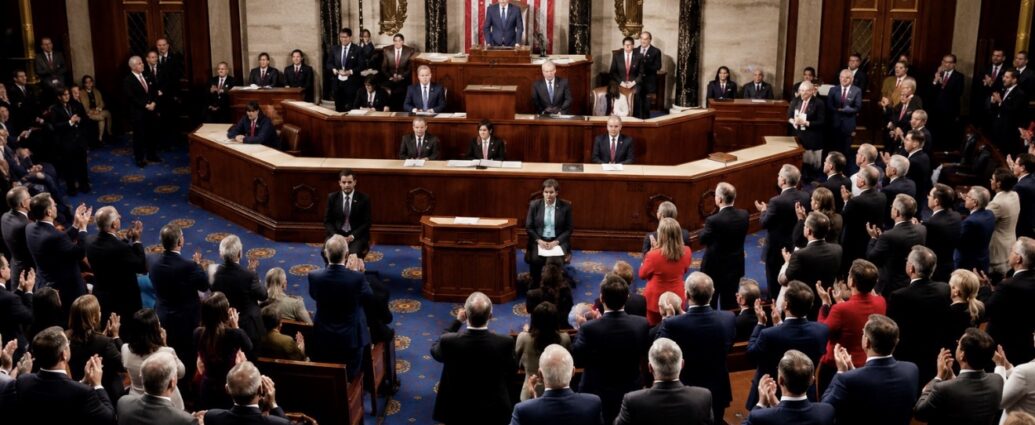
The House of Representatives voted Wednesday to bar its members from buying individual stocks while in office, the first time the full chamber has ever advanced legislation to restrict lawmakers’ trading — a milestone on an issue that has dogged Congress for years. The measure now heads to a Senate where its prospects are far from certain, in part because of how House Republicans chose to package it.
The bill cleared the chamber on a 232-198 vote, carried by nearly all Republicans and at least 13 Democrats. Branded the Stop Insider Trading Act (H.R. 7008) and led by House Administration Committee Chairman Bryan Steil of Wisconsin, it would prohibit members of Congress, their spouses and their dependent children from purchasing shares of individual publicly traded companies while serving, while still permitting broader holdings such as mutual funds and index funds. Notably, it stops short of forcing lawmakers to sell the individual stocks they already own. The bill also sharpens the penalties for failing to disclose stock sales, raising fines to $2,000 or 10% of the transaction’s value, whichever is greater, up from the current $200 for first-time offenders.
Supporters framed the vote as a long-overdue response to public frustration. House Speaker Mike Johnson said Americans struggling to make ends meet have watched too many lawmakers arrive in Washington and leave as multimillionaires, calling the ban a commonsense step toward restoring trust. Representative Zach Nunn of Iowa, one of its leading backers, argued the measure delivers something an overwhelming majority of Americans want and could reach the president’s desk quickly.
The path to the floor, however, has drawn sharp criticism, and the controversy centers less on the ban itself than on what Republicans attached to it. Leadership fused the trading restriction with a separate measure requiring proof of citizenship to register and photo identification to vote — a priority for President Trump but a nonstarter for most Democrats. That pairing prompted dozens of House Democrats to vote against the combined package, and even some Republicans objected to the tactic. Representative Thomas Massie of Kentucky argued that a standalone stock-trading ban could pass with a large bipartisan majority and a real chance in the Senate, contending the voter-ID attachment was designed to force Democrats into a no vote that could be wielded in the November elections.
The bill’s substance has critics of its own, including among lawmakers who have pushed hardest for a ban. A bipartisan group has spent years advancing the rival Restore Trust in Congress Act, which would prohibit both buying and selling of individual stocks and require members to divest their holdings within 180 days of enactment — a far stricter standard than the buy-only restriction the House passed. That measure counts 141 co-sponsors, including a bloc of Republicans. Representative Seth Magaziner of Rhode Island, part of that coalition, dismissed Wednesday’s bill as a trading ban that still permits trading, while Representative Joe Neguse of Colorado argued the cleanest way to ban members from trading stocks is simply to ban them from trading stocks.
The backdrop is a decade of scrutiny over lawmakers’ market activity. A 2012 federal law already makes it illegal for members to trade on nonpublic information, but its penalties are weak and rarely enforced. Reporting in recent years has documented well-timed trades around the onset of the pandemic and other market-moving events, and one prominent analysis found that between 2019 and 2021 a meaningful share of members traded stocks in sectors tied to the committees on which they served. Those episodes have fueled bipartisan calls for tighter rules and repeated, stalled attempts at reform.
Whether this attempt fares differently now rests with the Senate, and the obstacles there are considerable. Most legislation requires 60 votes to overcome a filibuster, and the voter-ID language bundled into the House bill makes attracting Democratic support harder rather than easier. The calendar is unforgiving as well, with only about 10 weeks of session remaining before the November 3 midterms. Several senators in both parties have their own stock-trading proposals in various stages, but none has yet cleared the chamber. For now, the House has done something it never has before — but turning a landmark vote into an enacted law remains a steep climb.
JBizNews Desk | Washington
© JBizNews.com All Rights Reserved. Reproduction or distribution without written permission is prohibited.