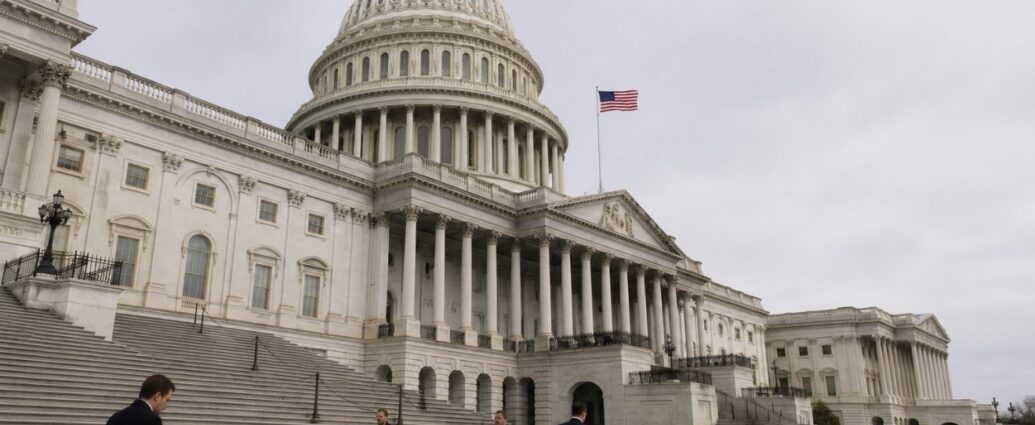
WASHINGTON — House Republicans pushed through a stopgap spending bill on Tuesday that would keep the federal government funded through Dec. 4, an unusually early maneuver designed to remove the threat of a shutdown from the calendar well ahead of the November midterm elections.
The measure cleared the chamber on a 220-205 vote that fell almost entirely along party lines. Six Democrats — Henry Cuellar of Texas, Don Davis of North Carolina, Jared Golden of Maine, Vicente Gonzalez of Texas, Gabe Vasquez of New Mexico, and Kathy Castor of Florida — crossed over to back the bill, while Kentucky Republican Thomas Massie was the lone GOP defector.
What makes the vote notable is its timing. Congress typically waits until the eleventh hour to pass this kind of temporary funding patch, often acting within hours of a lapse. The current fiscal year does not end until Sept. 30, more than two months out. But with the House scheduled to be in session for only 16 more days before that deadline once lawmakers leave for the August recess, Republican leaders opted to act now rather than gamble on a chaotic September that could rattle voters just before they head to the polls.
For the business community, the early action carries a practical upside: predictability. A continuing resolution that generally holds agencies at existing spending levels gives federal contractors, grant recipients, and companies that depend on government operations a clearer runway through the fall. Shutdowns freeze contract payments, stall permitting and regulatory reviews, and force agencies to furlough workers — disruptions that ripple outward to the private firms doing business with Washington. Locking in funding through early December, if it holds, takes that particular source of uncertainty off the table during a period when markets already have plenty to digest.
House Speaker Mike Johnson framed the vote as a direct challenge to Democrats, warning that if they blocked the funding and a lapse followed after Sept. 30, the political fallout would land squarely on them. He argued that the party opposing the measure would own whatever disruption resulted.
Democrats saw the process very differently. Rep. Rosa DeLauro, the ranking Democrat on the House Appropriations Committee, said the legislation was handed to her side last Friday with no bipartisan negotiation, leaving lawmakers to rush a one-sided bill through two days before the recess. She said Democrats would have used any real negotiation to push back on a proposed federal rule that could let agency heads block or cancel grants they deem out of step with the administration’s priorities — a provision with direct consequences for universities, nonprofits, and businesses that rely on federal grant funding.
The bill also tucks in death gratuity payments of $174,000 each to the heirs of the late Sen. Lindsey Graham and Rep. David Scott, a customary provision attached to funding legislation following the deaths of sitting members.
The bigger question now moves across the Capitol. Passage in the House was the easier lift; the Senate is another matter. Majority Leader John Thune signaled that quick action in his chamber is far from assured. Unlike the House, the Senate needs a degree of bipartisan buy-in to advance spending legislation, meaning Republicans cannot move a stopgap on their own. That hands Senate Democrats real leverage, and the path forward there is murky at best.
The standoff sets up a familiar dynamic with unfamiliar timing. Republicans are betting that funding the government early denies the opposition a shutdown fight in the closing weeks of the campaign — a scenario that historically damages the party in power. Democrats, for their part, are unlikely to hand over that leverage without extracting concessions, and some see a shutdown fight as politically useful heading into November.
Republican leaders said work on the dozen annual appropriations bills would continue through the fall regardless, with the December deadline meant to buy time for that longer process rather than replace it. Whether that timeline survives contact with the Senate remains to be seen.
For now, the takeaway for anyone with exposure to federal spending — contractors, grant-dependent institutions, and the broader web of firms tied to government operations — is cautious. The House has done its part to push a shutdown out of the pre-election window, but the funding is not secure until the Senate acts and the president signs. Until then, the early vote is best read as a statement of intent rather than a guarantee.
JBizNews Desk | Washington, D.C.
© JBizNews.com All Rights Reserved. Reproduction or distribution without written permission is prohibited.