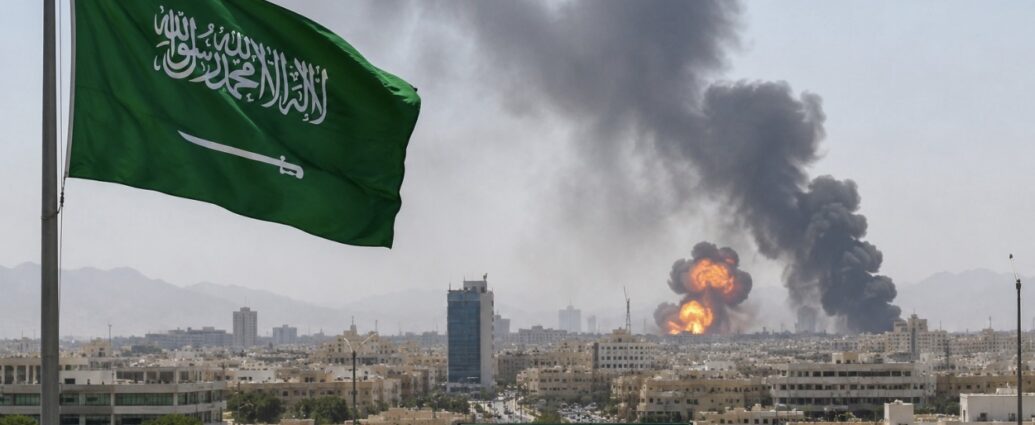
Yemen’s Houthi movement fired ballistic missiles and drones at Saudi Arabia on Monday and threatened a wider campaign, an escalation that has revived fears of disruption to Red Sea shipping and Gulf oil flows just as markets are already on edge over the U.S.-Iran war.
The flare-up began, according to Yemen’s internationally recognized government, when its forces bombed the runway at Sanaa International Airport on Monday to stop an Iranian aircraft from landing. The plane was carrying a Houthi delegation returning from Tehran, where it had attended the funeral of the late Iranian supreme leader. The Houthis blamed Saudi Arabia for the strike, and their military spokesman, Yahya Saree, called it “blatant aggression” and declared an end to a period of de-escalation. Houthi political official Mohammed al-Bukhaiti said the group would impose a “siege” on Saudi Arabia in response and warned that the attacks would not go unpunished.
Within hours, the Houthis said they had targeted Abha International Airport in southwestern Saudi Arabia, warned aviation companies to avoid Saudi airspace, and threatened to strike King Khalid International Airport in Riyadh. Saudi state media said the kingdom’s air defenses intercepted the incoming missiles. The U.S. State Department said it was monitoring the situation closely and reaffirmed Washington’s partnership with Riyadh, saying it stands with Saudi Arabia against Iranian-backed attacks. Hans Grundberg, the United Nations Special Envoy for Yemen, warned of the danger of escalation and said his office remained in contact with all parties.
The business concern centers on oil and global shipping.
A Houthi political bureau member, Muhammad Al-Farah, warned that continued fighting could drag the Bab al-Mandab Strait into the same type of disruption now surrounding the Strait of Hormuz, claiming oil prices could climb toward $200 per barrel. While that figure represents a political warning rather than a market forecast, the strategic importance of the region is undeniable. The Bab al-Mandab serves as one of the world’s most critical shipping chokepoints, linking the Red Sea with the Gulf of Aden and ultimately the Suez Canal.
Renewed attacks also raise concerns over Saudi Arabia’s East-West Pipeline, which transports crude oil from the kingdom’s eastern oil fields to export terminals on the Red Sea. The pipeline was designed specifically to provide an alternative route should the Strait of Hormuz become inaccessible. Any credible threat to that infrastructure would add another layer of uncertainty to already strained global energy markets.
Until now, the Houthis had largely remained on the sidelines of this year’s broader U.S.-Iran conflict. Unlike the widespread commercial shipping attacks seen during 2023 and 2024, which forced vessels to reroute around Africa and sharply increased freight costs, the group had limited its activity to relatively isolated missile launches without reopening a sustained campaign against international shipping.
That restraint may now be weakening.
If the Red Sea once again becomes a conflict zone while tensions continue around the Strait of Hormuz, two of the world’s most important energy corridors could face simultaneous disruption. Such a scenario would significantly increase shipping costs, insurance premiums and transit times for cargo traveling between Asia, Europe and North America.
The economic impact would extend far beyond the Middle East. Shipping companies would likely divert vessels around the Cape of Good Hope, adding thousands of miles to many voyages. Longer transit times increase fuel consumption, reduce vessel availability and drive higher freight rates that ultimately filter into consumer prices worldwide. Higher oil prices would also raise transportation costs across industries, contributing to inflation and placing additional pressure on businesses already coping with elevated borrowing costs.
The immediate question for energy markets is whether the latest exchange develops into a sustained military campaign or remains limited retaliation. Diplomatic efforts continue, but the fragile truce that largely contained Yemen’s conflict since 2022 appears increasingly strained.
For investors and businesses alike, attention is once again turning toward the Red Sea. With the Strait of Hormuz already under close scrutiny, any renewed disruption at Bab al-Mandab would threaten another critical artery of global commerce, reinforcing concerns that geopolitical tensions could continue driving volatility across energy, shipping and financial markets.
JBizNews Desk | New York
© JBizNews.com All Rights Reserved. Reproduction or distribution without written permission is prohibited.