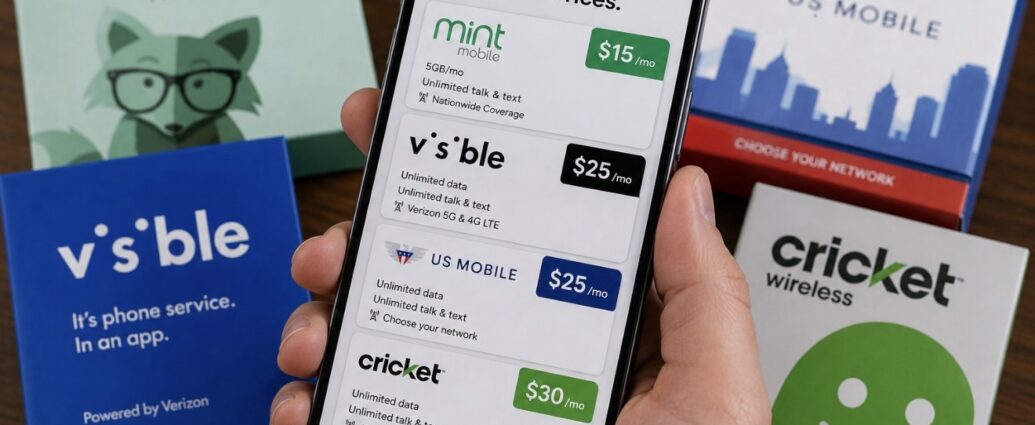
NEW YORK — May 15, 2026 — Americans are overpaying for wireless service by an average of $456 per year, according to a Consumer Reports analysis that has been quietly reshaping the U.S. cell-phone market — and a wave of low-cost carriers running on the exact same cellular towers as Verizon Communications Inc., AT&T Inc., and T-Mobile US Inc. is finally giving cost-conscious households a credible exit. Major-carrier postpaid plans now run $60 to $80 per single line, while equivalent coverage from Mint Mobile, Visible, US Mobile, and Cricket Wireless is available for as little as $25 per month — a 40% to 70% discount on the same physical network. For households living paycheck to paycheck, the wireless bill is one of the largest recurring discretionary expenses that can be cut without sacrificing service quality.
The original disruptor is Mint Mobile, the prepaid brand co-founded by actor Ryan Reynolds and acquired by T-Mobile in 2024 for $1.35 billion. Mint Mobile runs on the T-Mobile network — which by T-Mobile’s own coverage data now reaches roughly 99% of Americans through its combined 4G LTE and 5G footprint — and is structured around annual prepay pricing. The company’s most popular plans now center around the $25-to-$30 range, with the unlimited plan running $30 a month if paid annually. Free calling and texting to Canada and Mexico are included on all plans. The catch is that the headline pricing is introductory; renewal rates can step up modestly, and taxes are extra.
Visible, owned outright by Verizon, has positioned itself as the simplest no-prepay alternative. The base plan is $25 a month, taxes and fees included, with truly unlimited data, calls, and texts on the Verizon 4G LTE and 5G network — which covers roughly 98% of the U.S. population. There is no annual contract and no multi-line discount because the per-line pricing is already at parity with the family-plan tier of the major carriers. Visible+ at $35 a month adds access to Verizon’s 5G Ultra Wideband network and a Global Pass day for international travel each month. A new Visible+ Pro tier at $45 a month, launched in April, adds calling to more than 85 countries. Visible is the cleanest pick for users who want major-carrier coverage without the major-carrier bill and do not want to prepay a year up front.
US Mobile is the most flexible of the three. Rather than locking customers to a single network, US Mobile allows users to choose between Verizon, Verizon Ultra Wideband, AT&T, and T-Mobile — and switch between them via eSIM without changing accounts or porting numbers. The Unlimited Starter plan runs $25 a month with 20 gigabytes of hotspot data, taxes included, plus free international calling on all plans. Annual prepay drops the same plan to $16.60 a month for new lines. Consumer Reports ranked US Mobile first overall among prepaid carriers in 2025 with a score of 89 out of 100, ahead of Mint Mobile at 80 and Visible at 77.
Cricket Wireless, a wholly owned subsidiary of AT&T, is the most family-oriented of the budget options. The company’s newer multi-line structures can push per-line pricing into the low-$30 range for families, while Boost Mobile, Tello, Total Wireless, and Metro by T-Mobile all now compete aggressively around the $25 price point. The result is that the American wireless market has quietly entered a price war most consumers have not fully noticed yet.
The ownership map is the part many customers still do not realize. Verizon owns Visible, Total Wireless, Tracfone, Straight Talk, Simple Mobile, Page Plus, and Walmart Family Mobile. AT&T owns Cricket Wireless. T-Mobile owns Metro by T-Mobile and Mint Mobile. The Big Three created these brands precisely so they could capture budget-conscious consumers without lowering their own premium pricing or damaging their flagship brand positioning. The cellular network is identical. The price is not.
The single tradeoff is data deprioritization. During periods of network congestion — typically major events, stadium evenings, urban rush hour in dense markets — postpaid customers of the parent carrier receive priority access to the network and budget-carrier customers may experience slower speeds temporarily. For most users, the impact is minimal. For heavy data users at large events or in dense cities, it can matter. Visible+ at $35 a month upgrades the user to Verizon’s premium data priority, largely eliminating the issue.
The savings, however, are immediate and substantial. The average American household with two adults on a major-carrier family plan is paying roughly $140 to $180 a month for wireless service. Switching two lines to $25 plans can save $80 to $130 a month — between $960 and $1,560 a year. For households trying to escape the paycheck-to-paycheck cycle, few recurring bills can be reduced this dramatically without changing daily life at all. The switch now takes about 15 minutes through eSIM activation. The bigger question is why so many consumers are still paying flagship-carrier prices for the exact same towers.
— JBizNews Desk
© JBizNews.com. All rights reserved. This article is original reporting by JBizNews Desk. Unauthorized reproduction or redistribution is strictly prohibited.