By JBizNews Desk | May 6, 2026
Washington Has a New Trade Weapon
Washington has a new trade weapon — and it does not look like a tariff. It looks like a semiconductor.
President Donald Trump has quietly rewritten the rules of AI technology exports, using access to Nvidia’s most advanced chips as diplomatic currency to pull Saudi Arabia and the United Arab Emirates deeper into the American economic orbit — and further from China. What began as a series of Gulf investment announcements has hardened into one of the most consequential strategic technology plays of the Trump administration’s second term.
The approach, now widely described as “AI diplomacy,” flips the previous administration’s logic entirely. Where former President Joe Biden restricted chip exports to the Gulf out of concern that American technology could ultimately benefit Beijing, Trump opened access aggressively — betting that locking Gulf states into U.S. technology infrastructure would itself become a form of strategic containment against China.
The Deals Reshaping the Gulf AI Race
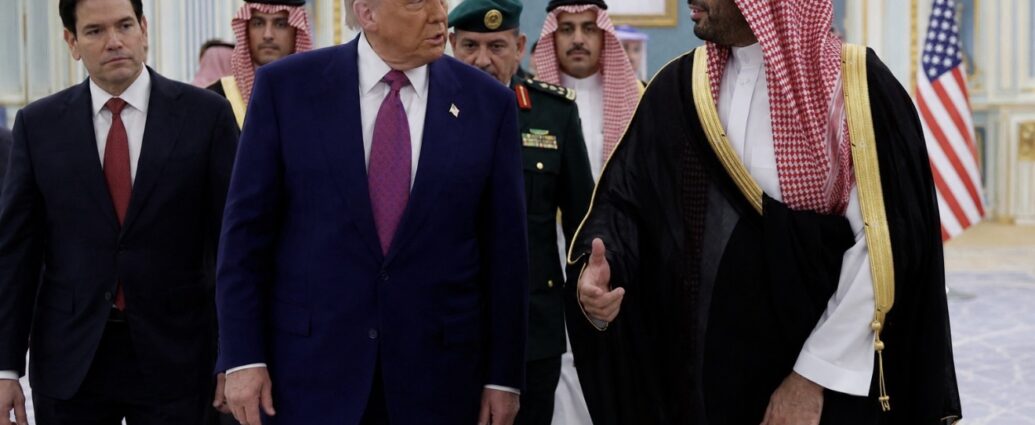
Trump’s recent four-day tour of Saudi Arabia, Qatar, and the UAE produced massive investment commitments while reshaping global AI alliances. Saudi Arabia pledged $600 billion in investments tied to the United States, while the UAE committed roughly $1.4 trillion focused heavily on artificial intelligence, semiconductors, advanced manufacturing, and energy infrastructure projects.
In return, the Trump administration loosened Biden-era restrictions and granted Gulf allies direct access to some of the world’s most advanced AI processors.
The centerpiece agreement involved Nvidia partnering with Humain, an AI startup backed by Saudi Arabia’s sovereign wealth fund. The deal includes an immediate shipment of 18,000 Nvidia Blackwell GB300 chips — among the most advanced AI chips currently available globally. AMD separately secured a reported $10 billion collaboration with Humain, while Qualcomm, Cisco, IBM, Alphabet, Oracle, and Salesforce collectively announced roughly $80 billion in technology investments tied to Gulf projects.
The UAE secured an even larger arrangement. Under the framework announced during Trump’s visit, the Emirates could import as many as 500,000 Nvidia AI chips annually between 2025 and 2027, a package analysts estimate could ultimately exceed $15 billion in value. Part of the supply would support G42, the UAE’s state-backed AI giant, while the remainder would fuel large-scale U.S.-backed data center construction inside the Gulf state.
The scale of the Gulf AI buildout is difficult to overstate. G42’s proposed five-gigawatt AI campus in Abu Dhabi could eventually house as many as 2.5 million Nvidia chips — potentially surpassing every other major AI infrastructure project currently announced worldwide, including OpenAI’s Stargate initiative inside the United States.
Tareq Amin, CEO of Humain, summarized the pace of ambition bluntly: “What we want to do in 2026 is to build the capacity equivalent to what Saudi has built in the last 20 years, in one year.”
The China Strategy Behind the Chips
The geopolitical logic behind the agreements is explicit. David Sacks, Trump’s AI and crypto policy adviser, has argued publicly that advanced chip exports can “shift the balance of power in the region,” with the administration viewing AI partnerships as a direct mechanism to counter China’s growing influence across the Middle East.
The agreements reportedly include anti-China safeguards as part of the underlying negotiations. The UAE agreed to reduce portions of its Chinese-developed AI infrastructure, remove Chinese personnel from sensitive projects, and limit Chinese technology access tied to exported U.S. chips. Security clauses included in both the Saudi and Emirati frameworks prohibit Chinese companies from directly accessing the hardware.
The broader strategy mirrors Trump’s evolving global trade doctrine. Rather than relying solely on tariffs or sanctions, the administration is increasingly using access to advanced American technology as leverage to force countries into deeper economic alignment with Washington.
The Risks and Pushback in Washington
But the strategy carries substantial risks.
China remains deeply embedded in Gulf supply chains and infrastructure development. Gulf nations continue relying heavily on Chinese manufacturing networks as they diversify beyond oil and modernize their economies. UAE semiconductor imports have risen sharply over the past decade, with a significant share historically sourced from Chinese companies.
Critics inside Washington argue the administration may be moving too aggressively.
The House Select Committee on the Chinese Communist Party warned that the Gulf chip agreements “present a vulnerability for the CCP to exploit,” while Senate Democratic Leader Chuck Schumer raised separate national security concerns surrounding potential technology leakage.
Some administration officials reportedly acknowledged privately that anti-China safeguards written into the deals may ultimately prove difficult to fully enforce. Others pushed to delay final approvals until stronger binding protections were established, though those objections were eventually overruled.
Even implementation has moved more slowly than Trump initially suggested. While the Gulf tour produced sweeping announcements, export approvals reportedly covered only a fraction of the originally discussed chip volumes, with negotiations tied closely to Gulf investment commitments inside the United States.
What It Means for Global Power
Still, the administration views the effort as a fundamental shift in global power politics.
For decades, Washington used military alliances, aircraft sales, oil relationships, and agricultural exports as tools of diplomacy. Trump is now attempting to add artificial intelligence infrastructure to that list — treating access to advanced chips as a strategic asset capable of reshaping geopolitical alliances.
The stakes extend far beyond the Gulf.
Artificial intelligence is increasingly viewed not simply as a commercial technology race, but as a defining battle over future economic dominance, military capability, and geopolitical influence. By tying Gulf ambitions to American chipmakers instead of Chinese suppliers, Trump is attempting to lock one of the world’s wealthiest and most strategically positioned regions into the U.S. technology ecosystem before Beijing can fully establish its own foothold.
Whether the strategy ultimately strengthens American dominance or creates new vulnerabilities remains uncertain.
But one thing is already clear: semiconductors are no longer just products. They have become instruments of foreign policy.
And the global AI race is rapidly becoming a contest over who controls the chips powering the future.
JBizNews Desk
© JBizNews.com. All rights reserved. This article is original reporting by JBizNews Desk. Unauthorized reproduction, redistribution, republication, AI scraping, or reuse in any form without prior written permission from JBizNews.com is strictly prohibited.