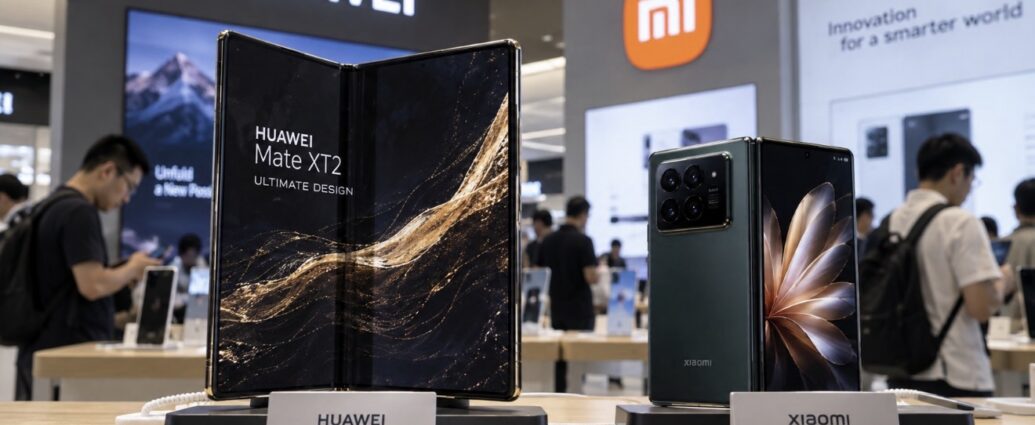
SHENZHEN, China — Huawei and Xiaomi unveiled new premium foldable smartphones Monday, sharpening competition with Apple just as the U.S. company prepares for one of the most important product weeks of its year.
Huawei introduced its latest Mate XT2, a twice-folding smartphone priced from roughly $2,980, while Xiaomi launched a new foldable device starting at about $1,540.
The launches matter because Chinese smartphone makers are no longer competing only on price.
They are increasingly trying to lead on design, hardware and advanced features — especially in premium devices that directly challenge the most profitable part of Apple’s business.
Huawei’s new phone expands on its unusual tri-fold design, which opens into a much larger tablet-like screen while still folding down into a handheld device.
Xiaomi, meanwhile, is pushing its own premium foldable lineup as it seeks to move further beyond the lower-cost segment where Chinese brands first built their global market share.
The timing is significant.
Apple is entering its annual fall product cycle while Chinese manufacturers are trying to capture more attention in the world’s largest smartphone market.
China has become one of Apple’s most difficult regions.
Local competitors have improved rapidly, especially in cameras, battery technology, artificial-intelligence features and foldable designs.
Huawei’s comeback has been particularly important.
The company was heavily constrained by U.S. export restrictions that cut its access to advanced Western semiconductor technology.
But Huawei has increasingly rebuilt its smartphone business around domestically developed chips and Chinese suppliers.
That has turned the company into something more than a consumer-electronics competitor.
It has become a symbol of China’s effort to reduce dependence on American technology.
Xiaomi is following a similar broader trend by increasing the amount of proprietary hardware and software inside its devices.
That puts pressure on Apple from two directions.
First, Chinese brands are offering features — such as advanced folding screens — that Apple currently does not sell.
Second, they are becoming less dependent on the same foreign technology ecosystem Apple and other Western companies use.
The commercial implications are significant.
Premium smartphones carry some of the highest profit margins in consumer electronics.
If Huawei, Xiaomi and other Chinese manufacturers continue taking share from Apple in that category, the impact could extend beyond phone sales into app revenue, services, accessories and the broader Apple ecosystem.
Foldable phones are still a relatively small part of the global smartphone market.
But they have become strategically important because they allow manufacturers to differentiate their products in an industry where traditional smartphones increasingly look and function alike.
Huawei’s nearly $3,000 starting price also sends a strong signal.
Chinese brands are no longer trying only to undercut Western competitors.
They increasingly believe consumers will pay luxury-level prices for Chinese technology.
That could be one of the biggest changes happening in the global smartphone market.
For years, Apple competed against Chinese companies primarily on the assumption that it owned the premium end.
Huawei and Xiaomi are increasingly challenging that assumption.
JBizNews Desk | Shenzhen, China
© JBizNews.com All Rights Reserved. Reproduction or distribution without written permission is prohibited.