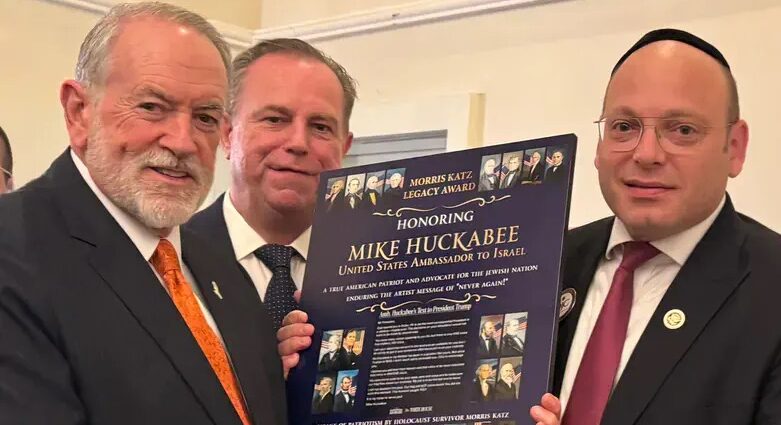
Jerusalem — U.S. Ambassador to Israel Mike Huckabee opened a speech in Jerusalem on Sunday with a joke at his own expense, telling the audience he had checked President Trump’s social media “to make sure that this isn’t my last speech.” Behind the laugh line was a serious message the ambassador has built a career on: that his commitment to Israel does not bend with the political winds, and that Trump remains firmly behind the Jewish state’s security.
Huckabee was speaking at the JNS Policy Summit, recalling that his first address as ambassador a year earlier had been at the same event. The quip nodded to a well-known feature of the Trump administration — that officials sometimes learn of their dismissal from a social media post — and to recent friction between the two men. Days earlier, Trump had claimed there would be no Israel without the United States, and Huckabee had pushed back, saying America owes its own existence to Israel.
On the substance, Huckabee sought to calm any doubts. He said Trump maintains a close relationship with Prime Minister Benjamin Netanyahu and has always called America’s bond with Israel unbreakable, adding that he trusts the president means what he says. He pointed to past Trump decisions as proof: recognizing Jerusalem as Israel’s capital, moving the U.S. embassy there, and recognizing Israeli sovereignty over the Golan Heights.
Other Israeli leaders at the summit struck the same note of resilience. Netanyahu, asked about his reported disagreements with Trump, brushed them aside, saying simply, “He is the U.S. president, I’m the Israeli prime minister.” JNS CEO Alex Traiman framed the broader moment in confident terms, noting that even as Israel manages threats from Hamas, Hezbollah and Iran, “Israel’s economy is strong, and the Jewish state is emerging as a regional superpower.”
On Iran, Huckabee said the best way to counter Tehran’s regional proxies is to cut off their funding at the source. He noted that Trump had that very afternoon sent a blunt message to Iran, warning that the United States would act militarily if Tehran believed Washington would fold. That lined up with a threat Trump posted Sunday, vowing to strike Iran again if it does not stop Iran-backed fighters in Lebanon.
The timing is what gives the reassurance its weight. Huckabee spoke as U.S. and Iranian negotiators met in Switzerland to finalize the interim deal that ended their war — an agreement Israel feels it was largely shut out of. Israeli officials have bristled at terms covering Lebanon, and renewed fighting between Israel and the Iran-backed group Hezbollah has rattled the talks. For an audience worried about being sidelined, hearing the U.S. envoy restate Washington’s commitment was the point of the speech.
The security stakes are concrete. The United States provides Israel with roughly $3.8 billion in military aid each year and has deepened cooperation through the recent war, including missile defense. America’s pledge to keep Iran from building a nuclear weapon, and to blunt its missile and proxy networks, sits at the center of Israel’s defense planning. Any sign that Washington’s resolve is softening would force Israel to weigh acting more on its own.
The economic stakes are just as real, if less visible. Israel’s economy — built on a large technology sector and heavy foreign investment — depends on a stable security picture. When investors believe the United States has Israel’s back, money flows more freely into Israeli startups, bonds, and the shekel. When that backing looks shaky, risk premiums rise, borrowing costs climb, and capital can pull back. A credible U.S. commitment also underpins the regional calm that keeps oil moving and trade routes open, from the Strait of Hormuz to the Suez Canal.
There is a bigger economic prize in the background. The administration has pushed to expand the Abraham Accords and draw Saudi Arabia into normalization with Israel, a step that could unlock major investment, trade, and energy deals across the Middle East. Those efforts rest on the perception that the United States is a reliable partner — the very perception Huckabee was working to protect.
Duvi Honig, founder and CEO of the Orthodox Jewish Chamber of Commerce, said Huckabee’s remarks carried added credibility because of the ambassador’s long record of support for Israel.
“Ambassador Huckabee has spent decades demonstrating that his support for Israel is rooted in principle, not politics,” Honig said. “He has consistently stood with the Jewish people regardless of changing political winds or personal consequences. At a time when many are questioning where U.S. policy is headed, Israelis know that Huckabee’s commitment is genuine. He has put himself out there time and again for Israel, and few American public figures have earned the level of trust and respect he enjoys among the Jewish people.”
For now, Huckabee’s message was meant to steady nerves on every front — diplomatic, military, and financial. He cast Trump as a consistent ally who has repeatedly backed Israel, even as the president pursues a deal with Iran that many Israelis distrust. Whether that reassurance holds will depend less on speeches than on what happens next in Switzerland, in Lebanon, and in the Iran talks that could still unravel.
The joke about getting fired drew laughs. The serious takeaway was that the ambassador, and the country he represents, still intend to stand with Israel — a commitment that carries weight not only for the region’s security but for its economy.
JBizNews Desk | New York
© JBizNews.com All Rights Reserved. Reproduction or distribution without written permission is prohibited.