
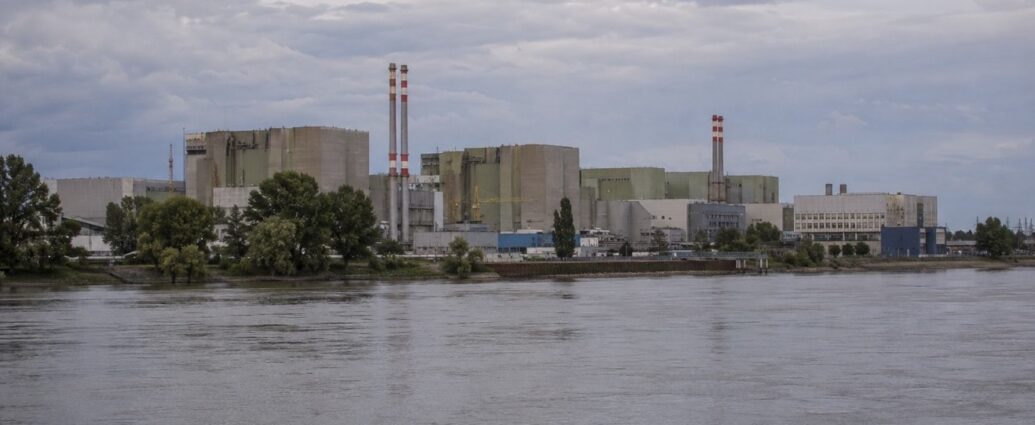
Hungary is preparing to restore more generating capacity at its Paks nuclear power plant after emergency work raised the Danube River near the facility’s cooling-water intake, easing an energy threat that had forced the country’s most important power station to operate at a fraction of its normal output.
Paks ordinarily supplies nearly half of Hungary’s electricity. But exceptionally low Danube levels caused by prolonged drought and extreme heat forced the plant to sharply reduce production, leaving only two of its eight turbines operating and cutting overall output to roughly 25% of capacity.
The government now expects the six idle turbines to begin returning gradually, with the plant potentially reaching full output later in the week if river conditions and safety requirements permit.
The recovery is not being driven by rainfall alone. Hungarian authorities used emergency engineering measures to increase the water level around the plant’s intake system by approximately 10 to 15 centimeters. The work included positioning barges in the river and beginning construction of a submerged riverbed barrier designed to hold more water upstream near the facility.
The plant’s nuclear reactors generate heat, but the Danube provides the water needed to remove excess heat and operate the electricity-producing turbines safely. When the river falls too low, the plant cannot draw enough cooling water, forcing operators to reduce or stop production even if the reactors themselves remain functional.
That distinction is important: Hungary is not restarting a reactor that failed. It is restoring electricity-generating equipment that was taken offline because the river could no longer reliably support normal cooling operations.
The disruption exposed a major weakness in Hungary’s energy system. With Paks producing nearly half the country’s power, a prolonged shutdown could increase electricity imports, raise wholesale prices and force Hungary to rely more heavily on natural gas and other fossil fuels.
Solar generation helped prevent a more serious shortage. At certain points during the nuclear reduction, solar power supplied more than half of Hungary’s electricity, providing critical daytime support. But solar production falls sharply in the evening and cannot independently replace the stable, round-the-clock electricity normally produced at Paks.
The crisis stretches beyond Hungary. Romania shut down nuclear generation at its Cernavoda plant because of low Danube water levels, while Bulgaria reduced output at its Kozloduy nuclear facility for the first time in its history for the same reason.
For European businesses and consumers, the episode demonstrates how drought can affect far more than farming and shipping. Low rivers can interrupt electricity production, increase industrial energy costs and place additional pressure on regional power markets.
Hungary’s immediate danger is easing, but the larger problem remains. If severe droughts become more frequent, countries that depend on rivers to cool nuclear and conventional power plants may need new cooling systems, greater renewable capacity and stronger cross-border electricity connections.
The Danube’s recovery is allowing Paks to return—but it has also delivered a warning about how closely Europe’s energy security is tied to its water supply.
JBizNews Desk | Budapest
© JBizNews.com All Rights Reserved. Reproduction or distribution without written permission is prohibited.




