By JBizNews Desk
May 11, 2026
Ten years ago, Nvidia was still largely viewed as a niche semiconductor company best known for building graphics cards used by gamers and cryptocurrency enthusiasts. Today it sits at the center of the artificial intelligence revolution, controls one of the most important chokepoints in global technology infrastructure, and has produced one of the most astonishing wealth-creation stories Wall Street has ever seen.
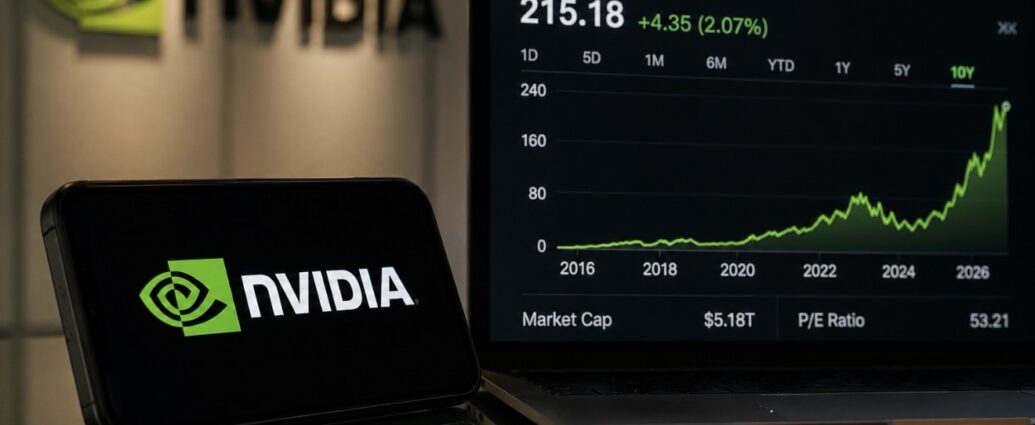
A $5,000 investment in Nvidia made in May 2016 would be worth approximately $1.24 million today, based on the stock’s roughly 24,779% total return over the past decade.
By comparison, the same $5,000 invested in the S&P 500 during that period would have grown to roughly $18,000 including dividends — a strong return by normal market standards, but barely more than 1% of what Nvidia ultimately delivered.
The numbers are almost difficult to comprehend. But they also tell a much larger story about how completely artificial intelligence has reshaped global markets, corporate spending, and investor psychology.
In 2016, Nvidia generated approximately $5 billion in annual revenue and carried a market capitalization near $17 billion. It was considered an innovative chipmaker, but still far removed from Silicon Valley’s most dominant technology giants.
Its graphics processing units, or GPUs, were primarily associated with gaming computers and advanced visual rendering. But internally, Chief Executive Officer Jensen Huang and Nvidia’s engineering teams already understood something most of Wall Street had not yet grasped: the same parallel-processing architecture that made GPUs ideal for rendering video game environments also made them uniquely suited for training artificial intelligence systems.
That realization would eventually change everything.
As large language models and generative AI systems exploded into the mainstream during the early 2020s, demand for computational power surged to levels traditional processors could no longer efficiently handle.
Nvidia’s GPUs suddenly became the essential hardware layer powering the global AI race.
Technology giants including Microsoft, Amazon, Alphabet, Meta Platforms, and Oracle began spending hundreds of billions of dollars building hyperscale AI data centers filled almost entirely with Nvidia chips.
No frontier AI model could be trained at scale without Nvidia hardware.
The financial results became historic.
In the third quarter of fiscal 2026 alone, Nvidia reported approximately $57 billion in quarterly revenue — more than the company generated during all of 2016 combined.
Operating profits surged to levels that once would have seemed impossible for a semiconductor company, while Nvidia’s market capitalization climbed to roughly $5.2 trillion, making it the most valuable publicly traded company in the world.
The rise also transformed the broader stock market itself.
Over the past several years, Nvidia became one of the single largest contributors to gains in the S&P 500 and Nasdaq Composite, helping fuel a broader AI-driven rally that pushed U.S. equity indexes repeatedly to record highs.
But the path upward was anything but smooth.
During 2022, Nvidia shares lost more than half their value as rising interest rates triggered a brutal selloff across high-growth technology stocks. At the time, many investors feared the AI trade had become dangerously overhyped.
Those who sold during the downturn locked in steep losses.
Those who held — or bought more shares while fear dominated the market — ultimately saw their investments multiply many times over in the years that followed.
That dynamic has become one of the defining lessons of Nvidia’s extraordinary decade.
The investors who generated life-changing wealth were not necessarily those who perfectly timed every market swing. More often, they were the ones who endured volatility while remaining committed to a transformational long-term trend.
Today, Nvidia trades near $215 per share, close to its all-time high of approximately $217.80 reached on May 8, 2026.
Despite the stock’s extraordinary run, many Wall Street analysts remain aggressively bullish.
The median analyst price target currently sits near $267.50, implying roughly 24% additional upside from current levels.
Some investors believe the long-term opportunity may be even larger.
Brad Gerstner, founder of Altimeter Capital, recently described Nvidia as “terribly undervalued,” arguing that markets still underestimate how much infrastructure artificial intelligence will ultimately require.
Meanwhile, Beth Kindig, lead analyst at I/O Fund, has projected Nvidia could eventually approach a market capitalization near $20 trillion if AI infrastructure spending continues accelerating globally.
Analysts at Morgan Stanley recently raised forecasts for AI-related capital expenditures among major hyperscalers including Alphabet, Amazon, Microsoft, Meta, and Oracle, projecting infrastructure spending could rise nearly 80% in 2026 alone to approximately $805 billion, with spending potentially surpassing $1.1 trillion by 2027.
Still, replicating the gains of the past decade from today’s starting point would be extraordinarily difficult.
Turning another $5,000 investment into more than $1 million again would require Nvidia’s market capitalization to expand toward roughly $130 trillion — a figure larger than the combined value of nearly every major stock market on earth today.
That is the mathematical reality of scale.
The extraordinary returns of the past decade were possible because Nvidia evolved from relative obscurity into dominance during one of the largest technological transitions in modern economic history.
That transition, by definition, can only happen once.
But Nvidia’s rise still offers a broader lesson for investors.
Every generation produces a small number of companies that quietly position themselves at the center of transformational technological shifts before the broader market fully understands what is coming.
Those opportunities are extraordinarily rare.
But for the investors who recognized Nvidia early, $5,000 proved enough to change a financial life forever.
— JBizNews Desk
© JBizNews.com. All rights reserved. This article is original reporting by JBizNews Desk. Unauthorized reproduction or redistribution is strictly prohibited.