
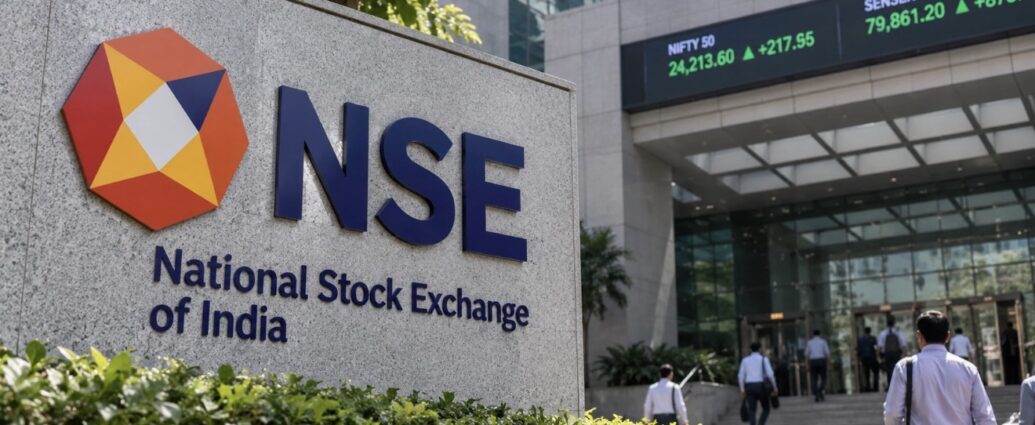
India’s National Stock Exchange has finally received regulatory clearance to move ahead with its long-awaited initial public offering, removing one of the biggest obstacles to what could become one of the country’s largest stock-market listings.
India’s market regulator, SEBI, cleared the IPO Friday after years of delays tied to legal and compliance disputes involving the exchange.
The timing is significant.
India’s Supreme Court also dismissed a major case tied to allegations that some high-frequency traders received unfair access to NSE’s systems, removing another major legal overhang as the exchange prepares to go public.
For investors, the simple story is this:
One of the most important stock exchanges in the world is finally preparing to become a publicly traded company itself.
Why NSE Matters
The National Stock Exchange is not a small regional marketplace.
It operates India’s benchmark Nifty 50 index and dominates the country’s equity-derivatives market.
By the number of derivative contracts traded, NSE is the most active derivatives exchange in the world.
That gives it a powerful position at the center of India’s rapidly expanding capital markets.
Every time investors trade stocks, futures or options through the exchange, NSE can generate revenue through transaction fees, technology services, data and other market infrastructure.
As India’s economy and investor base grow, that activity becomes increasingly valuable.
A Potential $55 Billion Company
NSE has been valued at roughly $55 billion in India’s unlisted share market.
At that valuation, it could rank among India’s ten most valuable publicly traded companies once listed.
That does not mean the IPO itself will raise $55 billion.
The offering is expected primarily to be an offer for sale, meaning existing shareholders will sell some of their stakes to public investors.
The exchange itself would not receive most of the proceeds.
But the listing would finally give investors a transparent public-market price for one of India’s most important financial institutions.
Why It Took So Long
NSE has been trying to go public for nearly a decade.
The major obstacle was regulatory controversy.
Authorities investigated whether certain high-frequency trading firms received faster or preferential access to the exchange’s trading infrastructure through systems involving co-location servers and specialized network connections.
In simple terms, regulators were examining whether some traders effectively got a technological head start over everybody else.
In markets where trades happen in fractions of a second, even tiny speed advantages can be worth enormous amounts of money.
Those allegations created years of legal battles and prevented NSE from moving forward with its listing.
The Legal Cloud Is Finally Lifting
The Supreme Court’s dismissal of the regulatory case removes a major hurdle.
NSE previously agreed in principle to pay roughly $155 million to settle outstanding issues connected to the dispute.
That allows regulators and the exchange to move toward closing a chapter that has hung over NSE since the middle of the last decade.
For investors, regulatory certainty matters almost as much as financial performance.
A company preparing for an IPO needs buyers to understand the risks they are purchasing.
A decade-old dispute involving the integrity of the exchange itself was a particularly serious problem.
Removing it makes NSE much easier to value.
India’s Capital Markets Are Becoming a Global Force
The IPO also reflects something bigger happening in India.
More Indian households are investing in stocks.
Domestic mutual funds are growing.
Foreign investors are increasingly active.
Companies are raising more money through Indian capital markets.
And India has become one of the world’s busiest IPO markets.
That creates a powerful business model for an exchange.
NSE does not have to guess which individual company will succeed.
It earns money from the infrastructure investors use to trade all of them.
The more active India’s markets become, the more valuable that infrastructure can become.
Why the IPO Could Draw Huge Interest
Stock exchanges can be unusually attractive businesses.
They often benefit from:
High margins.
Recurring trading activity.
Market-data revenue.
Technology fees.
Strong network effects.
And significant barriers to new competitors.
Once investors and brokers concentrate on one major exchange, it becomes difficult for a newcomer to recreate that liquidity.
NSE already has that scale.
That is why the IPO could attract substantial interest from domestic and international investors.
What It Means for Businesses
For Indian companies, a stronger and more transparent public exchange can deepen access to capital.
For global investors, the listing provides another way to invest directly in the growth of India’s financial markets rather than choosing individual banks, technology companies or manufacturers.
And for India itself, the IPO marks another step in the maturation of its capital-market system.
The irony is difficult to miss.
For years, millions of companies and investors have relied on NSE to buy and sell shares.
Now investors are preparing to buy shares in the exchange itself.
After nearly a decade of regulatory battles, one of the world’s busiest financial marketplaces is finally moving toward becoming a publicly traded company.
JBizNews Desk | Mumbai
© JBizNews.com All Rights Reserved. Reproduction or distribution without written permission is prohibited.




