
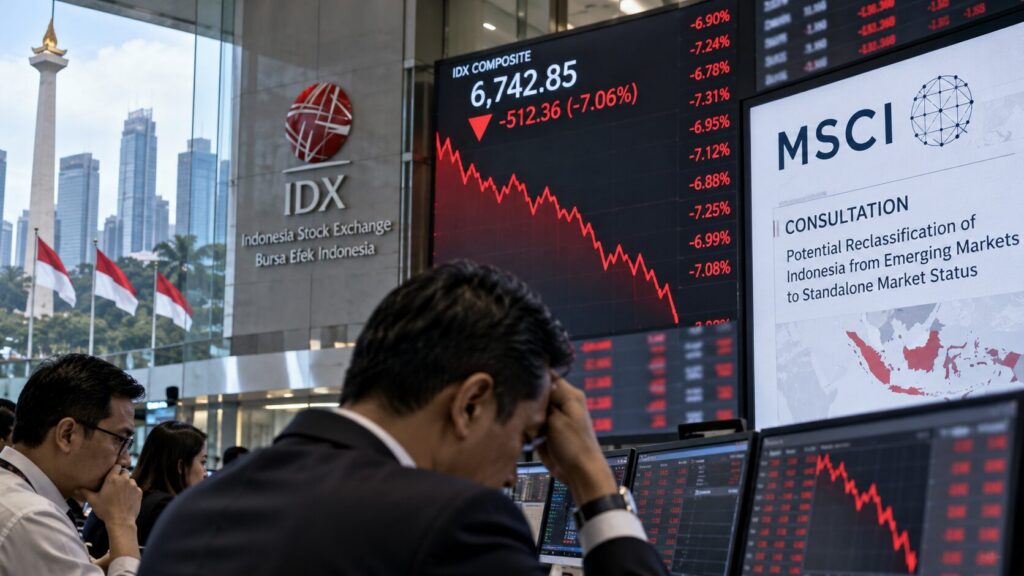
JAKARTA, Indonesia — October 16, 2026 — Indonesian stocks suffered their steepest one-day decline since the 1998 Asian financial crisis on Friday, after global index provider MSCI warned that the country could lose its emerging-market status, potentially triggering billions of dollars in foreign investment withdrawals.
The Jakarta Composite Index plunged approximately 11%, falling to its lowest level in six years. The selloff spread across banking, mining and energy stocks, while Indonesia’s rupiah weakened to around 18,070 against the U.S. dollar.
The collapse followed MSCI’s announcement that it is considering reclassifying Indonesia from an emerging market to a standalone market, a designation that could remove Indonesian stocks from major international indexes followed by institutional investors worldwide.
Why MSCI Is Threatening a Downgrade
MSCI raised serious concerns about transparency in Indonesia’s stock market, including unclear corporate ownership structures, concentrated shareholdings and suspected coordinated trading activity.
Although Indonesian regulators have announced reforms, MSCI said investors remain unconvinced that those measures have produced meaningful and sustained improvements.
The downgrade would carry major financial consequences. International investment funds that track MSCI benchmarks could be required to sell Indonesian shares if the country is removed from their indexes.
Market estimates suggest Indonesia could face as much as $19 billion in investment outflows, including approximately $4 billion from passive funds and $15 billion from actively managed investments.
A Market Already Under Pressure
Friday’s collapse adds to an already devastating year for Indonesian investors.
The country’s equity market has lost nearly 40% of its value in 2026, making it one of the world’s worst-performing stock markets.
Major companies across the financial, commodity and energy sectors were caught in the selloff, with several shares reaching exchange-imposed daily price-decline limits.
The currency’s weakness adds another concern for international investors, whose losses can increase when both stock prices and the local currency decline.
What Happens Next
MSCI has not yet made a final downgrade decision. The index provider will consult with market participants and expects to announce its determination by the end of June 2027.
Indonesia now faces pressure to demonstrate meaningful improvements in ownership disclosure, market oversight and investor protections before that decision.
A downgrade could significantly reduce the country’s access to international investment capital, increasing financing costs for Indonesian businesses and placing further pressure on the economy.
The broader concern extends beyond Friday’s market collapse. Indonesia, Southeast Asia’s largest economy, risks losing its standing among the emerging markets that attract substantial international institutional investment.
For investors, the immediate question is whether Indonesian authorities can restore confidence before a proposed reclassification becomes a financial reality.
JBizNews Desk | Jakarta, Indonesia
© 2026 JBizNews. All Rights Reserved.