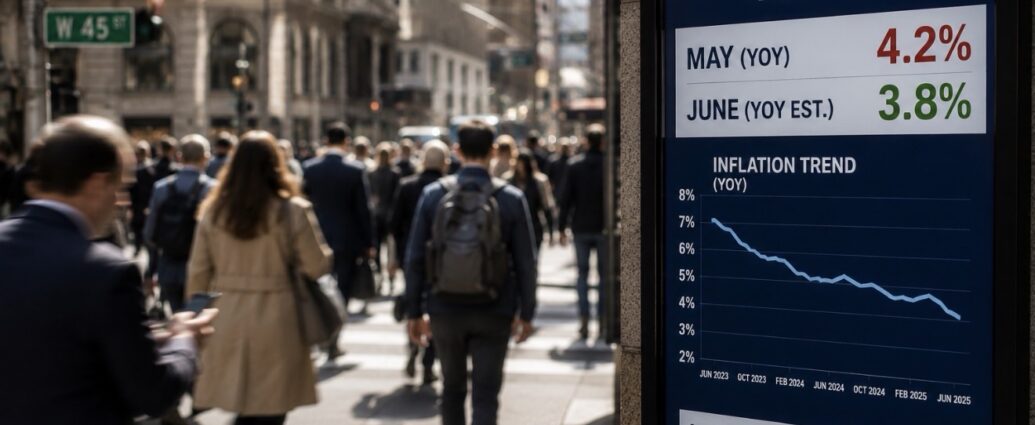
The government is set to deliver a rare piece of good news on prices this week, but economists are warning families not to get comfortable. The Bureau of Labor Statistics releases its June Consumer Price Index on Tuesday, and forecasters expect it to show consumer prices fell from the previous month — the first monthly decline in two years and only the third since the pandemic. Nearly all of that drop, analysts say, comes down to one thing: gasoline.
Prices at the pump tumbled in June after President Donald Trump signed a memorandum of understanding with Iran in mid-June, easing fears over Middle East oil supplies and sending crude sharply lower. Pooja Sriram, an economist at Barclays, forecasts headline inflation cooled to 3.8% for the year through June, down from 4.2% in May, with prices falling about 0.18% on the month, driven by an estimated 10% drop in retail gasoline. That would mark a welcome retreat from May’s reading, which at 4.2% was the highest since April 2023.
The relief, though, is narrow. Strip out volatile energy and the picture looks far less encouraging. Sriram expects core inflation, which excludes food and fuel, to have accelerated slightly to 0.26% on the month, led by rising service costs. Core inflation was already running warm before the conflict and climbed every month through May, when it hit 2.9% annually.
That distinction matters because services inflation is the stubborn kind. When the price of a haircut, a doctor’s visit, a vet appointment, or a car repair rises, it rarely falls back. Those costs tend to move in one direction, and because labor is the biggest expense for service businesses, they cool slowly. Economist Claudia Sahm has noted that businesses are also still passing along the cost of tariffs, pushing goods prices higher even as energy provides temporary cover.
There are fresh sources of pressure building, too. Memory and storage chip prices are surging as data centers absorb supply for artificial-intelligence systems, and the effects are reaching consumers. Apple recently said it would raise prices on its iPad and Mac lines, citing the climbing cost of memory chips. Abiel Reinhart, a senior economist at JPMorgan, estimates that each 10% increase in AI-related hardware costs adds roughly 0.1% to consumer inflation. Software is following: Microsoft raised personal Office 365 prices 43% in February, its first increase in a decade, after adding its Copilot AI assistant.
The report also arrives at a delicate moment for the timing of the gasoline relief. The June decline reflects a drop in oil prices that has since partly reversed. Over the weekend, Trump declared the Iran agreement effectively over and announced a renewed blockade on shipping through the Strait of Hormuz, sending crude and gasoline climbing again on Monday. That means the favorable June figures may look dated almost as soon as they are published, with July’s numbers likely to reflect the rebound.
All of it lands on the desk of the country’s new central banker. Fed Chair Kevin Warsh, sworn in on May 22, delivers his first congressional testimony this week, appearing before the House Financial Services Committee on Tuesday and the Senate Banking Committee on Wednesday. The Federal Reserve has held its benchmark rate between 3.50% and 3.75% for four straight meetings, and minutes from its June meeting showed some officials open to resuming rate hikes if inflation proves sticky. Lawmakers are expected to press Warsh on how he reads the mixed signals — cooling headline prices, warm underlying inflation, and a fresh energy shock.
For households, the practical stakes are straightforward. A softer inflation reading would ease pressure on the Fed and, eventually, on borrowing costs for mortgages, car loans, and credit cards. But a hot core figure could keep rates higher for longer and revive talk of hikes, a scenario that would raise the cost of every kind of consumer debt.
The consumer sentiment data due Friday from the University of Michigan will offer an early read on how families are absorbing all of this. For now, the message from economists is measured: enjoy the gasoline-driven dip in Tuesday’s headline number, but watch the core figure underneath it. That is where the true state of the family budget shows through — and where the relief is proving hardest to find.
JBizNews Desk | New York
© JBizNews.com All Rights Reserved. Reproduction or distribution without written permission is prohibited.