At NAIOP’s recent National Forums Symposium, held in Salt Lake City, participants stepped out of the meeting rooms and into the streets for a firsthand look at one of the city’s most significant redevelopment stories. A walking tour of the Gateway District offered commercial real estate professionals a closer view of how a legacy retail center has been repositioned into a vibrant, experience-driven mixed-use destination.
The walking tour, led by Andy Moffitt of Newmark’s Mountain West team, focused on the Gateway District, a downtown asset that has evolved well beyond its original role as a traditional retail center. Today, the district spans more than 1 million square feet and combines retail, dining, office, residential and hospitality uses into a highly walkable, transit-oriented environment that reflects how downtown Salt Lake City is continuing to change.
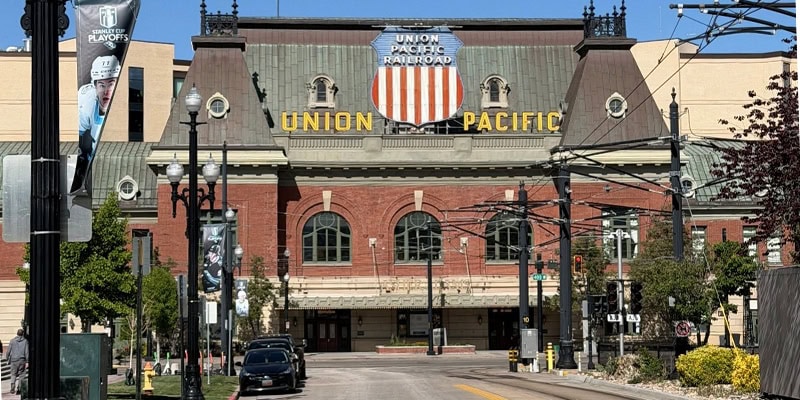
A central highlight of the tour was the adaptive reuse of the historic Union Pacific Depot, now home to the Asher Adams Hotel. Senior Group Sales Manager Olivia Ikimau led the group through the boutique hotel, which has become both an anchor and a symbol of the broader Gateway reinvention. Located at South Temple Street and 400 West, the project has brought new activity and energy to a site that carries deep historical importance for the city.
Completed in 1909, the depot served as Salt Lake City’s primary railroad station for decades and was an essential gateway to the region. Its architectural character and civic presence led to landmark designation in the early 1970s and inclusion on the National Register of Historic Places. Though restored during the Gateway’s original redevelopment in the late 1990s, the building and surrounding district struggled after the opening of City Creek Center. Retail traffic declined sharply, and the depot’s grand hall became little more than a pass-through space.
Since acquiring the Gateway in 2016, Vestar has pursued a strategy to reposition the district around entertainment, dining, creative office and experiential retail rather than traditional enclosed shopping. The Asher Adams Hotel reflects that approach, preserving the depot’s French Renaissance architectural details while giving the building a new and economically viable use. Original design elements such as arched openings, decorative pilasters, and classical moldings remain central to the space, reinforcing the project’s balance of history and modern hospitality.
The tour also placed the Gateway within the broader context of Salt Lake City’s growth. More than $10 billion have been invested across the metro area between the airport and the University of Utah in recent years. The region has added more than 10,000 housing units over the past decade, contributing to increased density shaped by geographic constraints from the lake and surrounding mountains. Infrastructure investment, downtown development and preparations for the 2034 Winter Olympics continue to drive momentum.
For the tour attendees, the Gateway District offered a clear example of how underperforming retail environments can be reimagined through thoughtful redevelopment, placemaking and adaptive reuse. The walking tour underscored that in growing urban markets like Salt Lake City, honoring historic assets while responding to changing tenant demand can create destinations that feel both rooted and forward-looking.