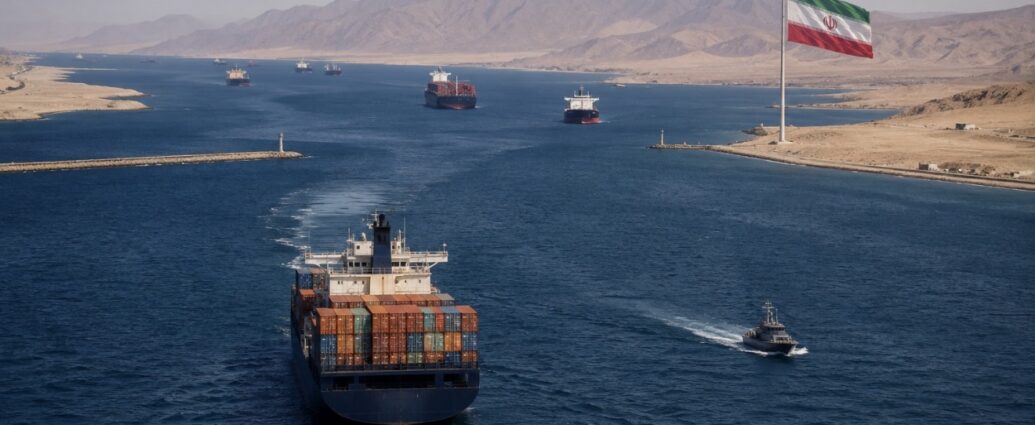
A senior member of the Houthi political bureau, Mohammed al-Farah, warned on Monday that Yemen’s armed forces are prepared to close the Bab el-Mandeb Strait — the Red Sea’s southern gateway — if Saudi Arabia keeps striking Yemeni territory, a step he said would drive crude to $200 a barrel. Al-Farah, in remarks carried by Iran’s Press TV, said that if conditions worsen, Bab el-Mandeb and the Strait of Hormuz would be shut together in what he called an operational alliance. He said Washington had erred by pushing the Saudi government toward new aggression against Yemen, tying the threat directly to Saudi airstrikes on Sanaa International Airport.
The signal matters because Hormuz is already choked off. Iran’s Islamic Revolutionary Guard Corps has declared the Gulf waterway closed until Washington halts its strikes, and tanker traffic has collapsed — fewer than twenty ships crossed on Monday. Bab el-Mandeb is the second lock on the same door. It is roughly 26 kilometers across at its narrowest, links the Red Sea to the Gulf of Aden, and carries about 12% of global maritime trade. Hormuz carries roughly a fifth of the world’s seaborne oil and gas. Iran cannot reach Bab el-Mandeb itself. The Houthis can, and have.
The price is already moving
Brent climbed to $86.35 a barrel on Tuesday, up 3.66% in a single session and up 3.82% over the past month. West Texas Intermediate opened Tuesday at $78.08, with Brent opening at $83.11 before running higher through the day. The move followed President Donald Trump’s announcement that the United States would reimpose a naval blockade on Iranian vessels using Hormuz, alongside a proposal to charge a 20% fee on other cargo moving through the chokepoint — a toll that would have run roughly $32 million for a single supertanker against the $2 million Iran previously charged. Trump dropped the toll idea within a day. OPEC cut its 2026 oil demand growth forecast to 800,000 barrels per day.
What the analysts are saying
Fawaz Gerges, a Middle East scholar, told Reuters that Tehran is prepared to go the distance, and that threatening both chokepoints at once turns a bilateral fight with Washington into a challenge against the sea lanes carrying global energy trade.
Andreas Krieg, a senior lecturer at King’s College London’s School of Security Studies, called the Houthi threat a second break-glass option for Iran after Hormuz — one Tehran would use only if the IRGC concluded that full-scale war had become unavoidable. He cautioned that deeper American strikes on Iranian infrastructure could trigger exactly that, stacking a Red Sea shutdown on top of the damage Hormuz has already done.
Abdulaziz Sager, chairman of the Gulf Research Center, said Gulf governments increasingly believe diplomacy with Tehran has run out of room. He added that both a victorious Iran and a defeated Iran carry costs for the region, and that many Gulf states may find the second more tolerable. Sager said the Houthis retain the capability to disrupt Bab el-Mandeb but are unlikely to move without direction from Tehran — and that any attempt would likely draw a heavy U.S. response aimed at degrading the group. Dennis Ross, a former U.S. Middle East negotiator, framed Washington’s problem as changing Iran’s calculus enough to produce not just talks but a workable arrangement.
The cost already built into cargo
Businesses do not have to wait for a formal closure. The Red Sea has been functionally expensive for two years. Oil moving through Bab el-Mandeb fell from 8.8 million barrels a day to roughly 4 million during the Houthi campaign, and about $1 trillion in goods normally passes through the corridor each year. The U.S. Defense Intelligence Agency found the attacks cut Red Sea container traffic by 90% between December 2023 and February 2024, affecting 29 energy and shipping companies across 65 countries and adding roughly 11,000 nautical miles, ten days, and about $1 million in fuel to every diverted voyage.
Most major carriers — Maersk, Hapag-Lloyd, MSC, and CMA CGM — still route the bulk of Asia-to-Europe traffic around the Cape of Good Hope, adding 10 to 14 days and a 25% to 30% premium. Suez Canal throughput remains down 50% to 60% from 2024 levels. A war-risk endorsement for Red Sea transit runs 0.5% to 1.0% of cargo value, and the Red Sea premium alone adds $800 to $1,500 to a 40-foot container moving from China to the U.S. East Coast.
The timing is unkind. The Suez Canal Authority’s new temporary surcharges take effect Wednesday, raising crude tanker fees from 25% to 37% and more than doubling dry bulk surcharges from 10% to 22%. Carriers will not absorb that. It arrives on shippers’ invoices as war-risk and peak-season surcharges.
For American importers, distributors, and small manufacturers, the exposure is fuel and freight. Every dollar Brent gains feeds bunker costs, which reprice into ocean rates within days through bunker adjustment factors. Diesel follows crude, and diesel sets the floor under trucking, food distribution, and construction. A second closed chokepoint would not stay a Middle East story. It would show up in landed cost, pump prices, and fourth-quarter margins.
Whether the order comes from Tehran is now the only question that matters.
JBizNews Desk | New York
© JBizNews.com All Rights Reserved. Reproduction or distribution without written permission is prohibited.