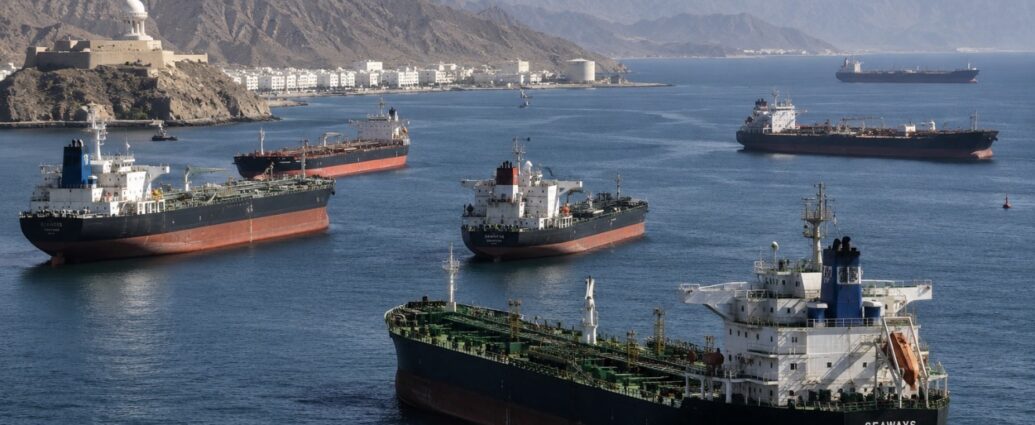
AP Photo: Oil tankers and cargo vessels wait at anchor near the Strait of Hormuz off the coast of Oman as commercial shipping cautiously resumes through one of the world’s busiest energy corridors.
A cargo vessel transiting the Strait of Hormuz was struck on its starboard side near Dahit, Oman, on Thursday evening, according to an advisory issued by the United Kingdom Maritime Trade Operations (UKMTO), which said the impact damaged the ship’s bridge but caused no casualties or pollution. A U.S. official confirmed to CBS News that Iran’s Islamic Revolutionary Guard Corps was responsible for the attack on the Singapore-flagged vessel, while two separate U.S. officials confirmed the incident to Reuters. The strike came just as commercial shipping had begun cautiously returning to the world’s most important oil chokepoint.
Energy markets reacted immediately. West Texas Intermediate crude reversed earlier losses to settle more than 2% higher at $71.92 per barrel, while Brent crude climbed 2.1% to $75.26. Oil had traded lower for much of the day amid optimism that shipping traffic was finally normalizing. According to shipping intelligence firm Kpler, more than 20 oil tankers carrying approximately 35 million barrels of crude have successfully passed through the strait since the United States and Iran agreed to reopen the vital waterway. Many of those shipments had remained stranded inside the Persian Gulf for more than three months.
The latest attack immediately disrupted an international maritime evacuation effort. The International Maritime Organization (IMO) announced it was temporarily suspending its coordinated evacuation framework after the vessel involved in Thursday’s incident was attacked outside the designated protection program. IMO Secretary-General Arsenio Dominguez said the organization would halt further evacuations until authorities gain greater clarity regarding the security situation. The evacuation effort had been launched only days earlier to help thousands of mariners aboard hundreds of vessels safely exit the region.
At the center of the dispute remains disagreement over approved shipping routes. The United States has encouraged vessels to follow a southern corridor hugging Oman’s coastline, while Iran continues insisting that ships obtain permission from Tehran and transit along routes closer to the Iranian coast. Following Thursday’s attack, Iran’s Persian Gulf Strait Authority warned that vessels operating outside its designated framework would not qualify for safe-passage guarantees or insurance protections, language closely watched by global shipping companies and marine insurers.
The incident also tests the fragile ceasefire framework currently governing navigation through the Strait of Hormuz. Under the existing 60-day memorandum of understanding, Iran agreed not to impose transit fees during the temporary reopening period. Before conflict disrupted shipping earlier this year, roughly 20% of the world’s oil supply passed through the narrow waterway. Separately on Thursday, The Wall Street Journal reported that Iran is seeking to generate billions of dollars by charging ships for security, environmental, and navigation services—a proposal that both President Donald Trump and Secretary of State Marco Rubio have publicly rejected.
Despite the latest attack, several major shipping companies continue cautiously resuming operations. A Liberian-flagged oil tanker successfully completed its transit Thursday using the southern route near Oman, while Maersk confirmed that two of its vessels safely exited the Persian Gulf overnight in coordination with international security partners. Other global carriers, including Hapag-Lloyd and CMA CGM, have also gradually resumed operations after months of delays caused by regional instability.
Many energy analysts continue to believe the long-term outlook for oil remains relatively stable despite Thursday’s price spike. Citi said a broader de-escalation remains its base-case scenario and expects Brent crude to decline toward $60 to $65 per barrel over the next six to twelve months as shipping volumes normalize. Even so, the geopolitical risk premium remains significant. Iran’s Islamic Revolutionary Guard Corps Navy reiterated Thursday that vessels failing to comply with Tehran’s navigation instructions could face enforcement action.
Speaking during meetings with Gulf foreign ministers in Bahrain, Secretary of State Marco Rubio adopted a measured tone, saying the United States expects commercial shipping to continue moving safely through the Strait of Hormuz and would judge Iran based on its actions rather than its public statements. “If ships are moving as they should be moving, then that’s what we’re going to judge,” Rubio told reporters.
For businesses, the implications extend well beyond oil prices. Every disruption in the Strait of Hormuz affects global freight costs, marine insurance premiums, energy markets, and supply chains that depend on uninterrupted shipments of crude oil and refined petroleum products. Thursday’s attack serves as another reminder that even modest security incidents in the narrow waterway can quickly ripple through global financial markets and international commerce.
JBizNews Desk
New York
© JBizNews.com All Rights Reserved. Reproduction or distribution without written permission is prohibited.