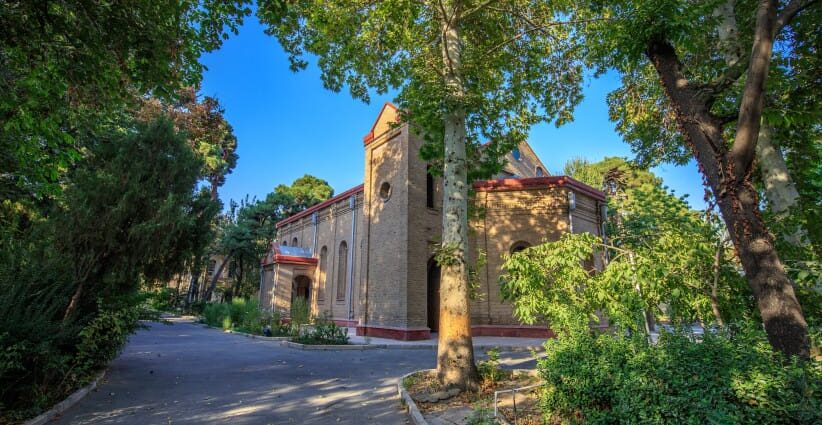
Iran has threatened to confiscate the historic compound of the Saint Peter Evangelical Church, also known as Qavam Church, in Tehran and evict the 20 families residing there, international media reported on Wednesday.
“Six security forces went into the church and sat through a session, saying they wanted to ‘identify’ people,” Sasan Tavassoli, a US-based minister with the Presbyterian Church in Iran, told the Iranian diaspora site Iran International. “They said they’ll return later to evacuate those living on the premises and take over.”
“I will tell you the literal words they used,” Tavassoli told The Free Press. “We were concerned about America all these years. America came. They slapped us on the face. We slapped them on the face back. And then America withdrew. So we are no longer afraid of America.”
Authorities have reportedly already seized a 10,000-square-meter garden belonging to the church, which is said to be occupied by four IRGC officials under a newly issued deed in their names. Church officials and members have also reportedly been told they will be considered trespassers if they enter the space.
Tavassoli told the site that the central property is worth “tens of millions of dollars.”
The reported seizure of the church would fit a broader pattern of repression targeting Iran’s Christian minority, according to experts who spoke with The Jerusalem Post.
Christian converts rising in Iran
Beni Sabti, an Iran expert and researcher at INSS, explained that there are a number of reports indicating that there was a rise in Christian conversion in Iran, although official figures would not be published by the Islamic regime, leading Iran to take its frustrations out on “the roots” of Christianity.
“There are many reports from private eyes that much more people are converting to Christianity, especially to Protestant versions, and trying to get out of Iran by that excuse, and also just running away, escaping this ideology and Islam. Even if they stay in Iran, they want some kind of better life in their values, so they convert much more in recent years,” Sabti explained.
After the mass killing of protesters in January and the war with the US and Israel in recent months, Sabti said that the regime was “very worried” that conversions would continue to rise, which is why there have been more arrests of Christian converts as of late.
“I think they wanted to go to the roots [of Christian life in Iran], and that’s why they began to hurt the church. It has stood there many years, even before the revolution. Of course, no one can establish a new church in Iran since the revolution began, nor a Sunni mosque, nor a synagogue, and now they plan to confiscate it,” Sabti continued. “Every time that the Iran regime does such a thing is because they are afraid and worried.”
The church has served Iran’s small protestant community since it was founded by American missionaries in 1876, on land granted by Naser al-Din Shah Qajar.
Iran no longer afraid of international community
Though Sabti said he thought that the seizure was a sign that the Islamic regime felt threatened, a letter signed by Sargez Benyamin, the Executive Secretary of the Synod of the Evangelical Church of Iran in Diaspora, suggested the very opposite, as did Tavassoli.
“The regime is no longer afraid of the international community,” the letter read, citing the recent discussions and concessions that came as part of the MoU between Tehran and Washington.
“It is clear that without a swift response to this crisis, we may be deprived of our last remaining church centers in the country,” the letter read, demanding international action to stop “the ongoing process of expelling Christians from their places of worship and the occupation and destruction of these properties.”
In early June, the World Communion of Reformed Churches warned that a church in Mashhad was seized and demolished on the orders of the Islamic regime.
Benyami said the Mashhad church’s property had been the subject of a long dispute with the Execution of Imam Khomeini’s Order (EIKO), also known as Setad, and the Islamic Revolutionary Court recently saw the order executed, despite earlier assurances from local governors and parliamentary representatives.
Under Article 49 of the Islamic Republic’s constitution, the regime claimed the right to seize abandoned wealth following the Islamic Revolution in 1979. Some estimates suggest that only 50% of the properties and assets seized belonged to Muslim Iranians who moved abroad, meaning the large majority of the remaining wealth was likely stolen from political dissidents and ethnic and religious minorities.