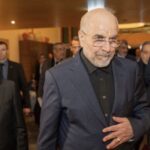
Legal proceedings have been initiated, and media officials have tendered their resignations after a hardline Iranian lawmaker appeared to publicly disclose private correspondence indicating Mojtaba Khamenei’s opposition to the terms of the memorandum of understanding with Washington, according to Iranian media reports.
Mahmoud Nabavian, a member of parliament’s National Security and Foreign Policy Committee, told the state-run Khabar Network that in correspondence dated April 5, April 19, and May 24, Khamenei voiced clear opposition to any MoU that didn’t recognize the Islamic Republic’s right to enrich uranium.
Khamenei also allegedly said that Iran would be responsible for managing the Strait of Hormuz, denying even shared control with Oman despite talks between the two countries’ foreign ministries on the issue.
“What has taken shape in the Pakistan negotiations is fundamentally different from what was supposed to happen and from what constituted the condition for the legitimacy of the negotiations,” he claimed.
Khamenei’s conditions for Iran-US negotiations
Nabavian claimed that Khamenei had set 11 conditions for the continuation of Iran-US negotiations, including preserving the right to enrich uranium, lifting sanctions, releasing Iran’s frozen assets, receiving compensation from the US, and exercising full sovereignty over the Strait of Hormuz.
امروز در شبکه خبر در مورد چرایی مخالفت رهبری با تفاهم یادداشت ایران و آمریکا مشغول بیان دیدگاه رهبری بودم که به صورت ناقص رها شد. بخش مهم آن بررسی متن یادداشت تفاهم بود که علت مخالفت رهبری را بیشتر آشکار می کرده است. انشاالله خداوند ما را در پیروی از رهبری عزیز ثابت قدم نگهدارد.
— سیدمحمود نبویان (@nabaviantwt) June 20, 2026
Khamenei also allegedly asserted that negotiations on the nuclear issue could not begin until the US concedes that the Islamic regime has a right to continue enriching uranium.
Saeed Ajorloo, an Iranian political analyst central to the ongoing negotiations, claimed that Nabavian sent a distorted version of the texts, omitting the 17 other letters allegedly penned by Khamenei.
Such terms, Nabavian noted, were incompatible with the current talks, and thus against the wishes of the supreme leader.
Nabavian’s remarks were quickly cut off by the Iranian Broadcasting Corporation. The corporation’s public relations department also announced that it would pursue legal action against Nabavian, claiming that the publication of incomplete state documents violated the law.
In a statement, the department said the news network “expresses regret over this guest’s disregard for the rules of live broadcasting, accepts the resignation of the relevant director general of the network and will take the necessary disciplinary action for negligence in professional management.”
In an absolutely ridiculous move, IRIB (Iranian state TV) announces it will sue Iranian MP Mahmoud Nabavian @nabaviantwt for criticizing the negotiatiors on state TV, accusing him of making ‘distorted statements about classified documents and high-level correspondence’
Nabavian… https://t.co/ZsSSJeDNkz pic.twitter.com/5lCRaucua2
— Arya Yadeghaar (Backup) (@AryJeayBackup) June 20, 2026
Nabavian stated he was ‘expressing the Leader’s perspective’
Despite the legal implications, Nabavian asserted on X/Twitter after the interview that he was “expressing the Leader’s perspective on why he opposes the Iran-America memorandum of understanding when it was left incomplete. The important part of it was the examination of the memorandum’s text, which would have made the reason for the Leader’s opposition even clearer. Inshallah, may God keep us steadfast in following our dear Leader.”
Elmira Sharifi, an Iranian Broadcasting Corporation (IRCC) anchor, responded: “Revealing the country’s confidential and classified letters is a violation of the law! The representative of the legislative branch does not respect the law and causes trouble and embarrassment for others.”
Member of Parliament Mojtaba Zarei also criticized Nabavian on Telegram, complaining that Nabavian had threatened the civil order in Iran with his need to prove himself right.
While IRIB has deleted the interview, it is still notably available on the IRGC-affiliated Fars News Agency.
Fars reported, “For the first time, Nabavian is revealing important details of the revolutionary leaders’ orders to the negotiating team, which it is essential for all people to take the time to watch these few minutes to understand why the revolutionary leader revealed in his recent message to the people that he had a different opinion, but because of the insistence of the officials, he issued a permit for the initial understanding with the United States.”
Security expert Roger Macmillan told The Jerusalem Post that the incident reflects a bigger issue than just a “hardliner’s outburst,” claiming it was a “rare public glimpse into a regime negotiating with itself as much as with Washington.”
Beyond displaying fractures in the regime’s ranks, the fact that a sitting member of the negotiating delegation breached Iran’s national security by sharing Khamenei’s classified correspondence, “accusing the team of breaching explicit red lines,” shows that the system is not “speaking with one voice.”