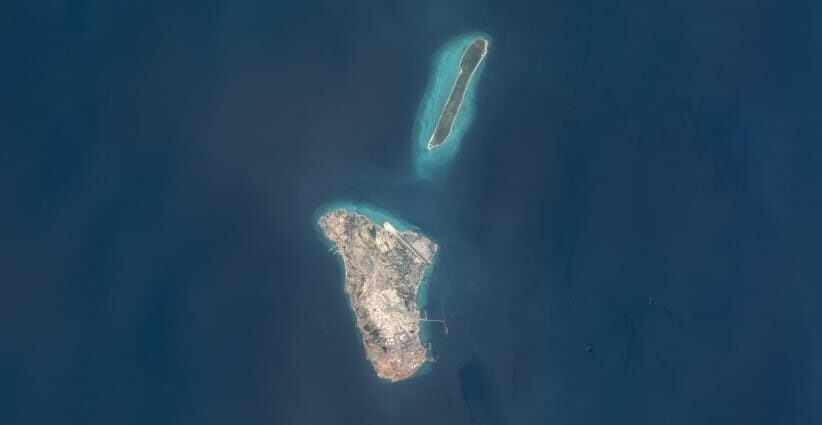
A nearly 30-year-old oil tanker, Nasha, is being used by Iran to store approximately two million barrels of oil off the coast of Kharg Island as the US naval blockade entered its fourth week, according to a report from United Against Nuclear Iran (UANI).
Satellite imagery and tracking data from Vortexa revealed that the Iranian-flagged supertanker Nasha has been re-mobilized to store oil off the coast of Kharg Island in the Persian Gulf. The Very Large Crude Carrier (VLCC) was built in 1996 and had not been used for nearly three years; its location and utility during that time were unknown, according to UANI.
According to a Bloomberg analysis, the commission of this nearly 30-year-old vessel suggested that Iran’s energy sector and oil storage capacity were facing a crisis, as the US Navy continues to block the passage of tankers carrying Iranian oil out of the Gulf.
As the blockade continues, Iran’s crude oil storage capacity is reportedly running low, forcing it to begin storing crude oil offshore in tankers like Nasha to keep wells and pipelines operational, the Center on Global Energy Policy (CGEP) reported.
“Reactivating vessels like this can help Iran in the short run, but the fundamental problem of the US blockade still exists as they struggle to bring in the ballast vessels,” said Xavier Tang, a senior market analyst at Vortexa. “The bigger question is perhaps when they will slow down their crude production.”
Simultaneously, US President Donald Trump reinforced his commitment to maintaining the blockade until Iran was willing to agree to his demands.
“It’s not acceptable to me. I’ve studied it, I’ve studied everything, it’s not acceptable,” President Trump told KAN News in a phone interview. “The Iranians want to make a deal, but I’m not satisfied with what they’ve offered,” he said, adding, “There are things I can’t agree to.”
CENTCOM: 20 Iranian tankers in Gulf of Oman
US Central Command (CENTCOM) reported on April 28 that a cluster of 20 oil-laden supertankers was huddled off an Iranian port on the Gulf of Oman, up from an average of just five before the blockade began. Furthermore, satellite images from the previous week showed 13 tankers anchored east of Kharg Island, roughly double the number seen the day before the April 13 blockade began.
Inbound traffic into the Persian Gulf via the Strait of Hormuz has remained near zero since the implementation of the blockade, as the US has continued to double down on its enforcement measures in the Strait.
“They better get smart soon! NO MORE MR. NICE GUY!” Trump said in a post on Truth Social.
Iranian crude oil extraction continues even as its storage capacity reaches its limits. Analysts at World Energy News highlighted that mature fields, such as those in Iran, face significant risks of “water coning” or chemical blockages (asphaltenes) if flow is stopped abruptly.
“The risk remains that if a well stays shut too long, the precipitation of asphaltenes-heavy complex hydrocarbons can solidify and block wells and pipelines permanently,” Antoine Halff, a senior research scholar at CGEP, noted.
Restarting these wells after a forced shut-in could take months and cost millions of dollars, risking permanent damage to the reservoirs that account for nearly 10% of Iran’s total GDP, according to the CGEP.
Remobilizing Nasha and other vessels like it could buy Iran some time in negotiations, as its storage capacity reached a breaking point, according to Bloomberg.