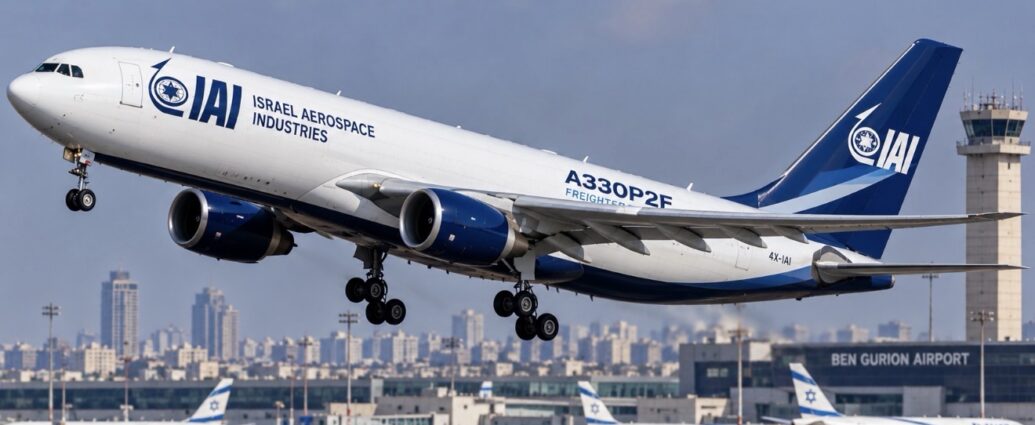
Israel Aerospace Industries has completed the maiden flight of its first converted Airbus A330-300 freighter, marking a major milestone in the company’s push to expand deeper into the global air-cargo market.
The aircraft began life as a passenger jet.
IAI has now converted it into a dedicated freighter capable of carrying up to 61 tons of cargo and accommodating as many as 30 cargo containers.
That turns an older passenger aircraft into a new commercial asset instead of sending it toward retirement.
Why This Matters
Passenger-to-freighter conversions have become a major business for airlines and aircraft lessors.
A new cargo aircraft can cost tens of millions of dollars.
Converting an existing passenger jet can be significantly cheaper.
The economics are straightforward.
An airline or leasing company takes an aircraft that may no longer be attractive for passenger service, removes the cabin interior, reinforces the floor, modifies the structure, installs a large cargo door and converts the aircraft for freight operations.
That can add many more years of useful service.
For aircraft owners, it can dramatically increase the value of an aging jet.
IAI Is Already a Major Player
Israel Aerospace Industries has decades of experience converting passenger aircraft into freighters.
Its work has historically centered heavily on Boeing aircraft, including widebody platforms used by cargo operators around the world.
The A330 program changes that.
IAI is now positioning itself as one of the relatively few aerospace companies capable of converting both Airbus and Boeing widebody aircraft.
That gives it access to a much larger pool of aircraft.
Thousands of Airbus A330s have been delivered worldwide.
As passenger versions age, many will eventually become candidates for conversion.
The A330 Is Well Suited for Cargo
The Airbus A330 is already widely used by passenger airlines.
It has strong range, a large fuselage and relatively efficient operating economics.
The converted A330-300 is aimed primarily at regional and medium-haul freight operations.
Its capacity of up to 61 tons gives operators a middle ground between smaller narrowbody freighters and much larger long-haul cargo aircraft.
That can make it attractive for routes where airlines need significant capacity but do not need the size of a Boeing 747 freighter.
The Maiden Flight Is Only One Step
The successful flight does not mean the aircraft is ready for commercial service tomorrow.
The program still has to complete flight testing and regulatory certification.
That process is designed to prove that the structural modifications, cargo systems and aircraft performance meet aviation-safety standards.
Once certification is completed, IAI can begin delivering converted aircraft to customers.
That is when the program moves from engineering project to revenue-generating business.
Why Air Cargo Still Matters
The air-freight market experienced extraordinary demand during the pandemic, when passenger flights collapsed and companies struggled to move goods.
Demand has since normalized.
But long-term structural drivers remain.
E-commerce continues to grow.
Pharmaceuticals rely heavily on air cargo.
Semiconductors, electronics, automotive parts and high-value industrial components often need rapid transportation.
Supply-chain disruptions also remind companies that speed can sometimes be worth paying for.
That keeps freighter aircraft strategically important even when the broader shipping market slows.
There Is Also a Huge Aircraft-Supply Opportunity
Many older passenger jets are reaching the point where airlines have to decide what to do with them.
They can sell them.
Store them.
Scrap them.
Or convert them.
For aircraft leasing companies, conversion can be particularly attractive.
A plane that has become less valuable in passenger service can potentially earn revenue for many additional years carrying freight.
That creates business for conversion specialists such as IAI.
What It Means for Israel
This is also an important aerospace-export story.
IAI is one of Israel’s largest industrial and defense companies.
Commercial aircraft conversion gives it a revenue stream outside traditional military systems.
The company sells engineering expertise to global airlines, lessors and cargo operators.
That means the value created in Israel is exported around the world.
It also strengthens Israel’s position in a highly specialized corner of the global aerospace industry where only a limited number of companies have the technical capability and regulatory experience to compete.
What It Means for Businesses
For cargo airlines and aircraft owners, the A330 conversion offers another option for adding capacity without purchasing a brand-new freighter.
For IAI, it expands the addressable market dramatically.
For the aerospace industry, it reinforces a broader trend:
Older passenger aircraft are increasingly being viewed not as obsolete assets, but as raw material for the next generation of cargo fleets.
The first flight is therefore about more than one aircraft.
It is proof that IAI’s Airbus conversion program has moved from the drawing board into the air.
If certification proceeds as planned, that could open a significant new commercial market for the Israeli aerospace company.
JBizNews Desk | Tel Aviv
© JBizNews.com All Rights Reserved. Reproduction or distribution without written permission is prohibited.