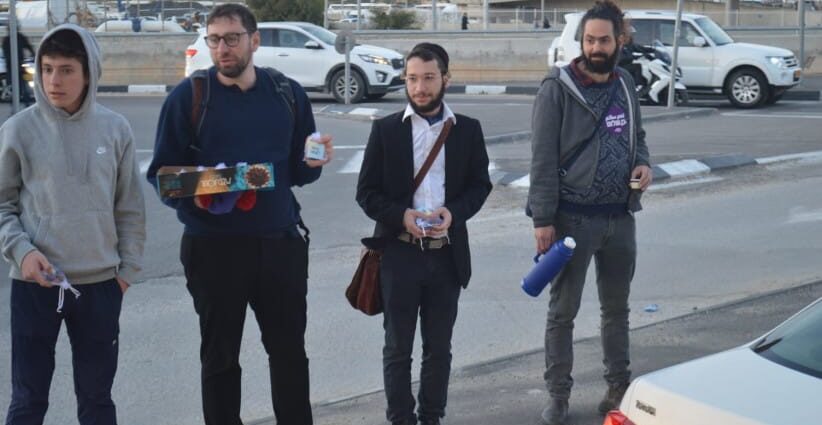
Israel’s Population Authority (PIBA) has revoked the aliyah approval of two Jewish activists in their 20s, both active in pro-Palestine advocacy in the West Bank.
This was first reported by Ha’aretz on Monday, but The Jerusalem Post spoke with one of the individuals – British national Lawrence Shenkin – who said the details of the report are correct. The story of the other individual – an American woman – mirrors Shenkin’s.
These are believed to be the first known cases where halakhic Jews without criminal records have been denied the right to immigrate to Israel.
Shenkin grew up in a Modern Orthodox family in Golders Green. He was raised Zionist and has already lived in Israel for five years.
He moved to Israel at 18 to attend yeshiva, intending the stay and live in the country permanently. During this time, Shenkin joined the left-wing religious organization Bnei Avraham in 2023. As such, he has been involved in protecting Palestinian communities in the West Bank from alleged Israeli settler harassment.
In November 2025, on the cusp of finishing his university studies, he started the process of Aliyah.
He submitted all his files to PIBA and, in January, received an email saying, “Due to a change in the circumstances of your case, your ETA has been revoked.” In lieu of citizenship, an ETA is required to enter Israel.
Shenkin said he didn’t think much of it, assuming the ETA revocation was a simple response to his Aliyah.
However, months went by, and he still hadn’t heard any update on his Aliyah.
He then traveled to the UK to visit his family for Passover, and applied for a new ETA to return, which was again denied.
“I couldn’t really think of what was happening,” Shenkin told the Post. “Friends then told me that lots of left-wing activists have had their ETAs denied and had their ETAs revoked and that maybe it was related to that.”
He decided to stay in the UK and finish his Aliyah from there. In July, he received an email from the Jewish Agency congratulating him on his successful Aliyah.
Peace activists’ aliyah denied over ‘Section 40’
“I was elated. I sent my passport to the consulate to receive the visa because that’s what they said to do. “About three weeks later, I got an email from the Jewish Agency saying, ‘Based on information received from the Population and Immigration Authority, and in accordance with Section 40 of the Entry into Israel Law, the approval of your eligibility for aliyah is currently under review by the Authority and is temporarily revoked.”
Shenkin’s lawyer said there is no Section 40 of the Entry into Israel Law. There is an amendment 40, which denies entry to people who denied October 7th or who call for the prosecution of Israeli soldiers, which Shenkin has not done.
“I was quite offended at the notion that it could be me. I’ve never done something like that ever at all,” he told the Post.
Shenkin’s lawyer informed him that Israel could not legally deny him Aliyah, given he is halachically Jewish, and has “never committed a crime.”
“I don’t know under what grounds they denied me.”
“I’ve been torn away from my homeland, which I love and whose welfare I’m only looking to contribute to. Israel is truly one of my greatest loves.”
Shenkin describes himself as a “very passionate religious Zionist.”
“I believe that, you know, there’s a mitzvah to be living in the land of Israel,” he said.
He, however, also believes that it is his religious duty to protect Palestinians from “settler violence” and “ethnic cleansing.”
He cited the Torah as commanding Jews to care for the welfare of the ger and the toshav.
“This is a Torah commandment, and the people who are committing this violence, often they’re wearing kippot and tzitzit and peyot; they are committing horrific acts that bring a terrible name onto Israel and onto my community of religious Zionists.”
Advocacy with Bnei Avraham
This informs much of his advocacy with Bnei Avraham.
“We’re a religious Jewish organization interested in creating a positive relationship between Palestinian communities and the religious Jewish community in Israel and in trying to prevent settler violence against Palestinians,” he said. I have been active with the group since late 2023, early 2024.”
“In 2025, our focus was on two villages that we had a connection with in the South Jordan Valley, Ras Ein al-Auja and Mu’arrajat. We would regularly go to these villages. And when settlers would come there, we went in principle, our hope was we were going to spend time with our friends who live in this village. These two villages no longer exist because they were ethnically cleansed as a result of settler violence. Every time we went every day, they suffered some kind of incident interaction with hilltop youth where they would get harassed, we would get harassed.”
“Violent incidents are very common. And so we would go because we wanted to stand in solidarity with them. And also we felt that as Israelis, oftentimes the police took us more seriously than they would take the Palestinians.”
He claimed that neither he nor anyone in Bnei Avraham “has ever been involved in a violent incident in the West Bank or a criminal incident in the West Bank of any type.”
“We are very careful about obeying the law and being respectful human beings,” he added.
When pressed by the Post on whether this activism and rhetoric may fuel the fire of anti-Israel hate and misconceptions around all settlers being violent, Shenkin said that idea is a “misrepresentation.”
“We were in the Palestinian village of Ras al-Ain. Okay. Where people not from that village came to invade private property and harass the people who lived on that property. These are people who have come and established an outpost with the goal of expelling the people there, explicitly the goal of coming to expel the people there. That is what they pursued and did.”
“If the state of Israel believes that non-criminal activity–activity that is in line with the biblical Torah commandments of caring for the welfare of non-Jews in the land of Israel–doing that in a way in a pacifistic way that does not involve violence, if they believe that–it is a serious offense that denies a person the rights that are codified in the Torah.”
“If that’s the case, it’s a total outrage, and that’s why this is a big story.”
Shenkin hopes that with public interest in the story it will be resolved.
“What’s happening here is anti-Zionist. After all, the whole promise of Israel is that any Jew can move there simply because they’re Jewish. And now there’s this new idea that you have to support a certain agenda, or else we don’t want you.”
PIBA told the Post that “The requests have been received and are being reviewed individually on their own merits. There is no freeze whatsoever.”
The Jerusalem Post was unable to reach the Jewish Agency for comment; however, the organization told Ha’aretz: “The Population and Immigration Authority is the government body responsible for implementing the Law of Return. In light of this, and for reasons of privacy, we cannot comment on the details of the cases.”