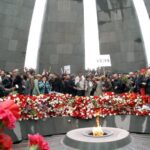
The Israeli government’s recognition of the Armenian Genocide has generated mixed reactions in the public sphere around the world and in Armenia itself.
Some have welcomed the decision, while others have argued that a government itself widely accused of committing crimes against humanity in Gaza lacks the moral authority to recognize another people’s genocide, suggesting that Israel is even exploiting the issue for gain.
While I understand the criticism, it rests on a fundamentally flawed understanding of geopolitics.
States do not recognize genocides because they have suddenly discovered a moral conscience. They do so when it aligns with their political, strategic, diplomatic, or domestic interests.
International relations have never been governed by moral idealism but by realpolitik. If morality were the driving force behind statecraft, genocides would not have occurred in the first place, nor would governments have ignored or enabled them whenever it suited their interests.
The notion that recognition of the Armenian Genocide is – or has ever been – a purely moral act is a comforting illusion.
Most states that have recognized the Armenian Genocide have not done so solely out of moral conviction, without domestic lobbying, geopolitical calculations, electoral considerations, or strategic interests.
Every recognition has taken place within a political context. Israel is no exception, and that does not detract from finally doing the right thing.
It is also important to note that while successive Israeli governments refused to recognize the genocide for decades, it was the Armenian National Committee of Jerusalem (ANCJ), together with several Israeli scholars and public figures and academic organizations such as the Zoryan Institute, that sustained the campaign for recognition.
They devoted a huge effort to educating Israeli society, lobbying decision-makers, and ensuring that the Armenian Genocide did not disappear from the Israeli national conversation.
Considering that, the Israeli government should, as part of the recognition, also have taken concrete steps to address the terrible conditions faced by the Armenian community in east Jerusalem.
Its several thousand members continue to experience discrimination and harassment from ultra-nationalist Jewish groups. Incidents such as spitting on clergy, verbal abuse, and the desecration of sacred sites have become part of the daily reality for many Armenians.
The climate of impunity surrounding these acts has turned such groups into an existential threat to the Armenian community of Jerusalem.
This raises an important question: recognition without meaningful measures to protect a vulnerable minority is little more than ink on paper. This pattern has been evident in many cases of genocide recognition.
Genocide acknowledgment without a genuine commitment to prevention is ultimately of limited value.
Recognition must go hand-in-hand with action
Israel was directly or indirectly complicit in the ethnic cleansing of the Armenians of Artsakh (known in Israel and elsewhere as Nagorno-Karabakh) through its extensive military cooperation with Azerbaijan.
Some estimates suggest that Israel supplied approximately 70% of Azerbaijan’s arms imports between 2016 and 2020. Haaretz, for example, reported that 92 Azerbaijani military cargo flights landed at Israel’s Ovda Air Base between 2016 and 2020.
During this period, Azerbaijan acquired a wide range of Israeli military equipment, including intelligence-gathering drones, Hermes UAVs, Harop loitering munitions (“kamikaze drones”), Spike anti-tank missiles, ATMOS self-propelled artillery systems, Cardom mortars, Barak air defense missiles, Searcher and Heron drones, naval patrol vessels, and Typhoon weapon stations.
Equally troubling is the fact that many states that formally recognized the Armenian Genocide failed to take meaningful measures to prevent the ethnic cleansing of Artsakh.
Despite their official recognition of the genocide of 1915, they did not impose significant sanctions on Azerbaijan or take other effective steps to deter the forced displacement of the Armenian population.
As a result, Armenians were uprooted from their historical homeland in Artsakh and continued to witness the destruction of their cultural heritage in territories they inhabited for centuries, all in full view of states that had previously acknowledged the Armenian Genocide.
This raises a fundamental question: What is the value of genocide recognition if it is not accompanied by a commitment to prevent similar crimes against vulnerable communities?
Since the 19th century, the Armenian question has too often become a pawn in international politics, with the so-called “civilized world” invoking it selectively to advance geopolitical interests rather than consistently defending the rights and security of the Armenian people.
Recognition, if it is to have genuine moral significance, must be accompanied by concrete action to prevent persecution, protect vulnerable populations, and uphold international law.
The writer was born and raised in the Old City of Jerusalem. A Guggenheim Fellow, he is professor of Modern Middle East history and Hymen Rosenberg Professor in Judaic Studies at the University of Nebraska, Lincoln.