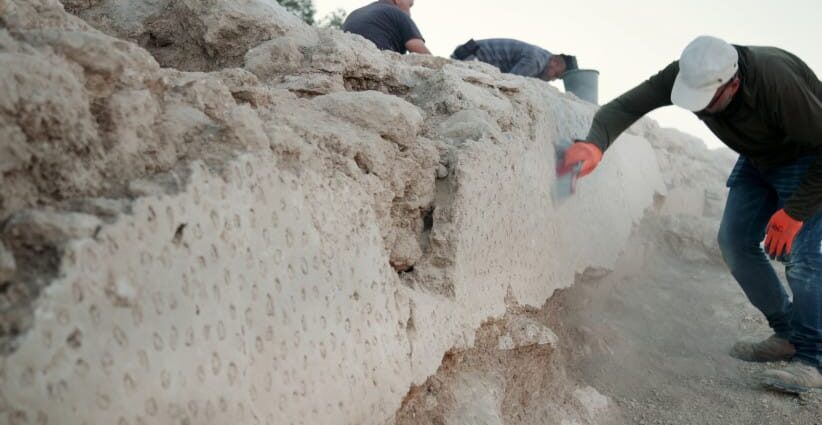
A 300-meter-long section of Jerusalem’s Lower Aqueduct, originally constructed in the Hasmonean period, was recently unearthed south of Kibbutz Ramat Rachel, near the capital, the Israel Antiquities Authority (IAA) announced on Sunday.
The aqueduct was part of a sophisticated ancient water system that carried spring water from the Gush Etzion area to the Temple Mount in Jerusalem through Solomon’s Pools.
Hasmonean architects designed the aqueduct so water could flow by gravity alone, adapting the route to move smoothly across hills and bedrock. They installed cleanout points along the system, providing access to the channel for blockages or routine maintenance.
“The Lower Aqueduct was an impressive engineering project, probably built in the time of the Hasmonean kings to supply water to Jerusalem, explained IAA Excavation Directors Dr. Benyamin Storchan and Gil Freid. “The system was so well planned that it remained in intermittent use until about 100 years ago.”
“The aqueduct runs about 21 km from Solomon’s Pools, south of Bethlehem, to Jerusalem. Along most of the route, the water flowed along a very gentle gradient, dropping just one meter in elevation per kilometer.”
Section exposes ancient water system’s history
The newly exposed section, located in an area slated by the Israel Land Authority for a new neighborhood, reveals several stages in the water system’s history.
Initially, the water flowed through a built and plastered channel. However, about 500 years ago, during the Ottoman period, they installed ceramic pipes within the original aqueduct.
At the same time, the outer wall was plastered, and small stones were pressed into it while the plaster was still wet, creating a distinctive surface that accompanied the aqueduct along its route.
These repairs reflect the aqueduct’s importance and the ongoing effort to maintain Jerusalem’s water supply.
“The aqueduct is an engineering marvel. Even today, with all our modern technology, building such a system would require extensive planning and effort,” said Dr. Amit Re’em, IAA Jerusalem district archaeologist. “The thought that about 2,000 years ago they managed to bring water to Jerusalem this way is astonishing, and we want the public to be able to appreciate this achievement up close.”
“The dream and vision of the Israel Antiquities Authority is to create a continuous park that will allow people to walk alongside the aqueduct from southern Jerusalem to the Old City, and we are already advancing this initiative together with the Jerusalem Municipality and other partners.”
Aqueduct to be incorporated into new neighborhood
The ILA and the IAA are planning to preserve the aqueduct and incorporate it into the main entrance of the new neighborhood.
According to Yehuda Eliyahu, acting director of the ILA, “The spectacular discovery of the ancient aqueduct in the heart of the area planned for the new neighborhood in Jerusalem reminds us that we are continuing a glorious chain of generations of building and development.”
“The Israel Land Authority is pleased to lead extensive modern development while showing national responsibility and carefully safeguarding our historical heritage assets,” Eliyahu said. “Integrating the aqueduct into the entrance of the new neighborhood will give residents and visitors a direct connection to Jerusalem’s rich history and to the deep bond of the people of Israel with its eternal capital.”
Heritage Minister Amichai Eliyahu echoed the sentiment, adding that “The aqueduct, whose construction is attributed to the days of the Hasmonean kings, tells of a leadership that knew how to think ahead: to expand Jerusalem’s capacity to absorb residents, pilgrims, and public life around the Temple.”
“Integrating the aqueduct into the new neighborhood today continues this story: the city is growing, and we are glad that its integration into the new neighborhood will allow future generations to get to know this heritage up close.”
The research on Jerusalem’s Lower Aqueduct will be presented at the 19th “New Studies in the Archaeology of Jerusalem and Its Region” conference, held in Jerusalem and Tel Aviv and initiated by the Israel Antiquities Authority, Tel Aviv University, the Hebrew University, and Tagliyot – Israel Institute of Archaeology.