The Ashkelon Magistrate’s Court on Tuesday extended the detention of two foreign activists taken into Israeli custody after Israel intercepted a Gaza-bound flotilla, allowing authorities to continue questioning them until Sunday morning.
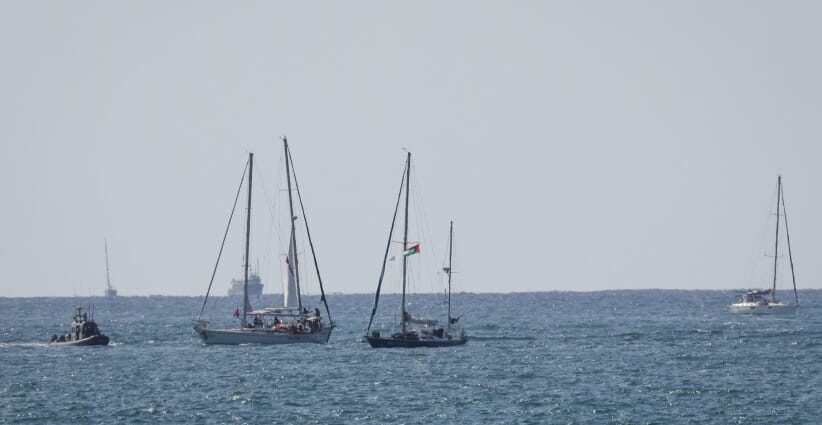
Spanish national Saif Abu Keshek and Brazilian activist Thiago Avila were among the activists aboard the Global Sumud Flotilla, which set sail last week in an attempt to break Israel’s naval blockade of Gaza and deliver humanitarian aid. Israeli forces intercepted the flotilla near Crete last week, hundreds of nautical miles away from Israel. Most of the activists were later released in Greece, while Abu Keshek and Avila were brought to Israel for questioning.
On Tuesday, police said the suspicions against the two included aiding the enemy during wartime, contact with a foreign agent, contact with terrorist elements, and additional terrorism-related offenses.
Police said suspicions had not changed since the previous remand hearing on Sunday, but argued that the investigation had progressed. In both hearings, the police representative claimed that the activists had linked themselves to an organization “recognized as a terrorist organization.”
The organization in question is the PCPA, or Popular Conference for Palestinians Abroad, a Palestinian diaspora organization that Israel and the US have accused of acting as a Hamas front. The US Treasury sanctioned the group in January, saying it was part of a covert Hamas-linked support network. The organization has denied the allegation.
Both men are on a hunger strike
In Avila’s hearing, police said the alleged “means” provided to a terrorist organization were the flotilla itself and identified the alleged foreign agent as Hamas. The state argued that Abu Keshek and Avila were detained, unlike most of the other flotilla activists, because they were “dominant” figures in the flotilla and because there was raw material raising suspicion against them.
Attorneys Hadeel Abu Salih and Lubna Tuma of Adalah, representing the two activists, argued that both men had cooperated with investigators and answered questions. They said the case amounted to an attempt to criminalize humanitarian aid and raised serious questions over Israel’s authority to arrest and investigate foreign nationals intercepted far from its shores.
The lawyers also told the court that the activists were being held in isolation, moved while blindfolded, and kept in cells with the light on around the clock. In Avila’s hearing, the defense also alleged that authorities had threatened him in an attempt to pressure him psychologically. Israeli authorities have denied allegations of torture or abuse.
Judge Yaniv Ben-Harush accepted the state’s request in both cases after reviewing the investigation files and classified material submitted to the court. He ruled that there was reasonable suspicion against the two, adding that the suspicions were not limited to the flotilla itself and appeared to extend to alleged activity beyond this specific incident.
The judge also accepted the state’s argument that some investigative actions could be disrupted if the activists were released.
Ben-Harush rejected, at this stage, the defense’s argument that Israel lacked authority because the alleged offenses took place outside Israeli territory. He ruled that, because the suspicions involved security offenses, they fall under the provisions governing extraterritorial offenses.
The court ordered Abu Keshek and Avila to be held until May 10 at 9 a.m. The judge also noted the defense’s statement that both men are on hunger strike, saying the Israel Prison Service should monitor their medical condition.
Adalah said that it would appeal the decision to the District Court, arguing that no indictment has been filed and that the continued detention is for interrogation purposes only.
The Foreign Ministry has accused the two men of links to the PCPA. Spain has rejected the accusation against Abu Keshek and demanded his release.
The case comes amid renewed international scrutiny of Israel’s handling of flotilla efforts to reach Gaza. Israel says the naval blockade is lawful and necessary to prevent weapons from reaching Hamas, while flotilla organizers and several foreign governments have argued that the interception in international waters was illegal.
A 2011 UN inquiry into the Mavi Marmara flotilla found Israel’s naval blockade to be a legitimate security measure, though UN human rights experts later disputed that conclusion, saying that the blockade amounted to collective punishment.