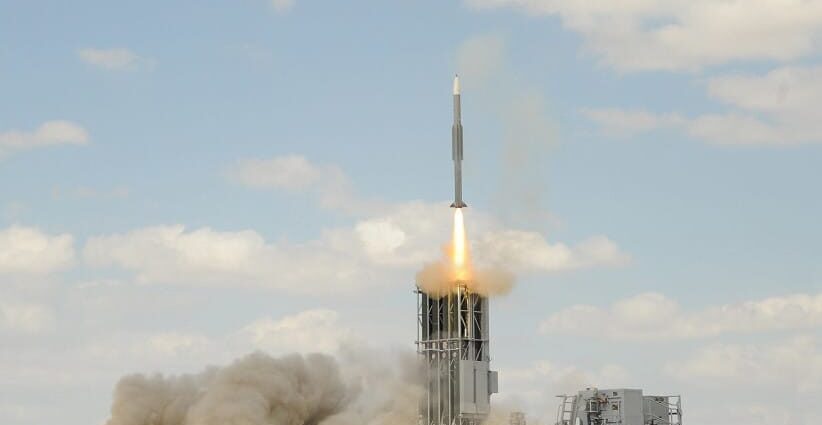
Israel Aerospace Industries (IAI), Elbit Systems, and other Israeli defense companies are heading to Morocco’s Marrakesh Air Show next month with a broad portfolio of air-defense, precision-strike, unmanned, and space technologies, as the Jewish state seeks to deepen its position in a market long served by French and US defense companies.
Defense & Tech by The Jerusalem Post has confirmed that IAI, Elbit Systems, Rafael Advanced Defense Systems, Xtend, Shilat, Uvision, and Orbit Technologies will be officially participating for the first time in the Moroccan exhibition, which will take place October 7-10 at the Royal Moroccan Air Force base in Marrakesh.
At the airshow, IAI will showcase its Barak air-defense solution, LORA precision-strike system, Heron MK II unmanned aircraft, OPAL collaborative-combat technology, and communications satellites. The company will also promote its aircraft conversion and maintenance capabilities. IAI said it will also use the exhibition to pursue local cooperation, industrial collaboration, knowledge sharing and technology transfer with Moroccan and regional partners.
Elbit Systems will exhibit its PULS multiple rocket launcher, Lizard modular precision guidance kits, SPECTRO advanced, multi-spectral electro-optical (EO) payload system, and several families of drones including the Hermes 900 unmanned aerial system, TerminaTHOR tactical airdrop munition system, the THOR tactical multi-purpose UAS, and others.
It has not been shared what the other defense companies will exhibit.
Rapid expansion
Morocco has had close economic, diplomatic, and military ties with Israel for years, and in 2020, Jerusalem and Rabat reestablished ties under the Abraham Accords.
A year later, the two countries signed a memorandum of understanding (MOU) surrounding arms deals, intelligence cooperation, and joint military projects. The North African kingdom has since signed several deals with Israeli defense companies as it has significantly increased its defense budget over the past year. This increase is part of the country’s effort to modernize its military and build a domestic military industry to reduce its reliance on foreign imports.
In January, the two countries signed a joint military work plan for 2026 and agreed to upgrade diplomatic ties last week.
For IAI, Morocco is already a major customer. The company signed a $500 million deal with Morocco for the Barak MX air-defense system, adding a major Israeli layer to the kingdom’s air-defense architecture. The system was jointly developed in close collaboration between India’s Defense Research and Development Organization (DRDO) and IAI’s RAFAEL ELTA Systems.
The versatile system can fire three types of missiles from the same vertical launcher, including the Barak MRAD for short-to-medium range of up to 35 kilometers, the Barak LRAD of up to 70 km., and the Barak ER, which can reach targets up to 150 km.
IAI has also been linked to a much larger space deal. In 2024, the company disclosed a $1 billion contract with an unnamed customer to be executed over five years. While neither IAI nor Marrakesh commented on the report, Reuters said at the time that Moroccan media had identified Morocco as the customer for an Ofek 13 reconnaissance satellite, which would replace Morocco’s existing satellites supplied by France’s Airbus and Thales.
IAI’s Moroccan footprint has also expanded through BlueBird Aero Systems, its unmanned-systems subsidiary. In 2025, the company opened a factory to produce SpyX loitering munitions, the first time advanced Israeli drone technology will be produced locally in North Africa.
The plant in Benslimane, Morocco, will focus on producing SpyX drones, which are lightweight, portable loitering munitions designed for precision strikes. With an endurance of two hours and a range of 50 km., these drones can carry a variety of warheads of up to 2.5 kilograms and enable tactical teams to detect, confirm, and strike targets.
Rabat has also purchased Elbit Systems’ ATMOS Howitzer and Elbit’s EXTRA rockets (cost-effective, precise, and with a range of up to 150 km. and an accuracy of 10 meters CEP), among others.
In addition to IAI’s Barak system, Rafael’s Spyder surface-to-air missile system has been deployed to the Sidi Yahia El Gharb military base outside of the capital.
The French connection
The deals between Israel and Morocco – as well as the strong Israeli presence at the Marrakesh Air Show – illustrate the scale of the competition now emerging between Israeli and French defense industries.
France remains deeply embedded in Morocco’s aerospace and defense ecosystem, with French companies, including Airbus, Thales, Safran, and Dassault, having long supplied the kingdom. But Israeli companies are now moving into the market as Morocco expands its requirements.
The companies set to display in Marrakesh also reflect where Morocco’s defense requirements are moving. Alongside traditional aerospace products, the Israeli companies are showcasing integrated air defense, long-range precision strike, unmanned systems, collaborative combat, and space-based capabilities.
The Israeli push in Morocco comes against a complicated backdrop in relations between the Israeli defense industry and France. French authorities excluded Israeli defense companies from the 2024 Eurosatory exhibition and 2025 Paris Airshow. The French Defence Ministry publicly said that conditions were not appropriate for their participation due to the war in Gaza and Lebanon, though Israeli officials criticized the move and blamed it on competition.
The same Israeli companies blocked from exhibiting their systems in France are now preparing to display many of the same categories of capabilities at the Marrakesh airshow, this time geared toward a market where French companies remain major players and where Israeli companies will not be blocked by large black walls like in Paris.