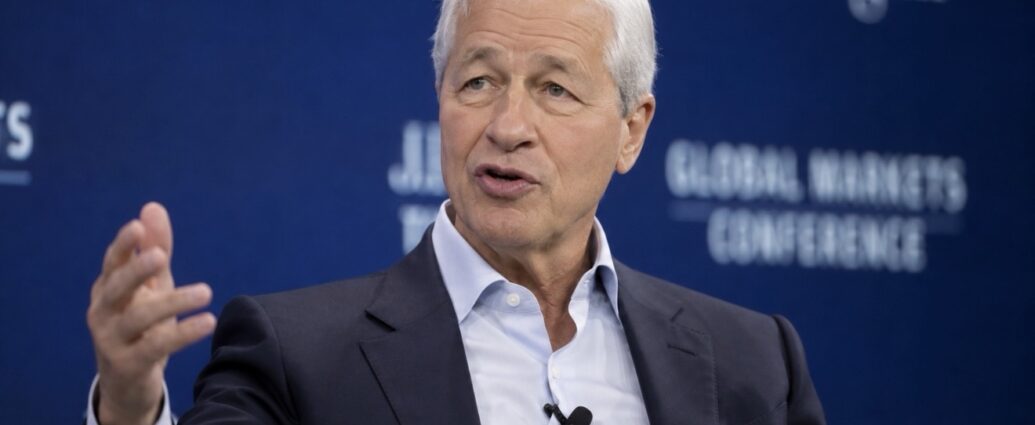
JPMorgan Chase & Co. Chief Executive Jamie Dimon warned Tuesday that the economic risks surrounding the Iran conflict are intensifying even as investors continue pouring money into risk assets, cautioning that Wall Street may be underestimating the combined threat posed by inflation, geopolitical instability, and energy disruption.
Speaking on Bloomberg Television shortly after the release of a hotter-than-expected April inflation report, Dimon said the Middle East crisis “gets a little more serious every day,” while also warning that there is “a little too much exuberance” in financial markets despite mounting macroeconomic risks.
The remarks came just hours after the Bureau of Labor Statistics reported that the Consumer Price Index rose 3.8% year-over-year in April — the highest inflation reading since May 2023 — reigniting fears that the Federal Reserve may be forced to hold interest rates elevated far longer than investors had expected.
Dimon suggested markets may be making a dangerous assumption that the geopolitical crisis will resolve quickly.
“There is a little too much exuberance,” Dimon said, warning that investors appear to be overlooking persistent inflation pressures and broader geopolitical threats while continuing to push equities toward record territory.
The comments landed against a backdrop of escalating global uncertainty.
Despite an April ceasefire effort brokered through Pakistan, tensions involving Iran remain unresolved, with the Strait of Hormuz still operating under severe restrictions following the ongoing U.S. naval blockade and broader regional instability. Oil prices climbed sharply again Tuesday morning, with WTI crude trading above $102 a barrel and Brent crude surpassing $103.
Dimon said the economic consequences of the conflict have so far been partially offset by major shifts in global oil flows.
According to the JPMorgan chief, China has reduced crude demand by roughly 5 million barrels per day, while the United States has simultaneously increased exports by approximately 3 million barrels daily, easing some immediate supply pressure despite the ongoing disruptions in the Gulf region.
Still, Dimon warned the broader inflationary backdrop remains deeply concerning.
He pointed to what he described as inflationary fiscal stimulus from Washington, including hundreds of billions of dollars in additional federal spending under the One Big Beautiful Bill Act, alongside surging gasoline and transportation costs flowing through the economy.
The combination, he suggested, could keep inflation structurally elevated even if oil prices eventually stabilize.
His comments closely align with the increasingly hawkish shift emerging across Wall Street.
Earlier this week, Bank of America pushed its forecast for the Federal Reserve’s next rate cut to July 2027, while traders in futures and prediction markets have begun assigning growing probabilities to the possibility of future rate hikes rather than cuts.
Dimon’s warning also highlighted the widening divide developing inside the U.S. economy.
He described the financial position of higher-income households as relatively strong, noting that wealthier Americans continue benefiting from rising home prices, strong employment, and healthy investment portfolios.
At the same time, he acknowledged that lower-income households are increasingly strained by rising living costs.
“The top 50% have money, jobs, and rising home prices,” Dimon said, while adding that the bottom portion of the economy remains under growing financial pressure even though employment conditions have so far remained stable.
The latest inflation data showed energy and food prices continuing to disproportionately impact lower-income consumers, widening affordability pressures across key household categories.
Dimon also addressed artificial intelligence, describing AI as a transformative force likely to reshape nearly every sector of the global economy.
He compared the technology’s long-term significance to electricity, the internet, and the industrial revolution itself.
But he warned that AI is simultaneously intensifying cybersecurity risks across the financial system.
“Cyber is our biggest risk,” Dimon said, cautioning that AI-driven attacks could dramatically increase threats facing banks, corporations, and critical infrastructure.
The warning carries particular weight given JPMorgan’s position at the center of the global financial system.
As the largest U.S. bank by assets, the firm has direct exposure to corporate lending, consumer credit, capital markets activity, and energy-sector financing — all areas now heavily influenced by inflation and geopolitical instability.
Markets reacted quickly to the broader risk concerns.
The S&P 500 fell 0.60% Tuesday morning to 7,368.53, while the Nasdaq Composite dropped nearly 1%. The Cboe Volatility Index (VIX) rose to 18.72, and the 10-year Treasury yield climbed to 4.43% as investors reassessed the likelihood of prolonged higher interest rates.
The debate now unfolding across Wall Street has become increasingly stark.
On one side, firms including JPMorgan Private Bank continue arguing that the AI-driven investment boom and resilient consumer demand could power markets higher for years.
On the other, Dimon himself is warning that inflation, geopolitics, and energy disruption may be creating a far more fragile environment beneath the surface.
Which outlook ultimately proves correct may determine not only the path of markets in 2026 — but the next direction of Federal Reserve policy itself.
JBizNews Desk
© JBizNews.com. All rights reserved.