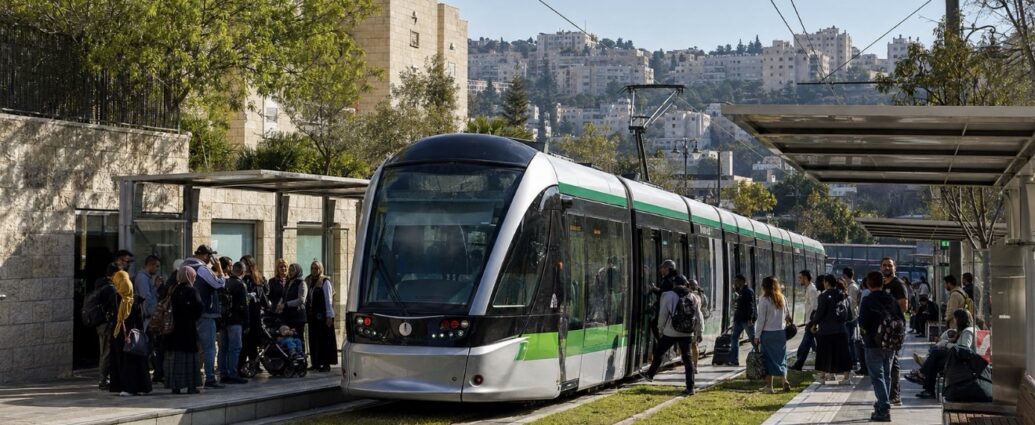
Jerusalem will begin operating its second light rail line Friday, becoming the first Israeli city to move from a single rail route to an interconnected urban network.
The first section of the Green Line, designated L3, runs approximately seven kilometers, or 4.3 miles, between HaTurim—near Mahaneh Yehuda—and Malha in southern Jerusalem. It includes 13 stations, 12 of them new, with trains expected every eight minutes during peak periods.
The practical change is larger than the distance suggests. Until now, Jerusalem’s light rail functioned primarily as one long corridor: the Red Line connecting Neveh Ya’acov in northern Jerusalem with Hadassah Ein Kerem Medical Center in the southwest. L3 gives passengers a second direction of travel and creates transfer points between separate rail services.
That moves Jerusalem ahead of the Tel Aviv metropolitan area, whose Red Line remains its only operating light rail route.
“This is a historic day for the capital and great news for Jerusalem residents and visitors,” Mayor Moshe Lion said. “This is a giant step in the transition from a city that has a light rail to a city with a light rail network.”
The new route connects some of Jerusalem’s most concentrated centers of employment, government, education and recreation. Stops serve the International Convention Center, the government complex, Hebrew University’s Givat Ram campus, its high-tech park, the Botanical Gardens, Teddy Stadium, Pais Arena and Malha Mall.
It also reaches the Givat Mordechai, Pat, Gonenim and Malha neighborhoods.
For a worker or student, the difference is not simply having a train nearby. It is being able to move between neighborhoods, Israel Railways, city buses and the existing Red Line without completing the entire journey by car.
L3 connects with the Red Line at HaTurim and again near the Central Bus Station and International Convention Center, behind Yitzhak Navon railway station. That second connection allows passengers arriving in Jerusalem by intercity train to transfer directly toward Givat Ram, Malha and the city’s sports district.
The sports connection has an immediate consumer effect. Visitors arriving from outside Jerusalem for soccer games at Teddy Stadium or basketball events at Pais Arena can now use Israel Railways and the light rail instead of driving into Malha and searching for parking.
That option will exist only on weekdays. Like the Red Line and most public transportation in Israel, the new service will not operate on Shabbat. People attending Saturday events will still need private transportation.
Friday’s opening is not the completion of the Green Line. It is the first operational segment of a much larger system that has been delayed by the war and is now scheduled to open in stages.
The next major step is expected in December, when the L4 service is scheduled to connect the Central Bus Station with Gilo, Jerusalem’s largest neighborhood, home to more than 100,000 residents. That will give Gilo passengers faster access to Givat Ram and the Navon railway station.
The route is then expected to reach Hebrew University’s Mount Scopus campus in June 2027, passing through French Hill and the area near Israel Police national headquarters. A separate branch serving Givat Shaul and Har Nof is planned for the end of 2027.
Jerusalem is also building the Blue Line, which is intended to connect Gilo with the city center, Har Hotzvim and Ramot during the next phase of the network’s expansion.
The larger economic effect will depend on whether passengers actually leave their cars. Jerusalem’s narrow roads and mountainous geography leave little room to keep widening streets. A functioning rail network can move more people through the same corridor while reducing the time businesses, employees and delivery vehicles lose to congestion.
The first seven kilometers will not solve that problem. They do, however, change the structure of the system. Jerusalem no longer has one train running across the city. It now has the beginning of a network—and every extension that follows will make the lines already operating more useful.
JBizNews Desk | Jerusalem
© JBizNews.com All Rights Reserved. Reproduction or distribution without written permission is prohibited.