At the Jerusalem Prayer Breakfast (JPB), the language of prayer now carries the weight of politics, war, and fear—and Albert Veksler speaks with a sense of urgency in his voice. One moment, he is talking about Iran and the longed-for freedom of its people; the next, he is warning that antisemitism has become so normalized that many now treat attacks on Jews as “understandable.” For Veksler, who leads the JPB, the spiritual and the political do not merely overlap. They are already living in the same room.
That tension runs through everything Veksler describes: a conference built around prayer but shaped by war, a global Christian network mobilizing around Israel, and a world in which support and hostility alike are becoming more organized. Turning first to Iran and the question of Reza Pahlavi, Veksler makes clear that his concern is larger than any one political figure. “It’s not just Pahlavi, it’s the Iranian people,” he says.
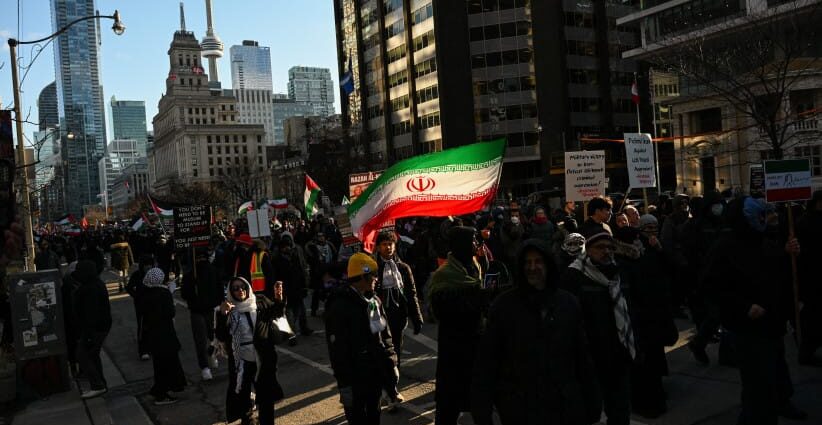
Pressed on Iran and the prospects for Reza Pahlavi, Veksler leaves little doubt about where he stands. Reflecting on his last interview with The Media Line in January 2026, when he said that he was praying for regime change, he says the people of Iran are “absolutely, absolutely worthy of this change,” and after 47 years under what he calls an “Islamic terror regime,” he believes freedom will come. He still sees a future role for Pahlavi, insisting, “I think they will be free,” and adding, “I believe it’s going to happen.”
But it is antisemitism that seems to most sharply animate his sense of danger. In response to a question about how rising anti-Jewish hostility is affecting both Jewish communities and his work around the world, Veksler argues that something deeper has shifted in public culture. “It’s normal to hate the Jews,” he says, describing what he sees as a frightening change not only among enemies, but among people once assumed to be friends in North America and Europe.
For him, the most chilling development is not simply the existence of hatred, but its social normalization. He returns several times to the idea that attacks on Jews are increasingly being treated as regrettable but somehow explicable. “These attacks are understandable,” he says, repeating the word with disbelief as he remembers attacks on synagogues in the United States and Canada. From there, his warning grows darker: “the only thing that is going to happen next is that these people will get in power.”
Canada reflects both solidarity and fear for Jews
Turning to what he had seen on his recent travels, Veksler points to Canada as one place where both solidarity and fear are now visible at once. He recounts a successful event there attended by about 10 members of Parliament, which he presents as evidence of real support for Israel and the Jewish people. Yet he pairs that with a story from Rabbi Idan Scher of Ottawa about his young son, who was shaken after their car was pelted with stones and left wondering whether wearing a kippah in public might put his life at risk. “The little boy is thinking in terms of, how do I stay alive?” Veksler says, before broadening the point with a terse reference to “Mamdani’s New York” as another sign, in his view, of how hostile the climate has become.
That anecdote leads him to a much larger appeal, especially to Christians. He argues that churches must now consider what moral courage would look like in a period of escalating danger, citing figures such as Corrie ten Boom and Raoul Wallenberg as examples of people who acted when others stayed silent. In his view, one crucial difference from those times is that many Christians today have rediscovered the Jewish roots of their faith and can no longer claim distance from the Jewish story. “There is no Christianity without Judaism,” he says.
Veksler’s appeal to Christians is also larger in scale than a passing call for solidarity. He speaks of “millions of Christians, if not hundreds of millions of Christians” who have come to recognize those roots, and says they should now “be activated, should be mobilized, should take their place.” He argues that churches in the United States and Europe may yet be called on to help protect Jewish communities and “bring the Jewish people back home.”
Pressed on where this hatred is coming from and what the antidote might be, Veksler argues not for retreat but for countermobilization. He says antisemitic ideas are spreading through social media and through a roster of high-profile voices who have, in his view, “been able to grasp the minds of the young people,” specifically naming Tucker Carlson, Candace Owens, and Nicholas Fuentes. The response, he argues, cannot be limited to denunciation. “There has to be another alternative,” he says. “There has to be another narrative. There has to be another story.”
That alternative, as he sees it, must be built across families, schools, churches, youth groups, and online spaces. Hatred may begin in the home or classroom, he says, but so can resistance to it. “The only way to survive in this is to make a strong bet on our friends,” he says, arguing that Israel must strengthen those allies rather than retreat into isolation.
Israel, in his view, should not surrender its identity under pressure. “We are still the light to the world,” he says. “We are still the startup nation.” In a world he describes as “this sea of hatred,” he argues that the task is not merely survival, but the ability to “thrive.”
Invited to explain what the Jerusalem Prayer Breakfast actually is, Veksler is careful to note that the name can mislead people unfamiliar with the event, because what sounds like a ceremonial breakfast is in fact a three-day gathering mixing education, politics, testimony, music, and public solidarity with Israel. Participants this year, he says, will hear from wounded Israeli veterans from Beit Halochem, speakers working on Holocaust memory projects, and figures including Mike Evans, Sharren Haskel, Yossi Dagan, and Billy Brim, along with a rabbi from Kentucky offering a blessing.
He also emphasizes the event’s international character. According to Veksler, people are expected from Canada, the United States, the Baltic states, Sweden, South Africa, Russia, Ukraine, and elsewhere, with roughly 300 attendees from around 40 nations despite severe travel obstacles. He also expects the event’s online reach to far exceed its in-person numbers, saying that when the concert takes place, “hundreds of thousands of people will view us all around the world.”
Travel warnings complicate Jerusalem conference plans
Even so, getting people to Jerusalem has become an ordeal in itself. Veksler says some Scandinavians, especially from Norway, have canceled because official warnings and insurance restrictions make travel to Israel difficult or financially risky. He describes these policies as a significant impediment to tourism and says they have “been holding back the Israel tourism in a very, very significant way.”
He contrasts that with places where popular support remains strong. Speaking of the Faroe Islands, he notes that about 50,000 of the islands’ 55,000 residents are Christian and says there is “such a support to Israel, such a support for the Jewish people.” But because the Faroe Islands are an autonomous entity under Denmark, he says, Danish foreign policy still “pretty much makes the rules of the game.”
What stands out is that he speaks about logistics almost the way others speak about ideology: as another arena in which Israel is being constrained. Flight options into Ben Gurion Airport, he says, remain limited, and ticket prices are painfully high. Yet the practical difficulties do not appear to have changed his tone. Asked what happens if attacks resume and people are forced into shelters during the gathering, he answers with resolve. “We will have the conference in any case,” he says. “People are here.”
If flights are canceled, he insists, the event will go on with those already in the country. More than that, he suggests that disruption itself could become a kind of rallying point. “I would invite all of our viewers to show up, and we’ll have a big party,” he says, turning the prospect of crisis into a declaration of defiance.
Asked how he viewed Somaliland’s diplomatic opening to Israel, Veksler says the move reflects the kind of initiative he believes Israel should pursue more often. He calls it “a very smart move” and says the hostile reaction from Turkey and other anti-Israel actors only underscores its significance. For him, the broader lesson is that Israel should stop living exclusively in a reactive mode. “We have to be more on the offensive edge,” he says, arguing that Jerusalem should initiate more moves that “would change the whole terrain and challenge the status quo.”
He puts the point even more sharply by arguing that Israel has spent too long in “defense, defense, defense.” In his view, that posture is no longer enough. For Veksler, the response to this moment must be more public, more confident, and more willing to seize the initiative.
Throughout the conversation, Veksler speaks about prayer as something closely connected to public action, solidarity, and support for Israel. As he sees it, the Jerusalem Prayer Breakfast is not simply a devotional gathering but a forum where faith, politics, and international backing for Israel meet.
Even with war fears and travel disruptions hanging over the event, Veksler insists the conference will go ahead. The broader message running through his remarks is that this is a moment not for withdrawal, but for visible solidarity, sustained engagement, and the kind of boldness he believes Israel and its friends now need.