A couple of eons ago, an Australian pop singer called Helen Reddy had a hit with a song called “I Am Woman.”
The 1971 number was a clarion call to the predominantly male-dominated world to sit up and take note of the distaff side of the populace.
The opening stanza sets the uncompromising tone: “I am woman, hear me roar, in numbers too big to ignore.”
That makes perfect sense, considering close to half the residents of Mother Earth are female.
Further down the lyrics, Reddy sings: “But I’m still an embryo, with a long, long way to go, until I make my brother understand.”
Sadly, the gender imbalance, in terms of pay, career openings, and plenty of other areas of daily life, including those of a fundamentally existential nature, continues to leave women trailing in their male counterparts’ wake.
However, strides are being made across certain fields, particularly in the arts.
There is clearly plenty to roar about at this year’s Jerusalem International Women’s Film Festival – the seventh edition to date – with screenings and other events and activities set for all kinds of locations and venues around the city October 12-16, spreading out from its traditional hub of the Jerusalem Cinematheque.
The five-day agenda, curated by Lihi Sabag and Shira Meishar, takes in thematically appropriate feature films, from here and around the world, documentaries, and shorts.
Many local filmmakers and the odd offshore visitor will attend the screenings, and there will be Q&As and discussions about the movies.
As per the norm these days in this troubled part of the world, the emotional ricochets of the barbarous Hamas attack down South, and the ensuing hostage situation and violence in Gaza, there is no getting away from those horrific, heartbreaking events.
“More and more things come out, each year on October 7,” Sabag says. “There is emotional baggage we carry with us. It’s hard.”
There’s been no getting away from that, certainly in the past three years, which followed ever so neatly on the heels of the COVID-19 business, lockdowns and all. But, somehow, Sabag and Meishar have kept the Women’s Film Festival on the road.
“Roni [Mahadav-Levin], the CEO of the Cinematheque, told me he has never known such challenging years for a festival to navigate.”
Indeed, Sabag and Meishar have endured seven years of scrapping for budgets and dealing with daunting logistics.
But Sabag remains steadfast and optimistic, dipping into scriptural climes for encouragement. “I told Roni we’ve had our seven challenging years, like the seven thin cows [in Pharaoh’s dream, interpreted by Joseph] in the Bible. Now we’re going to have seven good years, like the seven fat cows.”
If the output of our filmmakers is anything to go by, Sabag’s vision of prosperity and good times in the coming years seems perfectly reasonable, paucity of funding sources notwithstanding.
The artistic director is well and truly in the game herself. “I am also a documentarist and am currently working on two films. The competition here [for financial backing] is very fierce. You submit lots of films to a corporation, to Yes and Hot, and ultimately only a few receive funding. That makes things very complicated.”
Why the festival?
I asked Sabag a simple, naive question to get the informed professional lowdown on the project backdrop. Why is there a need for a women’s film festival in this country?
“Shira [Meishar] and I have this sort of ‘sports’ activity,” she fires back. “Every time they hold Israeli Film Day – that happens about twice a year – we check the list of movies being filmed. Out of 35 films, there are three or maybe four directed by women.”
That, says Sabag, may not be the result of an anti-female stance per se, but the scarcity of works created by and featuring women, she feels, besides other salient points that could be raised in the context, simply doesn’t make artistic sense.
“I don’t know if that is a matter of discrimination, but we want to say we have amazing female artists, and it is important to give them a stage. The stage doesn’t always have room for everyone; there are lots of festivals, and the focus is not always on them [women creators].”
That is one, definitively polite, way of putting it.
“We want to celebrate the artistry of women. It is important for us to have our narrative, our perspective, with the same amount of screen time [as male filmmakers].”
Then again, it is not just about achieving quantitative parity at movie theaters and other venues where films are shown.
“Even if we do get that, we will still have the Women’s Film Festival,” Sabag points out. “We want to tell the story from our [female] standpoint.
“It is also because it is more difficult for women to direct films. I don’t know why. But we see fewer films by women, so their stories are less front and center. We have to do something about that.”
Next week’s festival is certainly one way.
The female touch
The female touch is definitively in the creative mix in Frank & Louis. All the main protagonists are male, as you might expect from a drama-thriller set in a prison populated by inmates who have committed serious crimes. But Swiss director Petra Biondina Volpe has imbued the characters with a certain tenderness and humaneness.
Those are not attributes one would normally associate with tough-looking lifers, people who have been shut away from society for terrible acts of violence.
“There is such a sense of compassion in the movie,” Sabag observes.
Having a woman at the helm, she says, makes all the difference.
“I see all these prison-based series, and they are always so hard-hitting. With Frank & Louis, I feel something completely different. That is a statement. You always have violence and knives and all that in prison series.”
Shades of October 7 and its very human emotional and societal aftermath. “You feel the healing in the film,” Sabag posits.
That is integral to the plot. The storyline feeds off the real-life Gold Coats program at the California Men’s Colony in San Luis Obispo, whereby long-term prisoners are trained to act as carers for elder inmates suffering from dementia.
There is no gratuitous violence in the movie, and Volpe skillfully steers clear of melodrama. That can only come from a sensitive hand on the directorial wheel, which, in this case, happens to belong to a woman.
French drama La Maison des Femmes is another female-crafted drama that should tug at festivalgoers’ heartstrings and even bring the occasional smile to their faces.
Directed by Melisa Godet, it tells the story of a healthcare and support center for women in all sorts of predicaments, including being subjected to abuse and violence by partners, and rape.
Again, Godet could easily have gone overboard with the pathos and tear-jerking. The stark existential subject matter is tailor-made for expressions of extreme emotion.
However, all the actors put in convincing performances, and Godet manages to keep her viewers on board to the end, the optimistic yet non-formulaic close.
Looking for identity
There is more emotive filmic quality on offer in My Underground Mother by American journalist-filmmaker Marisa Fox.
This is as gripping a documentary as you could hope to see, as Fox slowly and tenaciously unravels the real story behind her late mother’s – Tamar’s – life.
It was only years after Tamar’s death that Fox managed to get her show on the road, somehow scraping the grants and other financial assistance together in adequate amounts, and setting off to meet Tamar’s former friends, fellow inmates in a forced labor camp in Poland.
The documentary is the ultimate voyage of discovery as Fox chases down every alleyway of cold hard tangible facts and/or clearly, and sometimes tearfully, retrieved recollections by women who shared Tamar’s fate during the Holocaust, and some during her relatively brief, yet very significant, time in pre-state Palestine and the young Israeli state.
Again, a deft, empathetic hand was required on the directorial tiller.
“It was an urgent desire. It was like, how can I know myself if I don’t know where I come from? It was as if I might have been living a lie. Am I living a life? Who am I?”
If she’d been looking for actors who could have done the business in a feature film, Fox could not have hoped for a better or more compelling bunch than the cast of characters that people the documentary.
The film is also superbly designed, as Fox sews animation segments betwixt the real-life encounters and the photogenic locations, crafting a seamless flow as the storyline unfolds.
There are so many emotions, sensibilities, and attributes across the 88-minute work, as Tamar’s former friends and co-survivors spin out the stirring nuts and bolts behind her incredible timeline, meandering through the trauma, resilience, pain, and ultimate victory.
There are even snippets of humor – generally of the darker ilk – that grab you and bring a smile to the face, and even laughter.
“Humor is a balm for atrocity and for trauma,” Fox declares.
It is, she feels, part and parcel of our history and our ability to work our way through anything and everything that is thrown at us.
“I think that’s why Jews are such great comics. We know hardship, and we know that one of the best defense mechanisms is to laugh about it and move on.”
There is popular evidence for that claim. “Just look at how effective [now 100-year-old Jewish American director, producer, writer and actor] Mel Brooks was with [1967 dark satirical movie] The Producers and so many of his movies. He knew that humor goes a long way in shining a light on injustice and trauma. It also helps us look at it in a right way.”
There are other, broader messages in My Underground Mother, relating to all-female Nazi camps and the way this then-incipient country mistreated Holocaust survivors. Neither of these two topics seem to attract the attention of documentarists or historians. Perhaps Fox’s work, which was around 15 years in the making, will help to eventually address that.
Local industry progress
And in case you haven’t taken note of developments in the local film industry over the past couple of decades or so, you should know that Israeli cinema has come on in leaps and bounds, particularly in the documentary arena.
However, the festival opens with a feature film by Klil Kovesh called Wild Things. After a bunch of shorts she made over the past decade or so, Kovesh’s first full-length effort looks at questions of identity, relationships, and societal values.
Celebrated actress, screenwriter, playwright, film director, and social activist Hanna Azoulay Hasfari gets a well-deserved lifetime achievement tribute, and several of her works, including Sh’Chur and Orange People, are on the festival roster.
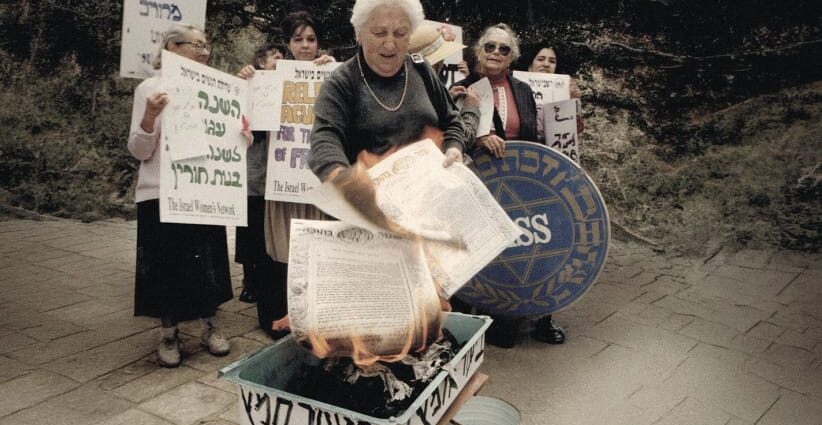
Alice. Last Conversations is one of the more eye-catching items on the documentary side of the five-day program.
The film tells the life story and lifework of German-born, British-bred Prof. Alice Shalvi, who made aliyah soon after the creation of the state.
She was an educator and tireless mover and shaker behind the fledgling feminism field here, lobbying politicians, pounding the protest march beat, and doing her damnedest to ensure as many young women as possible, across all religions and ethnicities, gained a solid education.
The film, made by Nurit Jakobs Yinon, offers an intimate portrait of Shalvi in the last year of her long, fruitful life as she runs the rule over her 96 years on terra firma, recalling her triumphs and failures, her achievements and regrets. Jakobs Yinon will attend the screening.
Several competitions dot the festival lineup, including Independent Shorts, Student Films, and Young Directors for budding high school student filmmakers.
The former includes Tal Kushner’s intriguing Mikveh, which offers a behind-the-scenes glimpse at issues faced by religious women relating to intimacy, relationships, motherhood, and hopes.
With all our trials and tribulations here in the security-political and individual spheres, there is, sadly, no shortage of thematic raw material to fuel exploratory projects. The documentaries in the festival lineup duly offer immersive, often highly personal looks at challenging life predicaments.
The Jerusalem Cinematheque is the festival’s traditional hub, but there are screenings and events scheduled at locations all over the city, including at women’s shelters, the Mazkeka, the Van Leer Institute, and, surprisingly, in haredi neighborhoods.
There are workshops, video therapy sessions, as well as a slew of free slots across the five days.
Notwithstanding the heavy subject matter of many of the films, Sabag expects Jerusalem Women’s Film Festival attendees to come away from the festival in a buoyant, hopeful frame of mind.
“In recent years, we have endeavored to bring movies that are not overly challenging. Our approach is that we need to present the public with more encouraging material. We have enough horrors around us in real life.”
Ain’t that the truth.
For more information: www.jwff.co.il