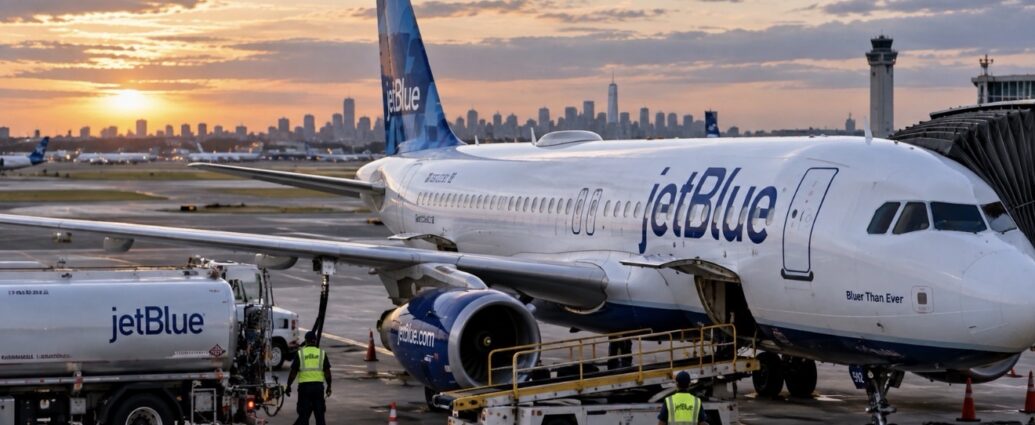
NEW YORK — JetBlue says passengers are continuing to fly and pay higher fares, allowing the airline to sharply increase its revenue forecast.
The problem is that the cost of flying those passengers is rising almost as quickly.
JetBlue said Thursday it now expects third-quarter revenue per available seat mile to rise 17% to 20% from a year earlier, considerably better than its previous forecast of 12.5% to 16.5%.
That is a strong indication that customers have continued booking flights despite higher ticket prices.
But JetBlue simultaneously raised its expected fuel price to $3.96 a gallon, up from the $3.49 it had previously projected.
That 47-cent increase matters enormously when an airline consumes hundreds of millions of gallons of jet fuel.
It shows why $100-plus oil can quickly turn a strong revenue environment into a much more difficult profit equation.
JetBlue has been raising fares to recover some of those higher costs.
So far, passenger demand has held up better than the company expected.
But fuel is only one problem.
JetBlue now expects its nonfuel cost per available seat mile to increase 6% to 8%, compared with its previous expectation of 2.5% to 4.5%.
Weather played a major role.
The airline said the number of severe-weather days during the summer was approximately 40% higher than the recent seasonal average.
Air-traffic-control disruptions in the Northeast added another layer.
JetBlue said ATC-related cancellations there nearly doubled from recent levels.
That is particularly painful for JetBlue because New York and Boston sit at the heart of its network.
When weather or air-traffic restrictions shut down those airports, aircraft and crews end up in the wrong places.
One canceled flight can therefore affect several flights afterward.
JetBlue is responding by flying less than previously planned.
The airline lowered expected capacity growth for the quarter to 1.5% to 3.5%, from an earlier forecast of 3% to 6%.
That can help protect pricing because fewer available seats make it easier to charge more.
But reducing capacity also limits how much revenue an airline can generate.
The result is a difficult balancing act.
JetBlue has customers.
It is collecting more money for the seats it sells.
Yet fuel, weather and operational costs are consuming a growing share of those gains.
The numbers also provide a warning for travelers.
When oil remains above $100 a barrel and jet-fuel prices rise, airlines cannot absorb those costs indefinitely.
They eventually respond through some combination of higher fares, fewer flights and tighter capacity.
That means the energy shock that begins thousands of miles from an American airport can ultimately arrive in the price of a family vacation or business trip.
For JetBlue, the third quarter is demonstrating something particularly important about the airline business:
selling more expensive tickets does not necessarily mean making more money when the cost of putting the airplane in the air is climbing just as fast.
JBizNews Desk | New York
© JBizNews.com All Rights Reserved. Reproduction or distribution without written permission is prohibited.