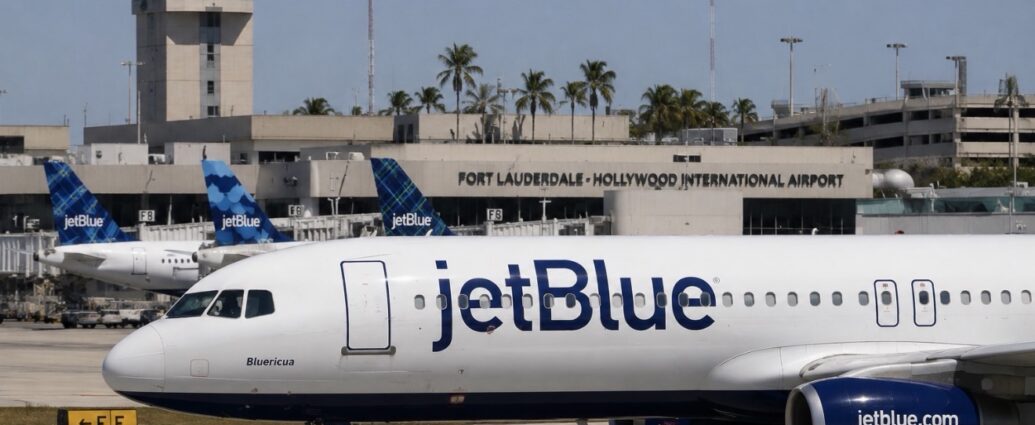
FORT LAUDERDALE, Fla. — JetBlue is betting heavily on one airport as it works to return to profitability.
“Lauderdale has been a star for us,” JetBlue President Marty St. George said this month, describing the airline’s rapidly expanding presence at Fort Lauderdale-Hollywood International Airport.
The strategy includes significantly more flights, new international destinations, premium cabin offerings, and potentially a new airport lounge. For an airline still working through losses and restructuring efforts, Fort Lauderdale has become a centerpiece of its recovery plan.
On June 1, JetBlue raised its revenue outlook for the year, citing stronger-than-expected demand.
Part of the opportunity emerged from a competitor’s collapse.
Spirit Airlines, long the largest carrier at Fort Lauderdale, ceased operations on May 2 after years of financial struggles and mounting debt. While JetBlue had already been growing its presence at the airport, Spirit’s exit created an opening to capture additional gates, routes, and customers.
According to aviation analytics firm Cirium, JetBlue now controls approximately 36% of airport capacity, up from about 24% a year ago, making it the largest airline at Fort Lauderdale.
Between May and June alone, JetBlue increased capacity by roughly 5%, even as several competitors reduced service during Florida’s slower summer travel season.
The growth has been dramatic.
JetBlue is averaging approximately 106 daily departures from Fort Lauderdale this year, compared with roughly 68 flights per day a year earlier.
During peak winter travel periods, including Presidents Day and major school vacation weeks, the airline expects to operate around 150 daily flights, bringing Fort Lauderdale close to the scale of Boston Logan International Airport, one of JetBlue’s largest hubs.
Longer term, the airline has indicated it could eventually exceed 250 daily flights from the airport by 2027.
One of the most visible signs of JetBlue’s ambitions is its expanding lounge strategy.
The carrier entered the airport lounge business only recently, opening its first BlueHouse Lounge at John F. Kennedy International Airport in New York. A second location is planned for Boston in 2026.
Fort Lauderdale could become the third.
St. George said the airline continues evaluating potential locations and believes the growing number of premium travelers makes a lounge a logical addition. Airport officials have also expressed support for the project.
International service is another major focus.
Fort Lauderdale has long served as a gateway to Latin America and the Caribbean, and JetBlue has been expanding aggressively. The airline recently announced new service to Caracas, Venezuela, while adding approximately 20 new routes from the airport over the past year.
The goal is to attract more international travelers and diversify revenue beyond traditional domestic leisure routes.
Premium offerings are increasingly central to that strategy.
JetBlue built its reputation on affordable fares but is now targeting higher-spending travelers through expanded Mint service, a new domestic first-class product known as Mini Mint, and enhanced loyalty and credit-card programs tied to future lounge access.
The airline says Fort Lauderdale has exceeded internal expectations, with revenue growth continuing even as capacity expands.
That growth is especially important because JetBlue remains unprofitable.
The airline reported a $319 million first-quarter loss in 2026, compared with a $208 million loss during the same period a year earlier. Higher fuel costs and operational challenges offset stronger passenger demand.
Revenue rose nearly 5% to $2.24 billion, while revenue per available seat mile increased 6.5%, near the high end of company guidance.
JetBlue ended the quarter with approximately $2.4 billion in cash, along with access to an unused $600 million credit facility.
The company’s broader turnaround initiative, known as JetForward, aims to generate approximately $310 million in additional earnings this year and between $850 million and $950 million by 2027.
Chief Executive Officer Joanna Geraghty has described the strategy as a combination of network optimization, cost reductions, and premium revenue growth.
According to St. George, all of JetBlue’s projected second-quarter growth is coming from Fort Lauderdale, where the airline expects seat revenue to rise between 7% and 11%.
JetBlue is also benefiting from its recently announced Blue Sky partnership with United Airlines, allowing customers to earn and redeem loyalty rewards across both carriers’ networks.
The airline’s largest competitor in South Florida remains American Airlines, which operates a major international hub at nearby Miami International Airport.
There are still risks.
Fuel prices remain volatile, the airline continues to operate at a loss, and passenger traffic at Fort Lauderdale declined slightly last year after years of strong growth.
JetBlue, Broward County, and airport officials are also completing a new five-gate Terminal 5 expansion designed to accommodate future growth.
For now, the airline is making a clear bet: that Fort Lauderdale can become the engine that powers JetBlue’s return to sustainable profitability.
Travel & Aviation — JBizNews Desk
© JBizNews.com. All Rights Reserved. Reproduction or distribution without written permission is prohibited.