
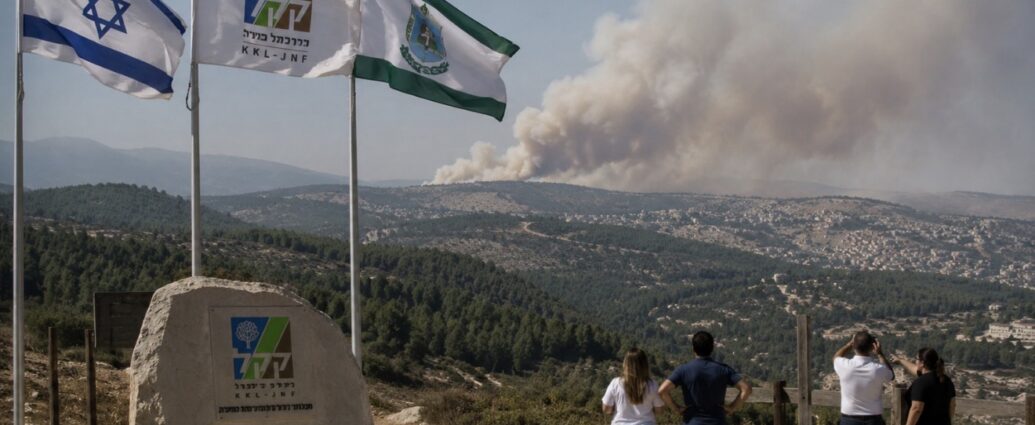
The board of Keren Kayemeth LeIsrael-Jewish National Fund voted Wednesday night to spend 863 million shekels — roughly $285 million — over the next three years on northern Israel, and the money is committed now rather than queued behind a future budget cycle. In plain terms: the organization is buying apartments, paying for roads and public works, and funding programs meant to move new families into the Galilee, in towns that are still climbing out from the fighting with Hezbollah.
The plan treats the north as one strategic region — from the Lower Galilee and Jezreel Valley up to the communities on the Lebanese border — while sizing each investment to what the individual locality needs. It is led by chairman Eyal Ostrinsky, who has spent most of his tenure on rehabilitation work in the region.
Where the money goes
The largest slice, 362 million shekels ($120 million), goes directly to local authorities for infrastructure and environmental development. That is municipal-level spending: roads, public spaces, drainage, the ordinary systems that stopped being maintained during months of cross-border fire.
A second block of 150 million shekels ($50 million) buys apartments that will be rented at below-market rates to teachers and other education staff. The north has a chronic teacher shortage, and the reasoning is straightforward — if a teacher cannot afford to live in Kiryat Shmona or Ma’alot, the school cannot staff itself.
Another 120 million shekels ($40 million) funds a program that relocates organized community groups into the Galilee and the north, with a target of about 1,200 new residents.
The remainder is allocated town by town:
- 100 million shekels ($33 million) to buy apartments in the mixed Jewish-Arab cities of Nof HaGalil, Karmiel and Acre
- 76 million shekels ($25 million) for four new community centers in Nahariya, Afula, Karmiel and Tiberias
- 32.5 million shekels ($10.7 million) for 12 communities within about a mile of the Lebanese border that had not previously received direct assistance
- 25 million shekels ($8.25 million) for the Misgav Regional Council
- 25 million shekels ($8.25 million) split between Hatzor HaGlilit and Rosh Pina, which the fund says were left out of earlier government aid programs
- 11 million shekels ($3.6 million) to finish building the Shibolet community in the Lower Galilee
- 5 million shekels ($1.65 million) for Kfar Vradim
- About 5 million shekels ($1.65 million) for cultural programming across northern municipalities
- 2.5 million shekels ($825,000) for wildfire protection at Kibbutz Hanita, on the border
The uncomfortable part
The more pointed story here is not the dollar figure. It is that a nonprofit is doing work that a national government is expected to do, and saying so openly.
Pressed on whether the fund is substituting for the state, Ostrinsky said it is not trying to replace government responsibility, and added that he wished the organization could put in another billion shekels on top of what the government has already pledged. His argument is one of speed: the fund can move money to a border town within weeks, while state allocations pass through ministries and multi-year plans before anything reaches the ground. He singled out Yitzhak Wasserlauf, minister for the Negev, Galilee and national resilience, as the one official keeping pace, and questioned why there is only one. His summary of the fund’s expanding role: “We’re becoming, in many ways, a miniature government.”
Context
This is not the fund’s first northern package. In May it approved 273 million shekels — about $93 million — for northern communities, including 115 million shekels for infrastructure in 11 towns adjacent to Lebanon where return rates were lowest, and 20 million shekels for security roads coordinated with the Defense Ministry. That earlier round also carried 70 million shekels for Golan Regional Council projects and 13.5 million shekels to buy housing in Katzrin. Ostrinsky has said the organization put more than a billion shekels into the northern border over the past year.
What to watch
Two things will determine whether this lands. The first is absorption — whether local authorities in towns of a few thousand people can actually execute infrastructure projects at this scale on a three-year clock. The second is the housing purchases, which put a charitable organization into the position of landlord across multiple municipalities, with the maintenance and management obligations that carries.
For the towns along the Lebanese fence, the practical question is narrower and older than any of this: whether enough families come back to make the schools, the clinics and the local economy work again. Money is the precondition, not the answer.
JBizNews Desk | Jerusalem
© JBizNews.com All Rights Reserved. Reproduction or distribution without written permission is prohibited.




