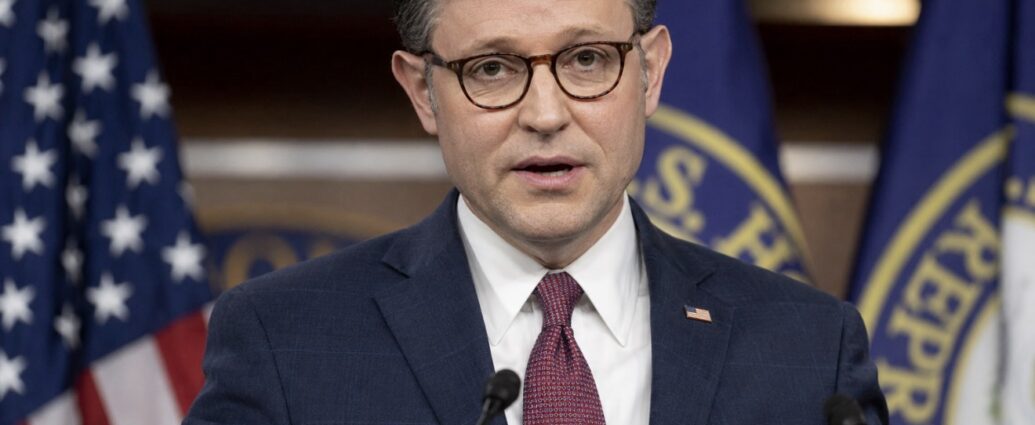
House Speaker Mike Johnson’s defense of congressional stock trading moved back into public focus this week as lawmakers, investors, and voters renewed debate over whether elected officials should be allowed to actively trade financial assets while serving in office.
Johnson’s argument, originally made last year and widely circulated again this week, centered on a reality many members of Congress quietly discuss in private: congressional salaries have remained unchanged since 2009 even as the cost of living in Washington has risen sharply.
Rank-and-file House and Senate members still earn $174,000 annually, according to the Congressional Research Service. Adjusted for inflation, congressional compensation has effectively declined by roughly 30% over the past 17 years.
Johnson argued that lawmakers today face mounting financial pressures tied to maintaining residences both in Washington and in their home districts while supporting families in an increasingly expensive economy. His broader point was that investment activity has become one of the few ways many members can preserve long-term financial stability while serving in public office.
The discussion resurfaced as new federal ethics disclosures showed President Donald Trump executed 3,642 securities transactions during the first quarter of 2026, highlighting once again how closely politics, investing, and financial markets have become intertwined at the highest levels of government.
According to filings submitted through the Office of Government Ethics, Trump’s disclosed transactions involved companies including Nvidia, Apple, Microsoft, Oracle, Goldman Sachs, Palantir, Broadcom, Dell Technologies, and Bank of America, with cumulative values reported within federal disclosure ranges totaling between approximately $220 million and $750 million.
Federal law does not prohibit a sitting president from trading securities, and disclosure forms require only broad value ranges rather than exact purchase prices or profits. A White House spokesperson said the holdings are managed through discretionary accounts while the Trump family business is overseen by Donald Trump Jr. and Eric Trump.
Members of Congress operate under a similar disclosure framework.
The STOCK Act of 2012 requires lawmakers to disclose securities trades within 45 days, though lawmakers from both parties continue debating whether disclosure alone is sufficient in an era where financial markets react instantly to government policy, regulation, and geopolitical developments.
The issue has become increasingly visible as congressional trading disclosures attract growing public attention.
Former Speaker Nancy Pelosi’s household portfolio has frequently drawn notice for outperforming broader market indexes, particularly in technology stocks, while other lawmakers including Representative Marjorie Taylor Greene have also become closely watched by retail investors who now track congressional disclosures almost in real time.
What was once a niche ethics issue has evolved into a broader conversation about wealth, public service, and how modern political life increasingly intersects with financial markets.
Behind much of the debate is the changing economics of serving in Congress itself.
Lawmakers receive no additional salary for committee assignments despite the significant time and fundraising responsibilities attached to them. Research from organizations including Issue One and the Brookings Institution has shown that members seeking seats on influential committees are often expected to raise hundreds of thousands — and in some cases millions — of dollars for party campaign organizations.
At the same time, outside earned income for lawmakers is tightly restricted under congressional ethics rules. Members may earn no more than 15% of their salary from outside employment, while honoraria have been banned for decades. Investment income, however, remains unrestricted.
That structure has gradually made investment portfolios a more significant part of long-term financial planning for many members of Congress.
Johnson’s comments reflected that broader reality.
Rather than framing stock ownership as extraordinary wealth accumulation, the Speaker described it as part of the financial balancing act lawmakers face while navigating rising housing costs, travel demands, fundraising expectations, and stagnant salaries.
Public opinion on the issue remains mixed but increasingly active.
Polling from YouGov and the University of Maryland’s Program for Public Consultation shows broad bipartisan support for restricting or banning individual stock trading by elected officials, including members of Congress, presidents, and Supreme Court justices.
Several proposals remain pending on Capitol Hill, including the Restore Trust in Congress Act, introduced by Representatives Chip Roy and Seth Magaziner, which would require lawmakers and their families to move many investments into blind trusts while prohibiting direct trading of individual stocks.
The legislation remains in committee as lawmakers continue debating where the line should be drawn between financial freedom and public trust.
The conversation unfolding around Johnson’s remarks ultimately reflects a larger shift taking place in Washington and across Wall Street: politics and financial markets are now more interconnected than at any point in modern American history.
Congress writes legislation affecting trillion-dollar industries. Presidents shape economic policy that can move entire sectors overnight. Investors increasingly monitor Washington as closely as they monitor earnings reports and Federal Reserve meetings.
Against that backdrop, the debate over congressional investing is evolving beyond ethics alone and into a broader question about how public officials should participate in the same financial system they help regulate.
Johnson’s central argument was straightforward: congressional salaries have not kept pace with inflation, and lawmakers, like many Americans, are trying to manage the economic realities that come with that shift.
Whether voters view investment activity as a reasonable extension of that reality or believe stricter limits are needed will likely shape the next phase of the debate on Capitol Hill.
JBizNews Desk
© JBizNews.com. All rights reserved. This article is original reporting by JBizNews Desk. Unauthorized reproduction or redistribution is strictly prohibited.