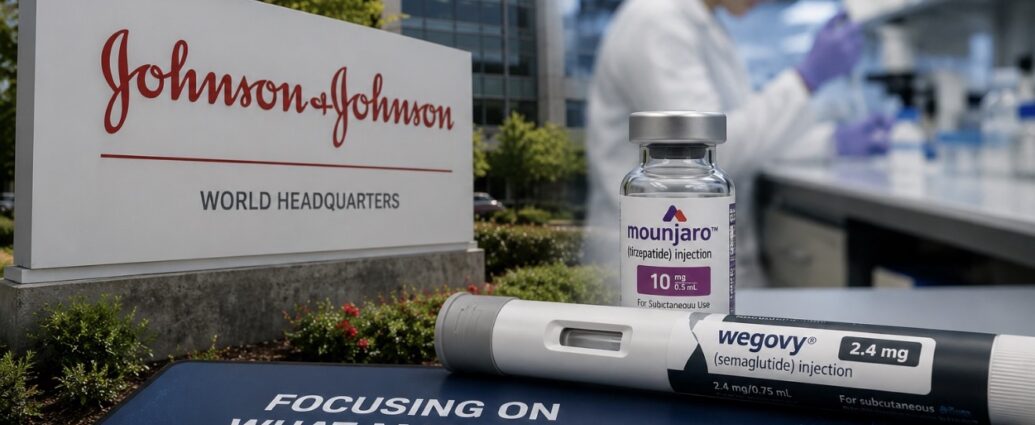
Johnson & Johnson has made a surprising decision at a time when much of the pharmaceutical industry is racing toward obesity treatments: it is staying out of the market entirely.
Speaking Tuesday at the Economic Club of Washington, D.C., Johnson & Johnson CEO Joaquin Duato said the healthcare giant has no plans to develop or acquire drugs in the booming GLP-1 category, the class of medicines behind blockbuster weight-loss and diabetes treatments that have transformed the industry over the past several years.
“We are not going to be in the GLP-1 area,” Duato said during a discussion with Carlyle Group co-founder David Rubenstein.
The statement places J&J among a small group of major pharmaceutical companies choosing not to chase one of the fastest-growing markets in healthcare history. While rivals have spent billions of dollars acquiring obesity-drug developers and launching their own programs, Johnson & Johnson is betting that its future lies elsewhere.
Instead, Duato said the company will focus its resources on two areas where it believes it can achieve greater medical and commercial success: cancer treatment and neuroscience.
“Our goal is to be No. 1 by 2030,” Duato said of the company’s oncology business.
The company already holds a strong position in multiple cancer categories. Johnson & Johnson markets leading treatments for multiple myeloma, one of the most common blood cancers, and maintains a growing portfolio of lung cancer therapies. Last year, the company expanded its oncology pipeline through a $3.05 billion acquisition of Halda Therapeutics, gaining access to a promising oral prostate cancer treatment.
The decision reflects the reality of a market already dominated by a handful of powerful competitors.
Eli Lilly and Novo Nordisk currently control the obesity-drug landscape through blockbuster products that have generated tens of billions of dollars in annual sales. Demand for GLP-1 medications has surged as studies continue to show benefits extending beyond weight loss, including improvements in diabetes management and potential cardiovascular benefits.
Lilly has emerged as the dominant player. The company became the first pharmaceutical manufacturer to surpass a $1 trillion market valuation last year, driven largely by demand for its obesity and diabetes drug tirzepatide. Lilly executives have estimated that the company captures roughly 70% to 75% of new patients entering the GLP-1 market.
For Johnson & Johnson, competing against such entrenched leaders may not represent the best use of research and development dollars.
The company’s position also aligns with a broader strategic transformation that has been underway for several years.
Johnson & Johnson has streamlined its operations to concentrate on higher-growth healthcare businesses. The company spun off its consumer-health division into Kenvue, separating well-known brands such as Tylenol, Band-Aid, and Listerine from the parent company. It has also restructured portions of its medical-device operations while increasing investments in pharmaceuticals and advanced medical technologies.
Duato highlighted the company’s recent performance, noting that Johnson & Johnson delivered a 47% total shareholder return in 2025, reflecting investor confidence in its current strategy.
Technology is also expected to play a major role in the company’s future growth.
Duato said artificial intelligence has the potential to accelerate drug discovery, improve clinical development, and enhance the effectiveness of medical devices, particularly in the field of robotic surgery.
“We are just at the beginning,” he said, describing healthcare as entering a period of significant technological change.
For investors and patients alike, the announcement underscores a growing divide within the pharmaceutical industry. Some companies are betting heavily on obesity treatments, viewing them as the defining medicines of the next decade. Others are choosing to focus on diseases where competition is less intense and unmet medical needs remain substantial.
Johnson & Johnson’s decision means one fewer major competitor pursuing obesity drugs, a market where additional competition could eventually help lower prices and improve access for patients. At the same time, the company’s vast research budget will remain focused on cancer and neurological disorders, areas where millions of patients continue to face limited treatment options.
As the obesity-drug market continues its rapid expansion, Johnson & Johnson is making a different wager: that breakthroughs in cancer and neuroscience will ultimately prove more valuable than joining the industry’s biggest gold rush.
Whether that strategy pays off will become clearer as the company works toward Duato’s goal of becoming the world’s leading oncology company by 2030.
JBizNews Desk
New Brunswick, N.J.
© JBizNews.com All Rights Reserved. Reproduction or distribution without written permission is prohibited.