Journalism continues to be harshly suppressed in Syria, with journalists still being disappeared and killed despite some improvements under the transitional government following the fall of the Assad regime, according to a report published last week by the Syrian Centre for Media and Freedom of Expression.
At least nine journalists have been killed in Syria in connection with their work over the past five years. Six of those killings took place in connection with or after the fall of the Assad regime. Of those six cases, four involved journalists covering military confrontations related either to the regime change or unrest in the Governorate of Sweida.
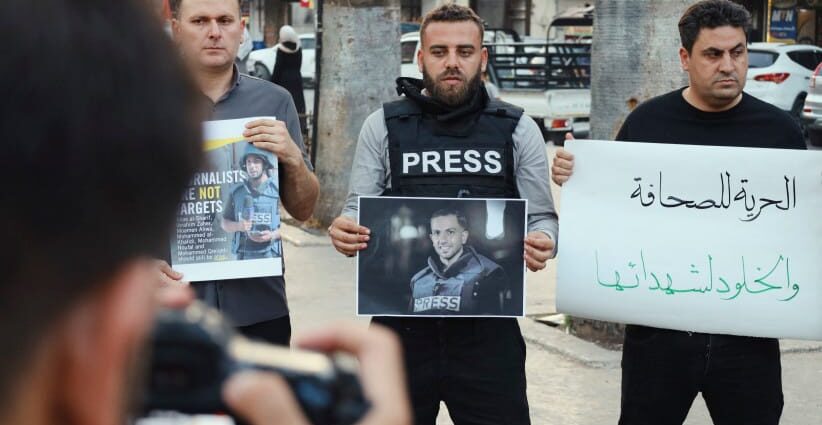
The majority of those killed while carrying out their work as journalists were clearly identifiable as members of the press, wearing vests and helmets and/or traveling in vehicles marked with “press” insignia.
Those who reported the killings to the center said they were unaware of any prompt, effective, independent, or publicly disclosed investigations into the deaths.
Some journalists were also murdered while not performing their duties, as was the case with Alaa Mohammed, who was killed in his own home over what is believed to have been his political commentary.
Journalists are killed, disappeared after covering sectarian violence
Mohammed belonged to the Alawite minority, which has faced frequent attacks since the fall of the Assad regime, particularly in March 2025, when more than 1,400 people were killed in sectarian violence. His death was neither adequately investigated nor condemned by the transitional government, the center asserted.
In addition to the killings, multiple journalists faced arbitrary detention, enforced disappearance, and harassment, often in connection with their coverage of sectarian violence.
International media coverage of sectarian issues was also heavily restricted. The New York Times reported that Syrian authorities sealed off areas affected by the March 2025 attacks on Alawites, preventing foreign journalists from accessing them. One journalist told the center they had been prevented from conducting on-the-ground reporting in the affected area, forcing the newspaper to rely on phone interviews.
“These practices raise concerns regarding transparency, media access, and the ability of independent journalists to document events of public interest during the transitional period,” the center noted. “They also appear inconsistent with public statements by representatives of the Transitional Government emphasizing openness toward international media and a commitment to facilitating journalists’ work in Syria.”
Foreign journalists also face numerous barriers to accessing and reporting from Syria despite government commitments. Authorities have required them to disclose extensive information about the subjects of their reporting, previous publications on Syria, where they intend to travel within the country, and whom they plan to meet. Approvals to report in Syria either never arrive or are significantly delayed. Some journalists also complained that they were barred from publishing while in Syria and required to pledge that they would not report on the country upon entry for “security reasons.”
Censorship of the sectarian attacks has also seemingly continued. The center noted that in August 2025, a theatrical production was suspended after actors criticized the Transitional Government’s conduct during the attacks against Alawites and Druze.
The Transitional Government also imposed restrictions on independent reporting in certain Aleppo neighborhoods following the government’s recapture of those areas.
In some cases, it remains unknown who killed journalists during sectarian violence. Sari Majid A. Shoufi, a photojournalist for Suwayda 24, went missing while covering the attacks on the Druze in Sweida in July. His body was found after a 10-day search.
Journalists have also been detained by Syrian security forces and transferred to undisclosed locations without any explanation for their arrest, the center asserted, highlighting the case of Kurdish journalist Hassan Zaza.
Syrian government claims arrests not related to journalistic work
Zaza was taken from his home by Syrian security forces and held incommunicado for a week before being released without formal charges. The Syrian Ministry of Information confirmed his arrest but stated only that it was “related to security concerns and not connected to his journalistic work.”
American journalist Bilal Abdul Kareem was also arrested by Syrian security forces in al-Bab and taken to undisclosed locations. No formal charges against Kareem are known, and he remains in custody, while his family has received no information about his whereabouts.
Detained journalists have reportedly faced delayed access to legal counsel and a lack of transparency regarding their detention. The center highlighted the cases of Ahmed Polad and German journalist Eva Maria Michelmann.
Polad and Michelmann’s whereabouts were undisclosed for months after security forces abducted them while they were reporting on clashes between the Syrian Arab Army and the formerly US-backed Syrian Democratic Forces. Their location remained unknown until April 2026, when it emerged that they were being held in detention centers in Damascus and Aleppo. Following extensive lobbying, the German government secured legal counsel for Michelmann, and she was released three months later. Polad, however, remains detained without legal representation, and the Transitional Government has not released any further information about his condition.
Legally, some protections for journalists and freedom of opinion have been introduced, but the center said these safeguards have largely been undermined by existing Assad-era legislation and new laws introduced by the transitional government.
While the 2025 Constitutional Declaration guarantees the rights to “freedom of opinion, expression, information, publication and the press,” Syria’s Law No. 20 of 2022 on Combating Cybercrime has been widely condemned by human rights organizations as a repressive tool used to stifle free expression and criminalize dissent by restricting the sharing of digital content on social media.
Additionally, Syria’s Law No. 19 of 2024, which established the Media Ministry, has been widely criticized by international watchdogs for consolidating government control over the media, allowing authorities to stifle dissent and censor information.
Outside of action by the Syrian authorities, or Syrian civilians acting with large degrees of impunity, the report noted that journalists have faced violence and death from a number of foreign nations.
The Russian military guard, for example, assaulted in March 2025 Souria Post journalists Hashim Al-Abdullah and Ehab Khaled at the Hmeimim air base, beating them, threatening them with death, and confiscating their materials during four hours of detention.
A number of journalists have also been killed in Turkey’s war against Kurdish militias, as was the case with ANHA journalists Jihan Belkin and Nazim Dashdan, who were killed in a drone attack near Aleppo as they were returning from covering clashes between the Syrian Democratic Forces and the Syrian National Army at the Tishreen Dam. Despite driving in a vehicle marked with a press insignia, Turkish or Turkish-backed forces are believed to have struck them with a drone.