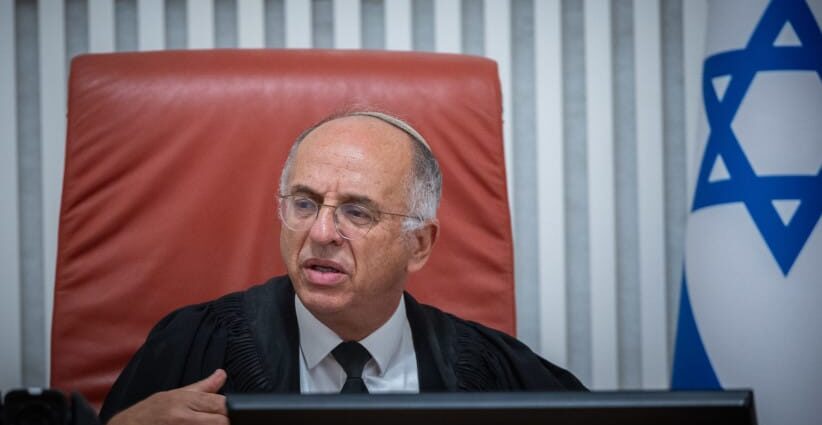
Supreme Court Deputy President Justice Noam Sohlberg accepted a petition filed on Friday by the Movement for Quality Government and ruled that National Security Minister Itamar Ben-Gvir must remove a video depicting a flotilla incident from all his social media accounts.
He also ordered Ben-Gvir to pay NIS 8,000 in legal costs to the movement, while the National Security Ministry and the Israel Prison Service were jointly ordered to pay an additional NIS 15,000, for a total of NIS 23,000.
In his ruling, Sohlberg said the 38-second video, in which the minister is seen touring a detention facility at the Port of Ashdod among bound Sumud flotilla activists and waving an Israeli flag, constitutes election propaganda through the use of public assets, in violation of Section 2A of the Elections Law (Election Propaganda Methods), 1959.
Applying the dominant purpose test, the judge concluded that the circumstances of the recording – filming inside an Israel Prison Service facility, in the presence of uniformed personnel, and later publishing the footage on the minister’s personal accounts – clearly indicate a political campaigning purpose.
The court said its discussion was limited strictly to election propaganda law and did not address broader public or international reactions to the video. It added that the footage is “saturated with propaganda elements,” noting that it highlights the minister’s achievements and political positions.
The ruling followed a petition submitted by the Movement for Quality Government last month, which demanded the video’s removal within four days. After Ben-Gvir refused, the movement filed a petition with the Central Elections Committee.
The decision also noted that the petition was submitted on June 2, nearly two weeks after the video was published. Because of this delay, no interim removal order was issued at the time. However, the committee stressed that the wide distribution of the video in Israel and abroad does not negate enforcement of the law, since its authority is reactive and not dependent on the extent of circulation.
Improper use of public assets
The movement argued from the outset that this was part of a broader pattern, and the committee chairman referenced a precedent he set in March in Ben-Gvir’s case, ruling that the use of Israel Prison Service facilities and uniformed personnel constitutes improper use of public assets.
The ruling emphasized that state assets, including uniforms, facilities, and security personnel, belong to the public and cannot be used as tools in a private election campaign. It reinforced the boundary between public office and political candidacy, setting a clear consequence for violations.
‘Undermining public trust’
Attorney Tomer Naor, deputy director general for law and strategy at the Movement for Quality Government, said that “when a government minister turns state facilities, Israel Prison Service uniforms and security personnel into tools in his election campaign, he is not only breaking the law, he is undermining public trust and the state character of his role.
“Today’s decision establishes that using public assets for political purposes comes at a price,” Naor continued. “We will continue to stand guard across all arenas and ensure that electoral integrity is preserved.”