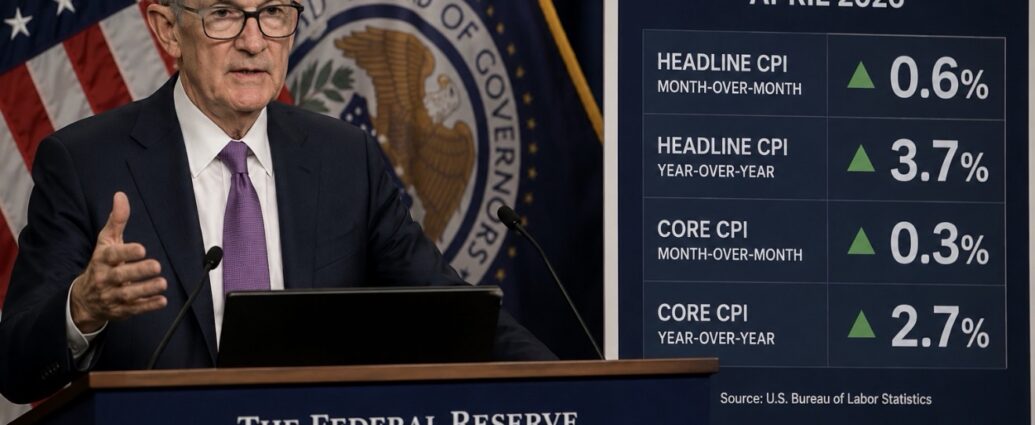
The U.S. Bureau of Labor Statistics released its closely watched April Consumer Price Index (CPI) report Tuesday morning at 8:30 a.m. Eastern Time, with economists across Wall Street forecasting what could become the hottest inflation reading in nearly two years as rising energy prices and tariff pressures continue flowing through the American economy.
Economists surveyed ahead of the report projected headline CPI increased approximately 0.6% in April month-over-month, pushing annual inflation to roughly 3.7%, up sharply from March’s 3.3% reading and marking the highest year-over-year inflation level since mid-2024. Core CPI, which excludes volatile food and energy prices, was expected to rise 0.3% for the month and 2.7% annually, according to consensus estimates compiled by Morningstar.
The largest contributor to the anticipated increase remained gasoline prices. UBS economist Alan Detmeister projected gasoline prices climbed approximately 6% during April alone, accounting for much of the projected monthly increase in headline inflation. The rise followed continued disruptions across global energy markets tied to the now eleven-week conflict involving the United States, Israel, and Iran, which has kept portions of shipping activity through the Strait of Hormuz below normal operating levels while helping push Brent crude oil above $104 per barrel.
March inflation data had already showed significant acceleration. Headline CPI rose 0.9% in March, the largest monthly increase since June 2022, driven primarily by a 10.9% surge in the energy index and a 21.2% spike in gasoline prices, according to prior Bureau of Labor Statistics data. Economists said April’s report was expected to remain elevated even if the pace moderated slightly from March’s unusually sharp jump.
Housing and shelter costs also remained a major focus for economists analyzing Tuesday’s release. Barclays U.S. economist Pooja Sriram noted the April report included technical adjustments tied to rent and owners’ equivalent rent calculations following data collection disruptions connected to last year’s federal government shutdown. Analysts expected those adjustments to place additional upward pressure on core inflation readings independent of broader housing-market fundamentals.
For American workers and consumers, economists warned the inflation report could reinforce concerns about declining purchasing power. Average hourly earnings increased 3.6% year-over-year in the April employment report released last Friday — potentially below the anticipated inflation rate if consensus projections proved accurate. That would imply flat or negative real wage growth after adjusting for inflation for many households already managing elevated costs tied to housing, healthcare, groceries, transportation, and energy.
The report also carried major implications for Federal Reserve policy and financial markets. Bank of America economists recently said they no longer expect the Federal Reserve to cut interest rates during 2026, while JPMorgan scenario forecasts project inflation could remain above the Fed’s 2% target into early 2027. According to the CME Group FedWatch Tool, futures markets have sharply reduced expectations for rate cuts this year compared to earlier 2026 projections.
Analysts at Vanguard noted that while core goods inflation appeared relatively stable, core services inflation was expected to accelerate due to higher transportation costs, rising medical care expenses, and elevated airfare pricing linked to fuel costs. Economists said transportation remained one of the primary channels through which higher oil prices continue spreading across the broader economy.
The inflation report arrived the same morning President Donald Trump prepared to depart for Beijing ahead of a closely watched summit with Chinese President Xi Jinping, where trade policy and tariffs are expected to dominate discussions. According to the Penn Wharton Budget Model, average U.S. tariffs on Chinese goods remained around 31.6% in early 2026, costs many economists say continue flowing directly into consumer prices and supply chains.
Economists cautioned that even if geopolitical tensions ease and global energy markets stabilize later this year, inflationary pressures already embedded across the economy may continue keeping prices elevated well above the Federal Reserve’s long-term target through the remainder of 2026.
For millions of American households balancing rising costs for gasoline, food, rent, insurance, and healthcare simultaneously, the financial pressure remains significant heading into the summer months.
JBizNews Desk